

Archive position — measured, not model output
1 like on Devpost
505 of the 7,850 archived projects have more likes, and 1,758 share exactly 1 — so this project's #1,243 place in the like-ranked listing is a tie-break inside that group, not a ranking.
Projects (log scale)
Likes on Devpost. ▲ marks this project's group.
Show the figures
| Likes | Projects | Share of archive |
|---|---|---|
| 0 | 5,587 | 71.2% |
| 1 | 1,758 | 22.4% |
| 2 | 284 | 3.6% |
| 3–4 | 132 | 1.7% |
| 5–9 | 75 | 1.0% |
| 10+ | 14 | 0.2% |
 User Stories BotA demo video on every pull request
Get a demo video on every new feature
GitHub App that watches your pull requests and records a narrated, captioned demo.
Save time on demo prep and make informed decisions faster with a video walkthrough of every new feature.
Executive Summary
Company: Interview Shadow AI
Self-reported basis: The entire analysis is based on the project description supplied by the caller — its name, tagline, the author's own write-up, and technology tags. This is unverified self-reporting.
What it appears to be: A mock technical-interview platform that uses AI to deliver adaptive, evidence-based feedback tailored to a candidate’s resume and projects.
What changed: The project was submitted as part of the OpenAI 2026 hackathon. It represents an early-stage prototype with a defined interview flow, scoring logic, and UI/UX.
Single most important open question: Is there evidence of traction or user adoption beyond the hackathon submission?
What The Product Actually Is
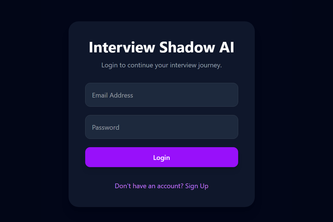
The description states that Interview Shadow AI is a mock technical-interview platform. Candidates can sign in, upload a resume, enter their target role and skills, complete a 15-question interview, and receive a scorecard.
- The scorecard evaluates communication, technical knowledge, and confidence.
- It also provides strengths, areas to improve, a hiring recommendation, and detailed evidence-based next steps.
- The platform uses GPT-5 for adaptive questions and structured feedback.
- The interview flow is guided by candidate role, skills, resume highlights, project context, and previous answers.
Inference: The product appears to be a prototype built for a hackathon. It includes frontend (React), backend (FastAPI), authentication (Firebase), and database (SQLite) components, with AI integration via OpenAI API.
Positioning & Claim Evolution
The tagline states:
“Interview Shadow AI delivers rigorous, adaptive mock interviews tailored to a candidate’s resume and projects—turning generic practice into evidence-based feedback and a clear hiring readiness score.”
Claim: The platform aims to improve interview preparation by offering personalized, data-driven feedback.
Inference: The positioning is that of an interview prep tool for technical candidates, especially students or early-career professionals. It is not positioned as a hiring platform or employer tool — rather, it’s a candidate-facing product.
Target Customer & ICP
The description states:
- Candidates can sign in, upload a resume, enter their target role and skills.
- The interview flow uses resume highlights, project context, and prior answers to guide questions.
Claim: The platform targets technical job seekers, particularly students or early-career professionals preparing for technical interviews.
Inference: The ICP appears to be candidates in tech roles, likely those preparing for internships or entry-level positions. No evidence of employer or recruiter use is provided.
Business Model & Pricing Evidence
The description does not state anything about pricing, monetization, or business model.
Not evidenced.
Technical & Delivery Signals
- Built with React (frontend), FastAPI (backend), Python, SQLite.
- Uses Firebase Authentication, OpenAI API (GPT-5), PDF parsing, prompt engineering, vector database, and RAG.
- Includes a demo mode for local testing without API quota.
- The interview flow is adaptive, using resume, role, skills, and prior answers to guide questions.
Inference: The platform is built as a full-stack prototype, likely intended for demonstration or early user testing. It integrates AI for personalization and feedback generation.
Traction & Maturity Signals
The description states:
- The project was submitted to the OpenAI 2026 hackathon.
- Accomplishments include building a complete 15-question interview experience, personalized questions, varied scorecards, and a polished UI.
- The team is small (3 members).
Not evidenced: No data on users, adoption, retention, or revenue. No evidence of product-market fit beyond the hackathon submission.
Competitive Context
The description does not mention competitors or market positioning.
Not evidenced.
Open Questions & Risks
- The platform is a hackathon prototype, with no evidence of traction or real-world use.
- No mention of monetization, pricing, or scalability plans.
- The team size (3) and tech stack suggest early-stage development.
- The product is described as a candidate-facing tool, but there’s no indication it has moved beyond the demo phase.
Inference: The project lacks commercial maturity. It may not have addressed key challenges like user acquisition, feedback quality, or long-term retention.
Questions the description leaves open
- What is your plan for scaling beyond the hackathon prototype?
- Have you tested this with real users outside of the team?
- How do you intend to monetize this platform?
- What are the key assumptions behind the scoring logic, and how have you validated them?
- Are there any plans to integrate with existing job platforms or companies?
Overall Assessment
Not evidenced: No data on revenue, customers, or traction is available beyond the hackathon submission.
Inference: This is a very early-stage prototype, likely in the idea or proof-of-concept phase. It has no demonstrated commercial viability or user adoption. It may be a candidate for future investment or partnership if it evolves into a product with traction and a clear path to monetization.
User Stories BotA demo video on every pull request
Get a demo video on every new feature
GitHub App that watches your pull requests and records a narrated, captioned demo.
Save time on demo prep and make informed decisions faster with a video walkthrough of every new feature.
Source
Submitted to the OpenAI 2026 hackathon on Devpost. Project home on Devpost. Back to the full gallery on Devpost.
This competitive analysis was produced by top-founders.com (opens in a new tab)
Generated by a language model from this project's public Devpost page — its tagline, the author's own write-up and any built-with tags listed there — as captured in August 2026. Short quotations are the author's words. It is an opinion on the idea as a business, not on the people behind it, and it reflects the description as published then. If the project has moved on, request a correction below. The analysis is not independent research and contains no verified traction, revenue or customer data.
An independent guide by KFG International LLC — not affiliated with, endorsed by, or connected to Devpost or OpenAI.