

Archive position — measured, not model output
0 likes on Devpost
2,263 of the 7,850 archived projects have more likes, and 5,587 share exactly 0 — so this project's #3,206 place in the like-ranked listing is a tie-break inside that group, not a ranking.
Projects (log scale)
Likes on Devpost. ▲ marks this project's group.
Show the figures
| Likes | Projects | Share of archive |
|---|---|---|
| 0 | 5,587 | 71.2% |
| 1 | 1,758 | 22.4% |
| 2 | 284 | 3.6% |
| 3–4 | 132 | 1.7% |
| 5–9 | 75 | 1.0% |
| 10+ | 14 | 0.2% |
 User Stories BotA demo video on every pull request
Get a demo video on every new feature
GitHub App that watches your pull requests and records a narrated, captioned demo.
Save time on demo prep and make informed decisions faster with a video walkthrough of every new feature.
Executive Summary
What the company appears to be
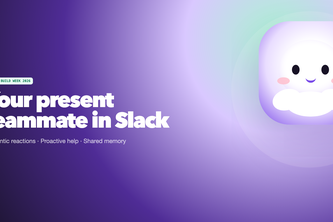
Chappy Tag is a self-reported Slack teammate built as a hackathon project for the OpenAI 2026 hackathon. It claims to offer proactive assistance within Slack channels, with features like semantic reactions, task management via Work Objects, user-owned Canvas memory, and privacy-safe execution identities. The product is described as running on Cloudflare Workers and uses OpenAI's Codex and GPT-5.6.
What changed
The project was submitted to a hackathon; no prior version or evolution is evidenced. It is presented as a prototype with no revenue, customers, or traction data.
Single most important open question
Is there any evidence of actual user adoption or feedback beyond the author’s own description?
What The Product Actually Is
The description states that Chappy Tag is a proactive Slack teammate, designed to react meaningfully to messages and offer help without being noisy. It claims to:
- React with emoji to ordinary messages;
- Offer concise help in-thread when detecting blockers, questions, or deadlines;
- Respond directly to mentions in Slack threads;
- Show Plan progress using native Slack blocks;
- Create and manage Slack Task Work Objects that are durable and privacy-safe;
- Provide a user-owned Canvas memory for channel context;
- Allow users to configure model settings, reasoning levels, and custom instructions via a Slack modal;
- Keep each participant’s ChatGPT identity separate through encrypted storage;
- Operate under strict cost constraints (<$100/month);
- Use a bilingual public experience, defaulting to English.
It also claims to use technologies such as:
- Cloudflare Workers
- Durable Objects
- Slack Canvas
- Codex and GPT-5.6
- TypeScript, JavaScript, OpenAI APIs
Inference The product is described as a Slack-native assistant, not a standalone app or service.
Positioning & Claim Evolution
The author states that Chappy Tag aims to be a proactive teammate that feels present without becoming noisy. It positions itself as an alternative to passive assistants by:
- Avoiding opaque, centrally owned memory;
- Ensuring shared context remains visible and usable;
- Offering durable Work Objects with stable IDs and ownership;
- Supporting Quiet Loops for recurring tasks;
- Maintaining user-owned Canvas memory;
- Separating execution identity per user.
The positioning is framed around:
- Proactivity
- Privacy
- Slack-native integration
- User control
Inference This is a self-reported repositioning of an assistant tool, not based on market feedback or competitive data. It does not indicate prior product evolution or customer validation.
Target Customer & ICP
The description states that Chappy Tag is built for Slack teams, particularly those who collaborate in channels and want:
- Proactive help without noise;
- Shared context preserved across threads;
- Privacy-safe task management;
- Customizable AI behavior per user.
It targets users who are already using Slack, especially those working with recurring tasks or collaborative planning.
Inference The ICP is inferred from the product’s design and use of Slack-native features. No explicit customer segments or personas are provided.
Business Model & Pricing Evidence
The description states that Chappy Tag:
- Operates under a strict cost envelope (<$100/month);
- Uses edge computing to reduce costs;
- Does not charge users directly;
- Is presented as a prototype, not a commercial product.
There is no evidence of pricing, subscriptions, or monetization strategy.
Inference No business model or pricing structure is evident beyond the author’s own claims. It appears to be an experimental prototype with no stated revenue path.
Technical & Delivery Signals
The project uses:
- Cloudflare Workers
- Durable Objects for state management
- Slack Canvas API
- Codex and GPT-5.6
- Slack Assistant API
- Runtime Cells for selective reasoning
- Edge path for low-cost reactions
- Encrypted user identities
It claims to:
- Scale to zero after 30 minutes of inactivity;
- Use bounded response turns;
- Prevent cross-channel context mixing;
- Keep one-time codes secure;
- Maintain idempotent retries.
The architecture is described as:
- Slack-native
- Privacy-focused
- Cost-controlled
Inference The technical approach is detailed, but no evidence of production deployment or performance data is provided.
Traction & Maturity Signals
There is no evidence of:
- Revenue
- Customers
- User adoption
- Product usage metrics
- Live deployment beyond the hackathon submission
The project is described as a hackathon prototype, submitted to the OpenAI 2026 hackathon.
Inference No traction or maturity signals are evident. The product is presented as experimental and unproven in real-world use.
Competitive Context
The description does not mention any competitors, nor does it reference existing tools in the Slack AI assistant space.
Inference No competitive analysis is provided. The author does not state how Chappy Tag compares to other tools or platforms.
Open Questions & Risks
- Unverified claims: All features and architecture are self-reported.
- No traction or revenue: No evidence of users, customers, or monetization.
- Prototype-only: Submitted as a hackathon project with no prior version.
- Limited scope: The product is described as experimental and not production-ready.
- Privacy assumptions: The system assumes user control over identity and context, but this is untested in practice.
- No third-party validation: No independent review or testing of the architecture or claims.
Inference The lack of any external validation or usage data raises significant risk that the product may not be viable beyond its prototype stage.
Questions the description leaves open
- What is the actual user feedback or testing done beyond the hackathon?
- How does Chappy Tag handle cross-channel context when it is not explicitly allowed?
- Are there any known edge cases or bugs from live testing in Slack?
- What is the roadmap for moving from prototype to a production-ready product?
- Is there any plan to monetize or scale beyond the current cost envelope?
- How does the system ensure that user settings and identities remain truly separate across users?
- Has the team considered how this would integrate with Slack Connect or larger organizations?
Overall Assessment
Not evidenced
The project is presented as a hackathon prototype, with no evidence of traction, revenue, customers, or commercial viability.
Confidence level Low This analysis is based entirely on self-reported information. No external validation, usage data, or financials are available to assess the product’s potential for investment or partnership.
Inference There is insufficient evidence to support a positive investment or partnership assessment. The project appears experimental and unproven in real-world use.
User Stories BotA demo video on every pull request
Get a demo video on every new feature
GitHub App that watches your pull requests and records a narrated, captioned demo.
Save time on demo prep and make informed decisions faster with a video walkthrough of every new feature.
Source
Submitted to the OpenAI 2026 hackathon on Devpost. Project home on Devpost. Back to the full gallery on Devpost.
This competitive analysis was produced by top-founders.com (opens in a new tab)
Generated by a language model from this project's public Devpost page — its tagline, the author's own write-up and any built-with tags listed there — as captured in August 2026. Short quotations are the author's words. It is an opinion on the idea as a business, not on the people behind it, and it reflects the description as published then. If the project has moved on, request a correction below. The analysis is not independent research and contains no verified traction, revenue or customer data.
An independent guide by KFG International LLC — not affiliated with, endorsed by, or connected to Devpost or OpenAI.