

Archive position — measured, not model output
0 likes on Devpost
2,263 of the 7,850 archived projects have more likes, and 5,587 share exactly 0 — so this project's #3,208 place in the like-ranked listing is a tie-break inside that group, not a ranking.
Projects (log scale)
Likes on Devpost. ▲ marks this project's group.
Show the figures
| Likes | Projects | Share of archive |
|---|---|---|
| 0 | 5,587 | 71.2% |
| 1 | 1,758 | 22.4% |
| 2 | 284 | 3.6% |
| 3–4 | 132 | 1.7% |
| 5–9 | 75 | 1.0% |
| 10+ | 14 | 0.2% |
 User Stories BotA demo video on every pull request
Get a demo video on every new feature
GitHub App that watches your pull requests and records a narrated, captioned demo.
Save time on demo prep and make informed decisions faster with a video walkthrough of every new feature.
Executive Summary
What the company appears to be
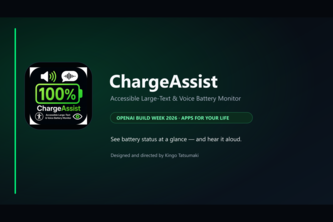
ChargeAssist is a self-reported Progressive Web App (PWA) designed to display battery status in large, high-contrast text and announce charging information via voice. It targets older adults, low-vision users, and anyone needing clearer battery information. The app uses browser APIs like Battery Status API, Web Speech API, and Screen Wake Lock API, with no backend or personal data collection.
What changed
The project was initially submitted as a small working PWA during Build Week and later extended and hardened using GPT-5.6 and Codex during the submission period. The author states that this involved improvements in voice announcements, layout responsiveness, offline caching, and testing across multiple conditions.
Single most important open question
Is there any evidence of real-world usage or user feedback from older adults or low-vision users beyond the developer’s own testing?
What The Product Actually Is
The description states that ChargeAssist is an installable Progressive Web App (PWA) built with HTML, CSS, and vanilla JavaScript. It uses browser APIs such as Battery Status API, Web Speech API, Screen Wake Lock API, Service Worker, Cache API, Web App Manifest, ARIA live regions, and responsive CSS.
It displays battery percentage in extremely large, high-contrast text and announces charging states in English. The app supports offline launch after a successful visit and does not require an account, advertising, analytics, or personal data collection.
The author also notes that GPT-5.6 and Codex were used during development but are not runtime dependencies.
Evidence
- Built with: androidchrome, aria, batterystatusapi, cacheapi, css3, githubpages, gpt-5.6, html5, javascript, openaicodex, progressivewebapp, screenwakelockapi, serviceworker, webappmanifest, webspeechapi
- Uses Battery Status API, Web Speech API, Screen Wake Lock API, Service Worker, Cache API, Web App Manifest, ARIA live regions
- No backend or personal data collection
- Deployed via GitHub Pages
- GPT-5.6 and Codex used during development but not in runtime
Inference The app is a lightweight, browser-based solution intended for accessibility use cases.
Positioning & Claim Evolution
The author positions ChargeAssist as an accessible battery monitor tailored for older adults, low-vision users, and anyone who needs a clearer charging experience. The tagline emphasizes accessibility: “An accessible large-text and voice battery monitor designed for older adults, low-vision users, and anyone who needs a clearer charging experience.”
The product is described as intentionally simple, with no menus, accounts, or advertisements. It focuses on one core function — displaying and announcing battery status — without feature bloat.
Evidence
- Tagline: “An accessible large-text and voice battery monitor designed for older adults, low-vision users, and anyone who needs a clearer charging experience.”
- “The experience is intentionally simple”
- No account, advertising, analytics, backend, or personal-data collection
Inference The positioning reflects an intent to solve a specific accessibility problem with minimal interaction.
Target Customer & ICP
The author identifies the target audience as:
- Older adults
- People with low vision
- Anyone who needs a clearer charging experience
There is no mention of specific personas, segmentation criteria, or customer acquisition strategy. The focus is on solving an everyday problem for a defined group of users.
Evidence
- “For older adults, people with low vision, and anyone who has difficulty reading small interface elements”
- “Japan's aging society made this everyday accessibility problem feel especially important to me.”
Inference The ICP is likely narrow and focused on accessibility needs rather than broad consumer appeal.
Business Model & Pricing Evidence
There is no evidence of a business model or pricing structure. The app is described as open-source, with no monetization strategy mentioned. It does not collect personal data, nor does it include any paid features or subscriptions.
Evidence
- No account, advertising, analytics, backend, or personal-data collection
- No mention of revenue streams or pricing plans
- Open-source and installable via GitHub Pages
Inference The app appears to be non-commercial in nature, possibly a prototype or hackathon submission with no current monetization.
Technical & Delivery Signals
ChargeAssist is built as a Progressive Web App using HTML, CSS, and vanilla JavaScript. It leverages browser APIs including Battery Status API, Web Speech API, Screen Wake Lock API, Service Worker, Cache API, and Web App Manifest.
It supports offline functionality, handles fallbacks for asynchronous events, and includes accessibility features like ARIA live regions and screen-reader-friendly summaries.
The author reports using GPT-5.6 and Codex during development for documentation, wording refinement, debugging, and verification workflows.
Evidence
- Built with HTML, CSS, JavaScript
- Uses Battery Status API, Web Speech API, Screen Wake Lock API, Service Worker, Cache API, Web App Manifest
- Supports offline launch
- Uses ARIA live regions
- GPT-5.6 and Codex used during development
Inference The technical stack is minimal and browser-native, which supports rapid deployment and low maintenance.
Traction & Maturity Signals
There is no evidence of traction or customer adoption beyond the developer’s own testing and submission to a hackathon. No user base, usage metrics, or feedback from real users are provided.
Evidence
- Submitted to OpenAI 2026 hackathon
- No mention of customers, users, or adoption
- No revenue data, ARR, or headcount
Inference The product is at a very early stage — likely a prototype or proof-of-concept — with no demonstrated market traction.
Competitive Context
There are no references to existing competitors or similar products in the description. The author does not compare ChargeAssist to other battery monitoring tools, nor does it describe how it differentiates from them.
Evidence
- No mention of competitors or market positioning
- No differentiation strategy described
Inference The competitive landscape is unknown; this may be a niche product with limited prior art in its specific accessibility focus.
Open Questions & Risks
Key risks and open questions include:
- Lack of verified user feedback or real-world testing beyond the developer’s own use
- No evidence of scalability, monetization, or long-term viability
- The app is described as a hackathon submission, suggesting it may not be production-ready
- No indication of future development plans or roadmap
Evidence
- No customer data or user feedback
- Submitted to a hackathon
- No mention of ongoing development or product roadmap
Inference This is likely an early-stage prototype with no commercial traction or sustainability.
Questions the description leaves open
- Has the app been tested with actual older adults or low-vision users beyond your own testing?
- What are the limitations of browser API support across devices and browsers, and how do you handle those?
- Are there any plans to expand beyond English-only interface or add localization?
- How does the app perform in real-world conditions (e.g., battery drain, offline behavior)?
- Is there a plan for long-term maintenance or updates beyond the current version?
Overall Assessment
Not evidenced.
The project is described as a hackathon submission with no commercial traction, revenue, or customer data. The author does not state any intention to pursue funding or partnership opportunities. There is no indication of product-market fit, scalability, or monetization strategy.
Evidence
- Submitted to OpenAI 2026 hackathon
- No mention of funding, partnerships, or commercial intent
- No evidence of traction or adoption
Inference This is a prototype with no clear path to investment or partnership unless further development and user testing occur.
User Stories BotA demo video on every pull request
Get a demo video on every new feature
GitHub App that watches your pull requests and records a narrated, captioned demo.
Save time on demo prep and make informed decisions faster with a video walkthrough of every new feature.
Source
Submitted to the OpenAI 2026 hackathon on Devpost. Project home on Devpost. Back to the full gallery on Devpost.
This competitive analysis was produced by top-founders.com (opens in a new tab)
Generated by a language model from this project's public Devpost page — its tagline, the author's own write-up and any built-with tags listed there — as captured in August 2026. Short quotations are the author's words. It is an opinion on the idea as a business, not on the people behind it, and it reflects the description as published then. If the project has moved on, request a correction below. The analysis is not independent research and contains no verified traction, revenue or customer data.
An independent guide by KFG International LLC — not affiliated with, endorsed by, or connected to Devpost or OpenAI.