

Archive position — measured, not model output
1 like on Devpost
505 of the 7,850 archived projects have more likes, and 1,758 share exactly 1 — so this project's #1,240 place in the like-ranked listing is a tie-break inside that group, not a ranking.
Projects (log scale)
Likes on Devpost. ▲ marks this project's group.
Show the figures
| Likes | Projects | Share of archive |
|---|---|---|
| 0 | 5,587 | 71.2% |
| 1 | 1,758 | 22.4% |
| 2 | 284 | 3.6% |
| 3–4 | 132 | 1.7% |
| 5–9 | 75 | 1.0% |
| 10+ | 14 | 0.2% |
 User Stories BotA demo video on every pull request
Get a demo video on every new feature
GitHub App that watches your pull requests and records a narrated, captioned demo.
Save time on demo prep and make informed decisions faster with a video walkthrough of every new feature.
Executive Summary
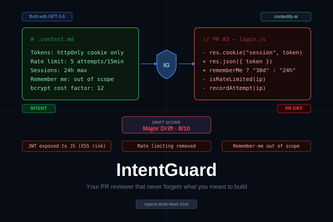
What the company appears to be: IntentGuard is a tool that uses AI to compare code changes in GitHub PRs against documented developer intent (stored in .context.md files) and flags semantic drift — i.e., changes that deviate from stated design decisions, even if syntactically correct. It was built as part of an OpenAI 2026 hackathon project.
What changed: The author describes a gap they observed in code review: reviewers check functionality but not alignment with intent. IntentGuard aims to close this loop by using AI to assess whether changes align with documented intent, particularly around security and scope decisions.
The single most important open question: Is there evidence of traction or adoption beyond the hackathon? The description states no revenue, customers, or usage data exist beyond the demo scenario.
What The Product Actually Is
- The description states that IntentGuard takes a GitHub PR URL, fetches the diff, reads
.context.mdfiles for changed files, and uses GPT-5.6 to compare what the code now does against what the developer originally said it should do. - It outputs a structured drift report per file, with a drift score from 0–10, assessment (aligned / minor drift / major drift), specific flags for what drifted, and a summary of what still aligns with intent.
- The tool integrates with GitHub REST API to fetch PR diffs and read
.context.mdfiles directly from the repo. - It is built using Next.js 14 (App Router), GPT-5.6, and contextify-ai as the upstream tool that generates intent files.
Note: The product is described as a web UI with API routes, but also mentions a potential future GitHub Action integration for automated PR checks.
Positioning & Claim Evolution
- The description states IntentGuard is “Your PR reviewer that never forgets what you meant to build.”
- It positions itself as a solution to the problem of developers writing careful decisions into code but having those decisions silently undone in later PRs.
- It claims to address a gap in standard code review: reviewers check whether code works, not whether it aligns with intent.
- The author frames this as a shift from syntactic diff checking to semantic drift detection — distinguishing between legitimate refactors and intent violations.
Inference: The positioning implies a move toward more intentional, documentation-driven development workflows. However, no evidence of market traction or adoption is provided.
Target Customer & ICP
- The description states that the author works as a Senior Front-End Engineer leading distributed teams across multiple product lines.
- It suggests the tool targets developers working in environments where intent documentation (via
.context.md) is already being used, such as those using contextify-ai. - The tool appears aimed at engineering teams that value security and scope control in code reviews.
Not evidenced: No explicit ICP or customer segment beyond the author’s personal experience. No data on team size, industry, or use case breadth.
Business Model & Pricing Evidence
- Not evidenced. There is no mention of pricing, monetization strategy, or business model in the description.
Inference: The tool appears to be a proof-of-concept built for a hackathon and not yet commercialized.
Technical & Delivery Signals
- Built with Next.js 14 (App Router), GPT-5.6, GitHub REST API, and contextify-ai.
- Uses prompt engineering to distinguish between syntactic changes and semantic drift.
- The core prompt is designed to reason about intent rather than just describe code changes.
- Codex was used for generating boilerplate code.
- The UI includes file cards that are collapsed by default and expandable on click, to manage complexity in large PRs.
Inference: The stack and architecture suggest a lean, developer-focused tool built quickly. No evidence of scalability or production-grade infrastructure.
Traction & Maturity Signals
- Not evidenced. There is no mention of users, customers, revenue, or usage beyond the demo scenario.
- The project was submitted to an OpenAI hackathon, indicating it's in early-stage development.
- The author notes that the tool was built in under 24 hours and is deployable but not yet production-ready.
Absence of evidence: No data on adoption, retention, or product-market fit.
Competitive Context
- Not evidenced. No mention of existing tools or competitors in the space.
- The description implies a niche where intent documentation is already being used (via contextify-ai), but no comparison to other code review or drift detection tools is made.
Inference: IntentGuard appears to be positioned at the intersection of AI-powered code review and intent-based development, an emerging area with limited known competition.
Open Questions & Risks
- The tool relies heavily on
.context.mdfiles being present — a gap in coverage could lead to missed drift. - It is built using GPT-5.6, which may not be available or scalable for enterprise use without additional infrastructure.
- The product is described as a hackathon project with no evidence of commercialization or long-term roadmap.
- There is no indication that the tool has been tested in real-world environments beyond a demo.
Inference: The lack of traction and commercial viability raises questions about its readiness for adoption by engineering teams.
Questions the description leaves open
- What is the current coverage of
.context.mdfiles in your target user base? - How does IntentGuard handle cases where intent documentation is missing or incomplete?
- Are there plans to integrate with GitHub Actions or other CI/CD pipelines?
- What are the technical and operational challenges in scaling this tool for enterprise use?
- Has the prompt engineering been validated across multiple types of codebases or domains?
Overall Assessment
- Not evidenced. No financials, funding rounds, or investment history are provided.
- The project is described as a hackathon submission with no evidence of traction or commercial viability.
- It appears to be an early-stage idea that builds on the author’s prior work (contextify-ai) and may have potential for further development.
Confidence level: Low. This is a self-reported, unverified description of a hackathon project with no evidence of product-market fit, revenue, or adoption.
User Stories BotA demo video on every pull request
Get a demo video on every new feature
GitHub App that watches your pull requests and records a narrated, captioned demo.
Save time on demo prep and make informed decisions faster with a video walkthrough of every new feature.
Source
Submitted to the OpenAI 2026 hackathon on Devpost. Project home on Devpost. Back to the full gallery on Devpost.
This competitive analysis was produced by top-founders.com (opens in a new tab)
Generated by a language model from this project's public Devpost page — its tagline, the author's own write-up and any built-with tags listed there — as captured in August 2026. Short quotations are the author's words. It is an opinion on the idea as a business, not on the people behind it, and it reflects the description as published then. If the project has moved on, request a correction below. The analysis is not independent research and contains no verified traction, revenue or customer data.
An independent guide by KFG International LLC — not affiliated with, endorsed by, or connected to Devpost or OpenAI.