

Archive position — measured, not model output
2 likes on Devpost
221 of the 7,850 archived projects have more likes, and 284 share exactly 2 — so this project's #479 place in the like-ranked listing is a tie-break inside that group, not a ranking.
Projects (log scale)
Likes on Devpost. ▲ marks this project's group.
Show the figures
| Likes | Projects | Share of archive |
|---|---|---|
| 0 | 5,587 | 71.2% |
| 1 | 1,758 | 22.4% |
| 2 | 284 | 3.6% |
| 3–4 | 132 | 1.7% |
| 5–9 | 75 | 1.0% |
| 10+ | 14 | 0.2% |
 User Stories BotA demo video on every pull request
Get a demo video on every new feature
GitHub App that watches your pull requests and records a narrated, captioned demo.
Save time on demo prep and make informed decisions faster with a video walkthrough of every new feature.
Executive Summary
What the company appears to be
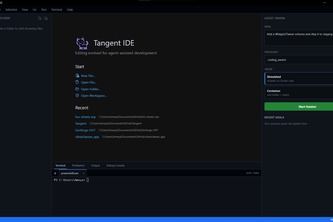
The description states that Tangent is a coding IDE with a swarm of specialized agents working underneath it. The core innovation lies in how these agents communicate using a compressed, pseudo-neuralese protocol to reduce token usage during inter-agent communication. It was built as part of the OpenAI 2026 hackathon and is presented as an actual IDE, not a demo.
What changed
The project description indicates that this is a proof-of-concept (POC) for a new kind of agent-based development environment, with a focus on optimizing token efficiency in multi-agent systems. It introduces a novel communication layer between agents and integrates it into an IDE.
Single most important open question
Is there any evidence of traction, revenue, or customer adoption beyond the hackathon submission? The self-reported description does not provide any data on usage, customers, or monetization.
What The Product Actually Is
The description states that Tangent is a coding IDE with a swarm of specialized agents working underneath it. These agents coordinate through a compressed, pseudo-neuralese protocol, which reduces token footprint compared to plain text communication. It includes features such as:
- A file tree
- An editor
- Live agent activity feed
The product was built using technologies including Docker SDK, Go, React, TypeScript, and Wails.
Inference It is not evidenced whether this is a fully functional IDE or just a prototype, nor if it supports real-world application development beyond the POC.
Positioning & Claim Evolution
The author claims that current AI copilots for coding:
- Use state-of-the-art models in a "costly way"
- Address the same problem with the same approach
- Focus on more capabilities rather than more capabilities per token
They position Tangent as solving inefficiencies in agent communication by introducing token-efficient inter-agent messaging, which they claim results in 10–15% lower token spend without compromising build quality.
Inference This is a self-stated positioning and a claim about product differentiation. There is no evidence of market validation or competitive analysis to support these claims.
Target Customer & ICP
The description does not explicitly state the target customer or ideal customer profile (ICP). It implies that Tangent is aimed at developers who build serious applications, as opposed to those making small changes.
Inference It is inferred that the intended users are software engineers or developers working on complex projects where token efficiency matters. However, no explicit segmentation or user persona data is provided.
Business Model & Pricing Evidence
There is no evidence in the description of a business model or pricing strategy. The project is described as a hackathon submission with no mention of monetization, licensing, or customer acquisition plans.
Inference No commercial structure is evident from the self-reported content.
Technical & Delivery Signals
The description states:
- The agent backbone was built on Codex
- Communication between agents uses a compressed pseudo-neuralese protocol
- The system includes an IDE UI, file tree, editor, and live activity feed
- Challenges included integrating asynchronous backend with responsive UI
- Compression tradeoffs were managed carefully to avoid loss of fidelity
Inference The technical architecture is described as novel in terms of agent communication, but there is no evidence of scalability, performance metrics, or production readiness.
Traction & Maturity Signals
There is no evidence of traction, revenue, customers, or adoption beyond the hackathon submission. The project is explicitly labeled as a POC and was submitted to the OpenAI 2026 hackathon.
Inference No signs of product-market fit, user engagement, or business development are evident.
Competitive Context
The description states that existing AI copilots for coding:
- Address the same problem in the same way
- Use state-of-the-art models in a costly manner
- Focus on more capabilities instead of more capabilities per token
It positions Tangent as different due to its agent communication optimization.
Inference This is a self-assessed competitive advantage. No evidence of market analysis, competitor names, or pricing comparisons is provided.
Open Questions & Risks
- The project is described as a hackathon POC with no evidence of commercial viability.
- There is no evidence of revenue, customers, or product-market fit.
- The compressed agent protocol may introduce reliability risks if not carefully tuned.
- No indication of long-term roadmap, funding, or team continuity beyond the initial three members.
Inference The lack of traction and business model signals a high risk of failure to scale or monetize.
Questions the description leaves open
- What is your plan for transitioning from a hackathon prototype to a scalable product?
- Have you validated the token savings in real-world usage beyond the POC?
- Are there any plans to integrate with existing IDEs or platforms (e.g., VS Code, GitHub)?
- How do you intend to monetize this product? Is there a pricing model or business plan?
- What are the key technical challenges that remain unresolved before production deployment?
Overall Assessment
The description presents Tangent as a proof-of-concept for an innovative agent-based IDE with token-efficient communication. However, it lacks any evidence of traction, revenue, customers, or business model.
Assessment Not evidenced. This is a self-reported, unverified idea with no commercial due-diligence signals to support investment or partnership interest at this time.
User Stories BotA demo video on every pull request
Get a demo video on every new feature
GitHub App that watches your pull requests and records a narrated, captioned demo.
Save time on demo prep and make informed decisions faster with a video walkthrough of every new feature.
Source
Submitted to the OpenAI 2026 hackathon on Devpost. Project home on Devpost. Back to the full gallery on Devpost.
This competitive analysis was produced by top-founders.com (opens in a new tab)
Generated by a language model from this project's public Devpost page — its tagline, the author's own write-up and any built-with tags listed there — as captured in August 2026. Short quotations are the author's words. It is an opinion on the idea as a business, not on the people behind it, and it reflects the description as published then. If the project has moved on, request a correction below. The analysis is not independent research and contains no verified traction, revenue or customer data.
An independent guide by KFG International LLC — not affiliated with, endorsed by, or connected to Devpost or OpenAI.