

Archive position — measured, not model output
0 likes on Devpost
2,263 of the 7,850 archived projects have more likes, and 5,587 share exactly 0 — so this project's #4,405 place in the like-ranked listing is a tie-break inside that group, not a ranking.
Projects (log scale)
Likes on Devpost. ▲ marks this project's group.
Show the figures
| Likes | Projects | Share of archive |
|---|---|---|
| 0 | 5,587 | 71.2% |
| 1 | 1,758 | 22.4% |
| 2 | 284 | 3.6% |
| 3–4 | 132 | 1.7% |
| 5–9 | 75 | 1.0% |
| 10+ | 14 | 0.2% |
 User Stories BotA demo video on every pull request
Get a demo video on every new feature
GitHub App that watches your pull requests and records a narrated, captioned demo.
Save time on demo prep and make informed decisions faster with a video walkthrough of every new feature.
Executive Summary
What the company appears to be
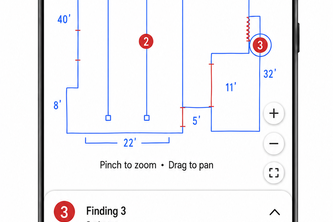
Groundmarker is an offline-first Android app designed for construction and home-inspection professionals to capture, sketch, mark, photograph, and report findings in the field. It allows users to create vector sketches with markers and attach up to three photos per finding, with a persistent undo function. The app generates a PDF report that includes a one-page overview, linked findings index, and locator mini-maps.
What changed
The project was built by a solo developer (Emily Lin) using AI tools including GPT-5.6 and OpenAI Codex to implement the full application from concept to code. It is described as a self-contained solution that runs entirely on the device without cloud connectivity or analytics.
Single most important open question
Is there evidence of real-world usage or traction beyond the developer's own testing? The description states no revenue, customers, or adoption data are available.
What The Product Actually Is
The description states that Groundmarker is an offline-first Android app designed around the real inspection process. It includes:
- An editable vector canvas for sketching layouts
- Numbered markers showing exact locations of findings (up to 50 per inspection)
- Ability to attach up to three photos per marker
- Persistent 16-step undo functionality
- Quick View feature for presenting findings to clients
- Prepare & Send flow for reordering findings and choosing what appears in the report
- Export as an immutable, timestamped PDF with a one-page overview cover, linked findings index, and locator mini-maps
The app is built using Flutter, SQLite (Drift), Riverpod, and automated tests. It does not require accounts or cloud connectivity.
Positioning & Claim Evolution
The description states that Groundmarker was originally conceived to help construction inspectors document their work more efficiently, particularly in dangerous environments like crawl spaces. The author notes that the inspection process is both risky and difficult to communicate afterward.
The positioning evolved from a simple tool for capturing inspection data to one focused on closing sales through better visual communication. The app's core value proposition appears to be helping inspectors present findings clearly to clients who may not understand construction details.
Claims made:
- "Groundmarker was born in foundation inspection, but it isn't limited to it"
- "The same flow: inspect, sketch, mark, photograph, report — works for any job where someone has to document what they found and explain it to a client"
These are self-reported claims about the product's scope and utility.
Target Customer & ICP
The description states that Groundmarker is built for construction and home-inspection professionals as the core audience. It also mentions that the app works for any job where someone has to document what they found and explain it to a client.
It was specifically designed with one user in mind: Emily Lin's husband, who works in construction and performs inspections under houses. The target customer is described as:
- Construction/home-inspection professionals
- Users who need to document findings in dangerous or tight spaces
- Clients who may not be familiar with construction terminology
No specific customer segments beyond this were identified.
Business Model & Pricing Evidence
The description does not provide any information about pricing, monetization, or business model. It states that the app runs on the phone with no account, cloud, or analytics — implying no subscription or transactional revenue model is currently in place.
There is no evidence of:
- Revenue streams
- Pricing tiers
- Customer acquisition costs
- Sales process
Technical & Delivery Signals
The description indicates that Groundmarker was built by a solo developer (Emily Lin) without an engineering background. Key technical signals include:
- Built using Flutter framework
- Uses SQLite database via Drift
- Implements Riverpod for state management
- Includes 209 automated tests
- Developed through AI-assisted coding with GPT-5.6 and Codex
- Features a phased build plan implemented in 10 phases
- No cloud or analytics required
The developer used AI tools to generate documentation (PRD, UX spec, UI design doc, etc.) before implementing code.
Traction & Maturity Signals
There is no evidence of traction or maturity beyond the developer's own testing. The description states:
- No revenue data
- No customer base
- No adoption metrics
- No field testing results
- No user feedback from external sources
The only indication of usage is that the developer’s husband will be using it for real inspections, but no results or performance data are provided.
Competitive Context
The description does not mention any competitors. It focuses on how Groundmarker addresses a specific pain point in construction inspection rather than situating itself within an existing market landscape.
No competitive analysis, market size estimates, or positioning relative to other tools were included.
Open Questions & Risks
- Solo developer risk: The app was built by one person without engineering background; this raises concerns about scalability and long-term maintenance.
- Unverified claims: All features and benefits are self-reported and unverified.
- No external validation: No customers, users, or third-party feedback is mentioned.
- AI dependency: Heavy reliance on AI tools for development may pose risks if those tools change or become unavailable.
- Limited scope: While the app is described as applicable beyond foundation inspection, there's no evidence of broader application or market testing.
Questions the description leaves open
- What specific feedback has been received from your husband regarding usability and effectiveness in real inspections?
- Have you conducted any formal user research or usability testing with other construction professionals?
- How do you plan to validate the assumption that better visual reports lead to higher closing rates?
- Are there plans for cloud integration or data synchronization in future versions?
- What is your strategy for scaling beyond a single developer?
- Can you provide examples of how the AI-generated documentation influenced actual code decisions?
Overall Assessment
Not evidenced.
The description provides no information about:
- Revenue
- Customers
- Market traction
- Financials
- Team strength beyond one person
- Product-market fit validation
Given that this is a self-reported, unverified project built by a solo developer using AI tools, and there is no evidence of any commercial activity or user adoption, it is not possible to assess its investment potential or partnership viability at this stage. The project remains in early development with no demonstrated traction or market validation.
This analysis is based solely on the self-reported description provided. No external verification or historical data exists for this project.
User Stories BotA demo video on every pull request
Get a demo video on every new feature
GitHub App that watches your pull requests and records a narrated, captioned demo.
Save time on demo prep and make informed decisions faster with a video walkthrough of every new feature.
Source
Submitted to the OpenAI 2026 hackathon on Devpost. Project home on Devpost. Back to the full gallery on Devpost.
This competitive analysis was produced by top-founders.com (opens in a new tab)
Generated by a language model from this project's public Devpost page — its tagline, the author's own write-up and any built-with tags listed there — as captured in August 2026. Short quotations are the author's words. It is an opinion on the idea as a business, not on the people behind it, and it reflects the description as published then. If the project has moved on, request a correction below. The analysis is not independent research and contains no verified traction, revenue or customer data.
An independent guide by KFG International LLC — not affiliated with, endorsed by, or connected to Devpost or OpenAI.