

Archive position — measured, not model output
0 likes on Devpost
2,263 of the 7,850 archived projects have more likes, and 5,587 share exactly 0 — so this project's #4,406 place in the like-ranked listing is a tie-break inside that group, not a ranking.
Projects (log scale)
Likes on Devpost. ▲ marks this project's group.
Show the figures
| Likes | Projects | Share of archive |
|---|---|---|
| 0 | 5,587 | 71.2% |
| 1 | 1,758 | 22.4% |
| 2 | 284 | 3.6% |
| 3–4 | 132 | 1.7% |
| 5–9 | 75 | 1.0% |
| 10+ | 14 | 0.2% |
 User Stories BotA demo video on every pull request
Get a demo video on every new feature
GitHub App that watches your pull requests and records a narrated, captioned demo.
Save time on demo prep and make informed decisions faster with a video walkthrough of every new feature.
Executive Summary
What the company appears to be
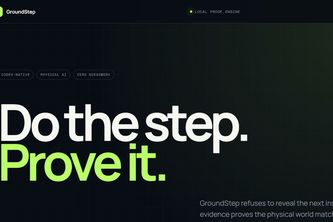
GroundStep is a self-reported Codex plugin that guides physical tasks through bounded actions, using multimodal AI to validate each step via user-submitted photos before unlocking the next. It operates as a deterministic state machine with a visual proof trail and does not require external APIs or cloud services.
What changed
The project description indicates this is a hackathon submission (OpenAI 2026) that resulted in a functional plugin, including a demonstration of a router assembly workflow with four assessment types: verified, mismatch, uncertain, unsafe. It includes local storage of evidence and cryptographic hashing for integrity.
The single most important open question
Is there any evidence of real-world usage or adoption beyond the hackathon demo? The description does not state whether GroundStep has been used outside of the development environment or tested in production conditions.
What The Product Actually Is
The description states that GroundStep is a Codex plugin with a reusable $groundstep skill. It uses Codex with GPT-5.6 for multimodal inspection and conversational loop, but separates interpretation from authorization so that only a deterministic state engine can unlock the next step.
It is built using:
- A Node.js runtime for security boundary
- A deterministic state machine to control current-step locks
- Local storage for evidence and cryptographic hashes (SHA-256)
- A responsive dashboard to replay proof trails
The system supports four assessments:
- Verified
- Mismatch
- Uncertain
- Unsafe
It is designed to work with user-submitted photos, which are processed by Codex with GPT-5.6, but only the deterministic code enforces workflow progression.
Not evidenced: whether GroundStep has been deployed beyond a demo or tested in real-world environments.
Positioning & Claim Evolution
The description states that GroundStep was inspired by the idea that AI assistants lose ground truth once users act in physical reality. It aims to close this gap by making reality the gate between instructions.
It positions itself as:
- A tool for guiding physical tasks one bounded action at a time
- A system that ensures only verified steps advance the workflow
- A solution that uses multimodal reasoning safely, with deterministic controls
The claim evolution shows a shift from general AI assistance to proof-gated task execution, where the model interprets reality but does not authorize progress.
Inferred: The positioning implies a focus on safety and trust in physical workflows, possibly targeting industries requiring verification or compliance.
Target Customer & ICP
The description states that GroundStep is built for physical tasks such as:
- Router assembly
- Equipment inspection
- Field maintenance
- Inventory handoff
- Travel packing
It also mentions potential use cases like accessible assembly, and notes that it keeps high-risk regulated work out of scope.
Not evidenced: No specific customer segments or personas are named. The description does not indicate whether GroundStep targets enterprise, consumer, or industrial users.
Business Model & Pricing Evidence
The description states that GroundStep is a Codex plugin, and that it runs locally without requiring cloud services or API keys.
It does not state:
- Whether the plugin will be sold or offered free
- If there are any pricing tiers or monetization plans
- Whether it targets developers, end-users, or enterprises for purchase
Not evidenced: No business model or pricing information is provided.
Technical & Delivery Signals
The description states that GroundStep:
- Is a Codex plugin with a reusable skill
- Uses Codex with GPT-5.6 for multimodal inspection and conversational loop
- Employs a deterministic state machine to control step progression
- Stores evidence locally using SHA-256 hashing
- Has a responsive dashboard for replaying proof trails
- Is built in Node.js, with no external dependencies
It also mentions:
- A seven-photo real-router demo
- Automated testing (engine, integrity, HTTP tests)
- A judge-facing replay dashboard
Inferred: The system is designed to be self-contained and secure, relying on local processing for safety.
Not evidenced: No information about scalability, performance, or deployment in production environments.
Traction & Maturity Signals
The description states:
- It was built for the OpenAI 2026 hackathon
- It includes a working plugin and a demo
- It has seven passing tests
- It includes a real-router proof trail
It does not state:
- Whether it is used in production
- If there are any users or customers
- If it has been tested beyond the demo
- If there is any revenue, ARR, or adoption data
Not evidenced: No traction or maturity signals beyond the hackathon submission.
Competitive Context
The description does not mention:
- Competitors
- Similar tools in the market
- Market positioning relative to other task guidance or verification systems
Not evidenced: No competitive analysis or context provided.
Open Questions & Risks
- No real-world usage: The system is described as a hackathon demo with no evidence of production use.
- Limited scope: It only supports physical tasks and excludes high-risk regulated work, which may limit its market appeal.
- Self-reported maturity: No independent verification or testing beyond the author’s own account.
- No monetization model: The business model is not described, raising questions about sustainability.
- Dependency on Codex: Reliance on a specific development environment (Codex) may limit adoption.
Inferred: If GroundStep is only a demo, it may not be ready for commercial deployment or market entry.
Questions the description leaves open
- What real-world tasks have been tested with GroundStep beyond the router demo?
- Has the system been used in any production or semi-production environments?
- Are there plans to monetize or scale the plugin beyond its current form?
- How does it handle edge cases or unexpected physical conditions not covered in the demo?
- What is the long-term vision for the product, and how does it plan to evolve from a hackathon prototype?
Overall Assessment
The description states that GroundStep is a self-reported hackathon submission with no evidence of traction, revenue, or customer adoption.
It is a functional plugin, but there is no indication of:
- Commercial viability
- Market demand
- Product-market fit
- Scalability beyond the demo
Inferred: The project shows early technical capability and a clear idea, but lacks commercial due-diligence signals. It may be an interesting prototype, but not yet a viable investment or partnership opportunity.
Not evidenced: No data on valuation, funding, or business traction to support any conclusion about investment potential.
User Stories BotA demo video on every pull request
Get a demo video on every new feature
GitHub App that watches your pull requests and records a narrated, captioned demo.
Save time on demo prep and make informed decisions faster with a video walkthrough of every new feature.
Source
Submitted to the OpenAI 2026 hackathon on Devpost. Project home on Devpost. Back to the full gallery on Devpost.
This competitive analysis was produced by top-founders.com (opens in a new tab)
Generated by a language model from this project's public Devpost page — its tagline, the author's own write-up and any built-with tags listed there — as captured in August 2026. Short quotations are the author's words. It is an opinion on the idea as a business, not on the people behind it, and it reflects the description as published then. If the project has moved on, request a correction below. The analysis is not independent research and contains no verified traction, revenue or customer data.
An independent guide by KFG International LLC — not affiliated with, endorsed by, or connected to Devpost or OpenAI.