

Archive position — measured, not model output
0 likes on Devpost
2,263 of the 7,850 archived projects have more likes, and 5,587 share exactly 0 — so this project's #6,369 place in the like-ranked listing is a tie-break inside that group, not a ranking.
Projects (log scale)
Likes on Devpost. ▲ marks this project's group.
Show the figures
| Likes | Projects | Share of archive |
|---|---|---|
| 0 | 5,587 | 71.2% |
| 1 | 1,758 | 22.4% |
| 2 | 284 | 3.6% |
| 3–4 | 132 | 1.7% |
| 5–9 | 75 | 1.0% |
| 10+ | 14 | 0.2% |
 User Stories BotA demo video on every pull request
Get a demo video on every new feature
GitHub App that watches your pull requests and records a narrated, captioned demo.
Save time on demo prep and make informed decisions faster with a video walkthrough of every new feature.
Executive Summary
What the company appears to be
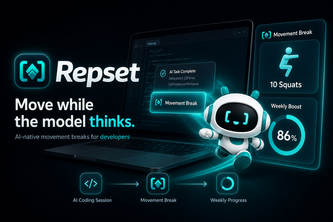
Repset is a Codex plugin designed to offer developers short, optional movement breaks during AI-assisted coding sessions. The product uses natural pauses in Codex activity as triggers for movement nudges, aiming to support wellbeing without interrupting concentration.
What changed
The project evolved from a personal observation about long coding sessions and idle waiting time into a structured plugin with privacy-by-design features, local-first architecture, and optional AI assistance for activity ranking.
Single most important open question
Does Repset have any evidence of user adoption or engagement beyond the author’s own use case?
Analysis basis
Self-reported only. No archived data, revenue figures, customer names, or traction metrics are available. All claims in this summary are based on the author's own description and must be treated as unverified.
What The Product Actually Is
The description states that Repset is a Codex plugin that turns natural pauses in Codex activity into optional movement breaks for developers. It operates through:
- A Stop hook that detects when a Codex turn completes.
- An event sanitizer that checks session duration, cooldowns, and user-selected context.
- A set of movement choices, including camera-assisted squat challenges, standing resets, seated activities, quiet options, and honor-mode alternatives.
- A local points ledger and weekly consistency tracking.
- Integration with Codex via MCP (Model Context Protocol) for status reporting and UI rendering.
It is built as a TypeScript monorepo, composed of:
- A website (
apps/site) - Core logic (
packages/core) - Local service (
packages/local) - MCP server (
packages/mcp) - Plugin manifest (
plugins/repset)
The plugin is distributed through the GitHub-backed Codex marketplace.
Claim
Repset is a Codex plugin.
Evidence Author's own write-up.
Claim
It uses Codex lifecycle hooks and MCP for integration.
Evidence Author’s own write-up.
Claim
It supports movement options like squat challenges, standing resets, seated activities, etc.
Evidence Author’s own write-up.
Claim
It does not collect or forward prompts, source code, or assistant responses.
Evidence Author's own write-up.
Positioning & Claim Evolution
The author positions Repset as a tool that helps developers notice opportunities for movement without interrupting their workflow. The core idea is to use the natural pause after a Codex turn as an opportunity for short breaks, rather than forcing interruptions like traditional timers.
Key positioning elements:
- Focus on wellbeing, not exercise or health outcomes.
- User control: Explicit start/skip/snooze; no lockouts or streak resets.
- Privacy by design: No data collection beyond sanitized events and local storage.
- Optional AI: GPT-5.6 is used only for ranking activities, not as a safety authority.
Claim
Repset aims to improve developer wellbeing during AI-assisted work.
Evidence Author's own write-up.
Claim
It avoids forcing or punishing behavior.
Evidence Author’s own write-up.
Claim
The plugin is delivered via Codex and integrates with MCP.
Evidence Author's own write-up.
Target Customer & ICP
The description states that Repset targets developers who use Codex for building websites, web apps, and mobile apps. It is especially relevant to those engaged in long coding sessions, where waiting for AI output leads to prolonged screen time and reduced movement.
It also implies a focus on:
- Developers working in AI-assisted environments
- Users seeking short, private movement breaks
- People who value control over their workflow
Claim
The target is developers using Codex.
Evidence Author's own write-up.
Claim
It appeals to those with long coding sessions and idle waiting time.
Evidence Author’s own write-up.
Claim
It supports users who want control and privacy.
Evidence Author’s own write-up.
Business Model & Pricing Evidence
Not evidenced. The description does not mention any pricing, monetization strategy, or business model beyond the plugin being open-source and distributed via GitHub.
Claim
No pricing or business model information provided.
Evidence Author's own write-up.
Technical & Delivery Signals
Repset is built as a TypeScript monorepo using:
- Next.js, React, Node.js
- Codex hooks, MCP (Model Context Protocol)
- SQLite for local persistence
- MediaPipe Pose Landmarker for camera-based movement detection
- GPT-5.6 for optional activity ranking
- Vercel, GitHub Actions, Playwright, Vitest
It supports:
- Local-first operation with no cloud dependency
- Camera-free alternatives
- Deterministic fallbacks when AI is unavailable
- Privacy-preserving event sanitization
- Onboarding and settings UI via MCP App cards
Claim
It uses a monorepo structure with modular packages.
Evidence Author's own write-up.
Claim
It supports local SQLite storage and browser-based pose detection.
Evidence Author’s own write-up.
Claim
It has deterministic fallbacks for AI components.
Evidence Author’s own write-up.
Traction & Maturity Signals
Not evidenced. There is no mention of:
- Users or customers
- Revenue or monetization
- Adoption metrics
- Product usage data
- Market traction
Claim
No traction or maturity data provided.
Evidence Author's own write-up.
Competitive Context
Not evidenced. The description does not reference competitors, existing tools, or market positioning beyond its own functionality.
Claim
No competitive context provided.
Evidence Author's own write-up.
Open Questions & Risks
- No user data or adoption metrics: The product is described only in terms of the author’s personal experience and design decisions.
- Unproven market demand: While the author notes informal recognition from peers, there is no evidence of a larger audience or validated need.
- Limited distribution channel: Only available via GitHub marketplace; no public launch or marketing.
- AI dependency risks: Though optional, GPT-5.6 is used for ranking and could be a point of failure if not properly handled.
- Privacy vs. utility trade-off: The strict privacy design may limit the product’s ability to adapt or improve over time.
Inference The lack of traction or user feedback suggests that Repset has not yet reached a market-ready stage.
Evidence Author's own write-up.
Questions the description leaves open
- What is your evidence of demand beyond personal experience?
- Have you tested the product with other developers outside your circle?
- How do you plan to scale beyond a single developer’s use case?
- Is there any data on how often users engage with movement suggestions?
- What are the key assumptions about user behavior and preferences that underpin the design?
- Are there plans for monetization or long-term sustainability?
- How do you intend to validate the effectiveness of movement nudges in improving developer wellbeing?
Note
These questions are based on the lack of evidence around adoption, usage, and market validation.
Overall Assessment
Not evidenced. No information is provided about:
- Valuation
- Funding rounds
- Team size beyond one person
- Strategic fit or partnership potential
- Commercial readiness
Claim
No investment or partnership data available.
Evidence Author's own write-up.
User Stories BotA demo video on every pull request
Get a demo video on every new feature
GitHub App that watches your pull requests and records a narrated, captioned demo.
Save time on demo prep and make informed decisions faster with a video walkthrough of every new feature.
Source
Submitted to the OpenAI 2026 hackathon on Devpost. Project home on Devpost. Back to the full gallery on Devpost.
This competitive analysis was produced by top-founders.com (opens in a new tab)
Generated by a language model from this project's public Devpost page — its tagline, the author's own write-up and any built-with tags listed there — as captured in August 2026. Short quotations are the author's words. It is an opinion on the idea as a business, not on the people behind it, and it reflects the description as published then. If the project has moved on, request a correction below. The analysis is not independent research and contains no verified traction, revenue or customer data.
An independent guide by KFG International LLC — not affiliated with, endorsed by, or connected to Devpost or OpenAI.