

Archive position — measured, not model output
0 likes on Devpost
2,263 of the 7,850 archived projects have more likes, and 5,587 share exactly 0 — so this project's #2,445 place in the like-ranked listing is a tie-break inside that group, not a ranking.
Projects (log scale)
Likes on Devpost. ▲ marks this project's group.
Show the figures
| Likes | Projects | Share of archive |
|---|---|---|
| 0 | 5,587 | 71.2% |
| 1 | 1,758 | 22.4% |
| 2 | 284 | 3.6% |
| 3–4 | 132 | 1.7% |
| 5–9 | 75 | 1.0% |
| 10+ | 14 | 0.2% |
 User Stories BotA demo video on every pull request
Get a demo video on every new feature
GitHub App that watches your pull requests and records a narrated, captioned demo.
Save time on demo prep and make informed decisions faster with a video walkthrough of every new feature.
Executive Summary
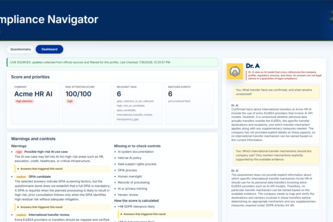
The description states that AI Act Compliance Navigator is a platform built during an OpenAI hackathon to help European startups and SMEs assess their compliance with the EU AI Act and GDPR. The author, Alessandro Benevelli, describes it as a "Codex-built compliance workspace" that transforms company profiles into explainable assessments and action plans using a modular agent architecture. It includes features like multilingual support, automated testing, Docker execution, and human-in-the-loop validation.
The platform does not provide legal advice or certify compliance but aims to guide users through structured questionnaires and generate actionable outputs including risk warnings, missing controls, prioritized recommendations, and regulatory timelines.
Key commercial due-diligence questions include: Is there a clear path to monetization? What is the actual market demand for such a tool among startups and SMEs? How does this differ from existing compliance solutions?
The single most important open question is whether the described functionality has been validated with real users or tested in actual regulatory environments.
What The Product Actually Is
The description states that AI Act Compliance Navigator is:
- A "Codex-built compliance workspace" that turns a startup's AI profile into an EU AI Act assessment and action plan
- A platform that guides companies through structured questionnaires covering:
- Activities in the EU
- AI development, provision, or deployment
- Sensitive or high-risk use cases
- Personal-data processing and GDPR indicators
- Transparency and human oversight measures
- Governance and documentation controls
- International data transfers and external providers
- A system with:
- Company Profile Agent
- Regulatory Monitoring Agent
- Regulatory Matching Agent
- Dr. A (contextual assistant)
- Policy Agent for prompt validation
- Built using Python backend, HTML/CSS/JS frontend, Docker execution, automated tests, GitHub Actions, and OpenAI Codex/GPT-5.6
The system is described as transforming questionnaire answers into:
- EU AI Act and GDPR relevance indicators
- Potential high-risk and prohibited-practice warnings
- Missing governance and compliance controls
- Prioritized recommendations
- Personalized regulatory timeline
- Links to official European sources
- Multilingual PDF and DOCX reports
- Progress view showing implemented and missing controls
Inferred: The system uses a modular agent architecture with deterministic rules for classifications and an LLM layer for explanation.
Positioning & Claim Evolution
The description states that the platform:
- Was created to make the first stage of AI compliance assessment more understandable, explainable, and actionable
- Does not provide legal advice or certify compliance
- Helps founders, product teams, and compliance professionals identify potential risk areas, missing controls, relevant regulatory evidence, and decisions requiring qualified human review
The author claims this addresses a gap where "large companies can rely on specialized legal and compliance teams, while European startups and SMEs often have limited time, budget, and regulatory expertise."
The positioning evolved from:
- Initial idea: "first stage of AI compliance assessment"
- Development during hackathon: "end-to-end local compliance workflow"
- Final product: "Compliance Action Workspace" that transforms warnings into operational tasks with priorities, statuses, ownership, deadlines, evidence, and explicit human approval
Inferred: The platform positions itself as a tool for regulatory navigation rather than legal certification.
Target Customer & ICP
The description states:
- Primary target: European startups and SMEs
- Secondary targets: Founders, product teams, and compliance professionals
- Specific use case: Making AI compliance assessment more understandable, explainable, and actionable for organizations with limited time, budget, and regulatory expertise
The author notes that large companies can rely on specialized legal and compliance teams, implying that the platform is aimed at smaller organizations lacking such resources.
Not evidenced: Specific customer segments beyond "startups and SMEs", or detailed buyer personas.
Business Model & Pricing Evidence
The description states:
- The platform does not provide legal advice or certify compliance
- It helps identify potential risk areas, missing controls, relevant regulatory evidence, and decisions requiring qualified human review
- It transforms questionnaire answers into assessments with actionable outputs
Not evidenced: Any pricing model, monetization strategy, or revenue streams.
Inferred: If monetized, it would likely be a SaaS or subscription model for access to the compliance workspace, though no details are provided.
Technical & Delivery Signals
The description states:
- Backend written in Python
- Frontend uses HTML, CSS, and vanilla JavaScript
- Interface supports 25 languages through local translation dictionaries
- Repository includes Docker execution, automated tests, continuous integration, reproducible evaluation cases, structured citations, persistent assessment snapshots, and multilingual report generation
- Modular agent architecture with:
- Company Profile Agent
- Regulatory Monitoring Agent
- Regulatory Matching Agent
- Dr. A (contextual assistant)
- Policy Agent for prompt validation
- Built with Codex and GPT-5.6 during OpenAI Build Week
- Uses RAG (Retrieval-Augmented Generation) and explainable AI principles
- Supports multilingual PDF and DOCX reports
- Includes 134 automated tests, security checks, Docker support, reproducible evaluation scenarios, and locally protected OpenAI credentials
Inferred: The system is designed for reproducibility, traceability, and auditability with deterministic rules layered over LLM explanations.
Traction & Maturity Signals
The description states:
- This was a hackathon project submitted to the OpenAI 2026 hackathon on Devpost
- The author is the sole team member (1 person)
- Includes 134 automated tests, continuous integration, security checks, Docker support, reproducible evaluation scenarios, and locally protected OpenAI credentials
Not evidenced: Any revenue, customer adoption, or usage metrics beyond the author's own development work.
Inferred: The project shows technical maturity through codebase structure, testing, CI/CD, and documentation, but lacks evidence of market traction.
Competitive Context
The description states:
- The EU AI Act creates important obligations for organizations that develop, provide, or deploy artificial intelligence
- Large companies can rely on specialized legal and compliance teams
- European startups and SMEs often have limited time, budget, and regulatory expertise
Not evidenced: Specific competitors or market landscape.
Inferred: The platform competes in the RegTech space, particularly for EU AI Act compliance tools targeting smaller organizations. It may compete with general compliance platforms or legal advisory services that are expensive for SMEs.
Open Questions & Risks
The description states:
- One main challenge was deciding which responsibilities should belong to the language model and which should remain deterministic
- Allowing a model to generate legal classifications freely would make results difficult to reproduce and audit
- The author designed the model as an explanation layer operating over trusted structured context, while deterministic rules remain the source of truth for risk signals
Open questions:
- No revenue or customer data to validate market demand
- Single-person team suggests limited scalability
- Platform does not provide legal advice or certification, which may limit its perceived value
- The system's reliance on "trusted structured context" and deterministic rules rather than model-generated classifications raises questions about the utility of AI in the compliance process
Inferred: Risk that the platform may not achieve commercial viability without clear monetization strategy or market validation.
Questions the description leaves open
- What specific regulatory requirements are you targeting beyond EU AI Act and GDPR?
- How do you plan to validate the accuracy of your regulatory matching and risk assessment logic?
- What is your go-to-market strategy for reaching European startups and SMEs?
- Have you conducted any user testing with actual startups or compliance professionals?
- What are the key assumptions underlying your pricing model, if any?
- How do you plan to scale beyond a single developer's capacity?
- What mechanisms ensure that the regulatory evidence used is current and authoritative?
- How will you handle updates to EU AI Act regulations over time?
Overall Assessment
The description states this is an OpenAI hackathon project submitted to Devpost, with no evidence of revenue, customers, or traction beyond the author's own development work.
Not evidenced: Any commercial viability, market demand, or competitive positioning that would support investment or partnership decisions.
Inferred: The platform shows technical maturity and addresses a real regulatory gap, but lacks validation in terms of actual user adoption or monetization strategy. The single-person team and lack of revenue data suggest significant risk for investment or partnership consideration at this stage.
User Stories BotA demo video on every pull request
Get a demo video on every new feature
GitHub App that watches your pull requests and records a narrated, captioned demo.
Save time on demo prep and make informed decisions faster with a video walkthrough of every new feature.
Source
Submitted to the OpenAI 2026 hackathon on Devpost. Project home on Devpost. Back to the full gallery on Devpost.
This competitive analysis was produced by top-founders.com (opens in a new tab)
Generated by a language model from this project's public Devpost page — its tagline, the author's own write-up and any built-with tags listed there — as captured in August 2026. Short quotations are the author's words. It is an opinion on the idea as a business, not on the people behind it, and it reflects the description as published then. If the project has moved on, request a correction below. The analysis is not independent research and contains no verified traction, revenue or customer data.
An independent guide by KFG International LLC — not affiliated with, endorsed by, or connected to Devpost or OpenAI.