

Archive position — measured, not model output
2 likes on Devpost
221 of the 7,850 archived projects have more likes, and 284 share exactly 2 — so this project's #481 place in the like-ranked listing is a tie-break inside that group, not a ranking.
Projects (log scale)
Likes on Devpost. ▲ marks this project's group.
Show the figures
| Likes | Projects | Share of archive |
|---|---|---|
| 0 | 5,587 | 71.2% |
| 1 | 1,758 | 22.4% |
| 2 | 284 | 3.6% |
| 3–4 | 132 | 1.7% |
| 5–9 | 75 | 1.0% |
| 10+ | 14 | 0.2% |
 User Stories BotA demo video on every pull request
Get a demo video on every new feature
GitHub App that watches your pull requests and records a narrated, captioned demo.
Save time on demo prep and make informed decisions faster with a video walkthrough of every new feature.
Executive Summary
What the company appears to be
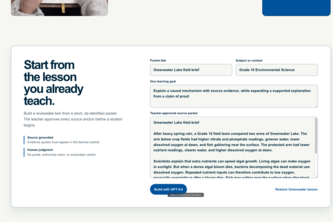
TeachBack is a self-reported educational tool built for use in classrooms, designed to help students articulate their understanding of concepts by explaining them to a simulated peer with a plausible misconception (named Nova). The system generates a structured learning trace that instructors can review formatively. It is described as an agentic clinical coach for learners, using large language models (LLMs) to scaffold learning through explanation and transfer.
What changed
The project was submitted to the OpenAI 2026 hackathon by two developers, Haidar Abdillah and Syamsul Arifin. It represents a self-contained prototype built in Next.js with TypeScript, integrating OpenAI APIs (GPT-5.6), and focused on formative assessment through cognitive scaffolding.
Single most important open question
Is there evidence that the described pedagogical approach—using simulated peer tutoring to surface conceptual understanding—has been validated or tested in real classroom settings?
What The Product Actually Is
The description states that TeachBack is a tool for educators to scaffold student learning by requiring students to explain concepts to a simulated peer named Nova, who holds a plausible misconception. The system parses source documents and constructs:
- A concept map (3–5 nodes)
- Literal evidence anchors from the source
- One target misconception for Nova
- Student prompts
The workflow includes:
- Instructor submits a source document and learning objective.
- System builds baseline setup, which instructor approves.
- Student explains to Nova and applies reasoning to a novel scenario.
- Nova’s internal state updates only when student addresses causal links with evidence.
- Entire trace is submitted for instructor review.
The system uses two structured generation phases:
- Setup Phase: Concept map, evidence anchoring, misconception formulation.
- Turn-Update Phase: Nova replies, validates evidence grounding, modifies concept-map state.
It avoids automated grading or AI-detection mechanisms and enforces strict server-side validation to prevent hallucination or model drift. The architecture is described as deterministic for offline demonstration purposes.
Evidence Self-reported by the authors; no external verification provided.
Positioning & Claim Evolution
The description states that TeachBack reframes the challenge of AI in education from a policing problem (e.g., detecting cheating) to a constructive, formative practice exercise. It positions itself as an agentic clinical coach for learners, emphasizing peer-tutoring effects and cognitive scaffolding.
Key claims:
- The tool avoids algorithmic surveillance or AI-detection arms races.
- It explicitly avoids automated grading or epistemic claims about internal knowledge.
- It focuses on making the AI’s mechanics legible through visible source maps, real-time state changes, and declarations of uncertainty.
- The system is built to maintain instructor authority via mandatory pre-approval and post-activity review.
Evidence Self-reported; no third-party validation or market positioning data provided.
Target Customer & ICP
The description identifies instructors as the primary users. Instructors submit source documents and learning objectives, approve baseline setups, and review student traces.
It also implies students are the end-users of the system, though not explicitly defined in terms of demographics or grade levels.
Evidence Self-reported; no explicit segmentation or targeting data beyond “instructor” and “student.”
Business Model & Pricing Evidence
Not evidenced. The description does not mention any pricing model, monetization strategy, or business model.
Technical & Delivery Signals
The system is built using:
- Framework: Next.js
- Language: TypeScript
- AI Integration: OpenAI Responses API with GPT-5.6
- Architecture:
- Two structured phases: Setup and Turn-Update
- Strict server-side validation to prevent hallucination or unauthorized state changes
- JSON schemas for grounding generative output
- Deterministic offline demo architecture
The codebase includes automated test suites covering workflow gates, citation validity, malformed inputs, and state-update boundaries.
Evidence Self-reported; no information on deployment, scalability, or infrastructure beyond the development stack.
Traction & Maturity Signals
Not evidenced. There is no mention of:
- Revenue
- Customers
- Users
- Adoption metrics
- Product usage data
- Market traction
The project is described as a hackathon submission and prototype, with no indication of prior use or iteration in real-world settings.
Competitive Context
Not evidenced. The description does not reference existing tools, platforms, or competitors in the educational AI space.
Open Questions & Risks
- Unvalidated Pedagogy: The approach is described as a novel pedagogical loop but lacks empirical validation or classroom testing.
- Limited Scope: The system avoids features like rubrics, LMS integrations, and student accounts—this may limit its utility in real-world adoption.
- Self-Reported Only: All claims are self-reported; no third-party verification, user feedback, or performance metrics are provided.
- No Commercialization Path: No indication of how the tool would scale beyond a hackathon prototype or how it would generate value for paying customers.
Inference The lack of real-world testing and commercial viability raises concerns about whether this is a viable product or just an experimental idea.
Questions the description leaves open
- Has the system been tested with actual instructors and students in real classroom settings?
- What specific pedagogical outcomes have you observed from using this approach?
- How do you plan to validate that the misconception design and prompt structure improve learning?
- Are there any plans for integrating with LMS platforms or scaling beyond the prototype?
- What is your roadmap for moving from a hackathon project to a product that could be used in schools or institutions?
Overall Assessment
Not evidenced. No information is provided regarding:
- Funding status
- Valuation
- Team experience
- Market opportunity
- Commercial traction
The description indicates this is a prototype submitted to a hackathon, with no evidence of product-market fit, revenue, or customer validation.
Confidence Level Low — based entirely on self-reported claims and no external data.
User Stories BotA demo video on every pull request
Get a demo video on every new feature
GitHub App that watches your pull requests and records a narrated, captioned demo.
Save time on demo prep and make informed decisions faster with a video walkthrough of every new feature.
Source
Submitted to the OpenAI 2026 hackathon on Devpost. Project home on Devpost. Back to the full gallery on Devpost.
This competitive analysis was produced by top-founders.com (opens in a new tab)
Generated by a language model from this project's public Devpost page — its tagline, the author's own write-up and any built-with tags listed there — as captured in August 2026. Short quotations are the author's words. It is an opinion on the idea as a business, not on the people behind it, and it reflects the description as published then. If the project has moved on, request a correction below. The analysis is not independent research and contains no verified traction, revenue or customer data.
An independent guide by KFG International LLC — not affiliated with, endorsed by, or connected to Devpost or OpenAI.