

Archive position — measured, not model output
0 likes on Devpost
2,263 of the 7,850 archived projects have more likes, and 5,587 share exactly 0 — so this project's #2,444 place in the like-ranked listing is a tie-break inside that group, not a ranking.
Projects (log scale)
Likes on Devpost. ▲ marks this project's group.
Show the figures
| Likes | Projects | Share of archive |
|---|---|---|
| 0 | 5,587 | 71.2% |
| 1 | 1,758 | 22.4% |
| 2 | 284 | 3.6% |
| 3–4 | 132 | 1.7% |
| 5–9 | 75 | 1.0% |
| 10+ | 14 | 0.2% |
 User Stories BotA demo video on every pull request
Get a demo video on every new feature
GitHub App that watches your pull requests and records a narrated, captioned demo.
Save time on demo prep and make informed decisions faster with a video walkthrough of every new feature.
Executive Summary
What the company appears to be
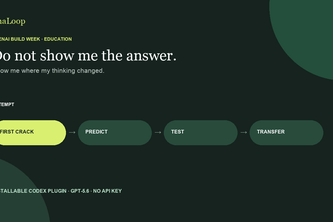
AhaLoop is a self-reported educational tool built as a Codex plugin that aims to improve student learning by identifying early reasoning errors and guiding students through a structured pedagogical loop: attempt → diagnosis → prediction → counterexample → transfer.
What changed
The project evolved from an API-dependent web app into a native Codex plugin using GPT-5.6 directly, in response to hackathon constraints around API credits. This rearchitecture allowed the team to make the product fully testable offline and simplified installation.
Single most important open question
Is there evidence of real-world student adoption or impact from this tool? The description states the goal is to turn a hidden assumption into a falsifiable belief, but does not describe any actual use cases, data, or feedback from learners.
What The Product Actually Is
The description states that AhaLoop is:
- A Codex plugin built with codex, codex-plugins, codex-skills, css, gpt-5.6, html, javascript, node.js
- A pedagogical state machine that runs GPT-5.6 directly inside Codex
- A tool that allows students to paste a problem and their reasoning or upload handwritten work
- Designed to identify the earliest unsupported inference in student thinking
- Capable of generating minimal counterexamples to distinguish incorrect beliefs from correct rules
- Includes support for algebra, geometry, probability, physics, logic, and beginner programming
The plugin is described as:
- Installable and distributable via repository
- Running locally without API keys or third-party services
- Not executing learner-provided code
- Marking ambiguity rather than inventing missing reasoning
Inferred: The tool is designed to be used in a learning environment where students submit their work, and the system guides them through an interactive loop of diagnosis and testing.
Positioning & Claim Evolution
The description states:
- AhaLoop aims to turn the first crack in a student's reasoning into an experiment they can touch
- It positions itself as an alternative to AI tutors that only produce polished explanations without helping students recognize their own flawed assumptions
- The tool is designed to center the student’s own attempt, not the model’s answer, in the learning experience
Inferred: The positioning evolved from a general AI tutoring concept to a more specific pedagogical framework focused on early reasoning detection and falsifiable belief testing.
The claim evolution shows:
- From a broad idea of improving AI tutoring
- To a narrow focus on identifying and correcting hidden assumptions
- To a practical implementation using Codex as the platform
Target Customer & ICP
The description states:
- The tool is designed for students working on academic problems in subjects like algebra, geometry, probability, physics, logic, and beginner programming
- It supports both typed and photographed student work
- It is intended to be used within Codex as a plugin
Inferred: The primary customer is likely students in STEM education, particularly those at an early learning stage where misconceptions are common.
Not evidenced:
- No mention of teachers or institutions
- No indication of age group or educational level beyond "beginner"
- No evidence of any target market segmentation beyond subject areas
Business Model & Pricing Evidence
The description states:
- AhaLoop is a native Codex plugin
- It runs locally without API keys, hosted services, or third-party accounts
- The plugin is installable and distributable via repository
- No pricing information is provided
Inferred: There is no evidence of any commercial model beyond the plugin being distributed for free or as part of a larger product ecosystem.
Not evidenced:
- No revenue model described
- No pricing structure, subscription, or licensing mentioned
- No indication of monetization strategy or business unit
Technical & Delivery Signals
The description states:
- Built using Codex plugins and skills
- Uses GPT-5.6 directly inside Codex
- No API key required
- Runs locally without backend services
- Plugin includes a validated manifest, local marketplace entry, and an ahaloop-coach Skill
- The web prototype uses Node.js server and HTML/CSS/JavaScript frontend
- Fully testable offline
Inferred:
- The tool is technically self-contained with no external dependencies
- It leverages Codex’s native capabilities to avoid API limitations
- The plugin architecture implies ease of distribution and installation
Not evidenced:
- No information on scalability, performance, or robustness in real-world use
- No mention of technical support or maintenance plans
- No evidence of integration with other platforms or systems
Traction & Maturity Signals
The description states:
- AhaLoop was built for the OpenAI 2026 hackathon
- It includes a responsive web prototype and a native plugin
- The team has created judge scenarios for algebra, probability, and programming
- It supports typed and photographed student work
- It is designed to be fully testable offline
Inferred:
- The project is in an early stage of development (hackathon submission)
- It demonstrates a functional prototype with some educational value
Not evidenced:
- No evidence of user adoption or feedback
- No data on usage frequency, retention, or impact
- No mention of any pilot programs or real-world deployment
- No indication of product maturity beyond the hackathon version
Competitive Context
The description states:
- AhaLoop is positioned as an alternative to AI tutors that only provide polished explanations
- It focuses on identifying early reasoning errors and guiding students through a structured loop
- It uses Codex as its platform, which may imply competition with other AI tutoring tools or educational platforms
Inferred:
- The tool competes in the space of AI-powered educational assistance
- It differentiates itself by focusing on pedagogical structure rather than just answer generation
Not evidenced:
- No mention of competitors or market analysis
- No indication of how it compares to existing tools or platforms
- No evidence of competitive positioning or differentiation beyond its own claims
Open Questions & Risks
The description states:
- The tool is a hackathon submission
- It was rearchitected from an API-dependent web app into a native Codex plugin due to hackathon constraints
- It runs locally without API keys, which may limit its broader utility or scalability
Inferred risks:
- The project is in early development and lacks real-world validation or traction
- The reliance on Codex as the only platform may limit adoption beyond that ecosystem
- The tool’s focus on a specific pedagogical loop may not scale to more complex learning needs
- The lack of any revenue, customer, or usage data raises questions about its viability as a product
Open questions:
- No evidence of real-world testing or student feedback
- No indication of long-term sustainability or business model
- The tool is described as a prototype, not a production-ready solution
Questions the description leaves open
- What specific educational outcomes have you observed from using this tool in practice?
- How do you plan to expand beyond the current subject areas (algebra, geometry, etc.)?
- Are there any plans for integrating feedback from teachers or students into future versions?
- What is your strategy for reaching and validating users outside of a hackathon environment?
- How do you intend to monetize this tool if it becomes more than just a prototype?
- What are the limitations of using GPT-5.6 directly in Codex, especially regarding accuracy or safety?
- Have you considered how this would work in environments where Codex is not available?
Overall Assessment
The description states:
- AhaLoop is a hackathon submission
- It is built as a Codex plugin with no API dependencies
- It includes a responsive web prototype and judge scenarios
Inferred:
- The project shows early potential in a niche educational space
- It has technical feasibility and a clear concept
- However, it lacks evidence of traction, revenue, or real-world validation
Assessment:
- Not ready for investment or partnership at this stage
- The tool is an interesting prototype with a strong pedagogical idea but no demonstrated market or user impact
- Further development and testing are needed before any strategic move can be considered
User Stories BotA demo video on every pull request
Get a demo video on every new feature
GitHub App that watches your pull requests and records a narrated, captioned demo.
Save time on demo prep and make informed decisions faster with a video walkthrough of every new feature.
Source
Submitted to the OpenAI 2026 hackathon on Devpost. Project home on Devpost. Back to the full gallery on Devpost.
This competitive analysis was produced by top-founders.com (opens in a new tab)
Generated by a language model from this project's public Devpost page — its tagline, the author's own write-up and any built-with tags listed there — as captured in August 2026. Short quotations are the author's words. It is an opinion on the idea as a business, not on the people behind it, and it reflects the description as published then. If the project has moved on, request a correction below. The analysis is not independent research and contains no verified traction, revenue or customer data.
An independent guide by KFG International LLC — not affiliated with, endorsed by, or connected to Devpost or OpenAI.