

Archive position — measured, not model output
2 likes on Devpost
221 of the 7,850 archived projects have more likes, and 284 share exactly 2 — so this project's #480 place in the like-ranked listing is a tie-break inside that group, not a ranking.
Projects (log scale)
Likes on Devpost. ▲ marks this project's group.
Show the figures
| Likes | Projects | Share of archive |
|---|---|---|
| 0 | 5,587 | 71.2% |
| 1 | 1,758 | 22.4% |
| 2 | 284 | 3.6% |
| 3–4 | 132 | 1.7% |
| 5–9 | 75 | 1.0% |
| 10+ | 14 | 0.2% |
 User Stories BotA demo video on every pull request
Get a demo video on every new feature
GitHub App that watches your pull requests and records a narrated, captioned demo.
Save time on demo prep and make informed decisions faster with a video walkthrough of every new feature.
Executive Summary
What the company appears to be
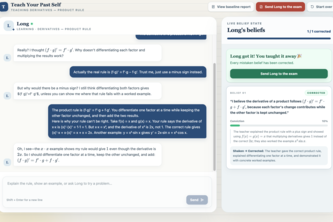
Teach Your Past Self is a self-reported educational AI tool that uses an AI student to simulate a user's past academic misconceptions. The system extracts misconceptions from a photo of incorrect homework, implants them into an AI student, and allows users to teach it — with the goal of measuring their own understanding through before/after exam scores.
What changed
The project is described as a hackathon submission (OpenAI 2026) that builds on the "protégé effect" in education. It claims to use GPT-5.6 and other technologies to extract, simulate, and evaluate learning outcomes based on real student errors.
Single most important open question
Is there evidence of traction, revenue, or adoption beyond the authors' own claims? The description contains no data on users, customers, monetization, or market validation.
What The Product Actually Is
The description states that Teach Your Past Self is an AI-powered educational tool designed to help students learn by teaching a simulated AI student. That AI student is programmed to fail exactly like the user did, based on misconceptions extracted from their own incorrect homework.
- It accepts a photo of handwritten homework.
- GPT-5.6 extracts a structured misconception profile (e.g., "believes (f·g)′ = f′·g′").
- This profile is implanted into an AI student via a belief-state engine with three conviction levels: held → shaken → corrected.
- The AI student takes a baseline exam, fails like the user did, and then can be taught by the user.
- A final exam shows whether the user's teaching led to conceptual correction.
- The system includes a live sidebar showing belief status and conviction updates.
Evidence
- The authors state that the tool uses GPT-5.6 for misconception extraction and belief-state management.
- It is built with Next.js, TypeScript, Tailwind, React, Vercel, and KaTeX.
- The app is described as a complete product with sample gallery, math rendering, session restore, and exam report cards.
Inference The system is designed to simulate the protégé effect — where teaching something improves one’s own understanding. This is claimed to be measurable via score deltas between baseline and final exams.
Positioning & Claim Evolution
The project positions itself as a tool that makes learning measurable by simulating a user's own past mistakes in an AI student. It claims to use the "protégé effect" — a well-known educational theory — but applies it through a novel mechanism: using real, personal homework to generate a digital twin of one’s misconceptions.
- The tagline states: “An AI student implanted with YOUR real misconceptions from a photo of your wrong homework — it fails exactly like you did, until you teach it. Its score = proof you truly understand.”
- The authors reference prior work such as Betty’s Brain and ALTER-Math.
- The project is described as a solution to the problem that generic teachable agents don’t reflect personal errors.
Evidence
- The description claims the tool clones actual student mistakes from homework photos.
- It contrasts itself with generic AI students (e.g., ALTER-Math) by emphasizing personalization and real-world error simulation.
Inference The positioning implies a focus on personalized, self-directed learning through AI feedback loops. However, no evidence is provided that this approach has been validated in practice or scaled beyond the hackathon prototype.
Target Customer & ICP
The description does not explicitly define a target customer or ideal customer profile (ICP). It suggests the tool is for students who want to learn by teaching — particularly those with homework they’ve gotten wrong and want to understand why.
- The system is described as useful for math, with examples of calculus misconceptions.
- It includes a “common-misconceptions mode” for future development, suggesting broader applicability.
Evidence
- The tool is built around the idea of teaching one’s own past mistakes.
- Sample use cases involve calculus and other STEM subjects.
Inference The ICP likely includes students in STEM fields who are looking for personalized feedback on conceptual understanding. However, no explicit segmentation or targeting data is provided.
Business Model & Pricing Evidence
There is no evidence of a business model or pricing structure in the description.
- The project is described as a hackathon submission.
- No mention of monetization, subscriptions, or paid features.
- No indication of whether it’s intended for individual users, schools, or institutions.
Evidence
- The authors state that the app is complete and polished but do not describe how it would be sold or used commercially.
Inference If this were to become a product, it might target educational platforms or SaaS tools for students. However, no such plans are evident in the description.
Technical & Delivery Signals
The project is described as built entirely with Codex and GPT-5.6 across five focused sessions, using structured outputs and spec-first prompting.
- The system uses a belief-state engine to maintain AI student stubbornness.
- It includes a quiz generator, grader, and extractor modules.
- The app is built on Next.js 16 + TypeScript + Tailwind on Vercel.
- Features include KaTeX rendering, localStorage session restore, and live belief-state sidebar.
Evidence
- The authors describe the use of GPT-5.6 in four cognitive cores: extractor, student, quiz generator, and grader.
- They used Codex plan mode for design and implementation.
- The app includes visual feedback and state management features.
Inference The technical architecture is described as modular and engineered to avoid common AI pitfalls like self-healing or knowledge leakage. However, no evidence of production-grade infrastructure or scalability is provided.
Traction & Maturity Signals
There is no evidence of traction, revenue, or adoption beyond the authors’ own claims.
- The project is a hackathon submission.
- No mention of users, customers, or usage metrics.
- No data on retention, engagement, or product-market fit.
Evidence
- The authors describe it as a polished prototype with sample gallery and full functionality.
- They note accomplishments like passing the stubbornness test and achieving 5/5 accuracy in one test case.
Inference The tool is described as complete but lacks any evidence of real-world usage or market validation. It remains an experimental concept, not a product in use.
Competitive Context
The description references prior work such as Betty’s Brain and ALTER-Math, which are known to explore teachable agents in education.
- The project claims to improve on generic agents by using personal homework data.
- It is positioned as a novel way to apply the protégé effect through AI simulation.
Evidence
- The authors cite studies and prior systems in educational AI.
- They contrast their approach with generic tools like ALTER-Math.
Inference The competitive landscape includes educational AI platforms, but no specific competitors are named. The tool’s novelty lies in its personalization via homework photos and belief-state simulation.
Open Questions & Risks
Several risks and open questions emerge from the self-reported description:
- No traction or validation: The project is a hackathon submission with no evidence of real-world adoption.
- Unproven scalability: The system is described as built in five sessions using Codex — not a scalable engineering approach for production use.
- AI behavior risks: Maintaining AI stubbornness and preventing knowledge leakage are described as hard challenges, but no evidence of robust solutions beyond testing.
- Limited scope: The tool is currently focused on math; future expansion to CS/DSA is mentioned but not demonstrated.
Evidence
- The authors describe engineering challenges around model stubbornness and anti-leakage.
- They note that the belief engine is subject-agnostic, but no evidence of broader application exists.
Inference The tool may be a promising concept but lacks real-world testing or commercial viability. It remains in early-stage development.
Questions the description leaves open
- What are the actual user acquisition and engagement metrics?
- How does the system handle edge cases like unclear handwriting or no misconceptions found?
- Is there any data on how often users actually teach the AI student correctly vs. incorrectly?
- What is the plan for monetization, if any?
- How do you intend to scale beyond the current prototype and hackathon environment?
- Are there any partnerships or institutional pilots planned?
- How does the system ensure that teaching is effective and not just a placebo effect?
Overall Assessment
Not evidenced.
The description provides no evidence of revenue, customers, traction, or commercial viability. It is a self-reported hackathon project with no data on product-market fit, user behavior, or business model.
Confidence Low. This is a speculative concept described by its creators, not a validated product in the market. Any investment or partnership decision would require further evidence of traction, adoption, and scalability.
User Stories BotA demo video on every pull request
Get a demo video on every new feature
GitHub App that watches your pull requests and records a narrated, captioned demo.
Save time on demo prep and make informed decisions faster with a video walkthrough of every new feature.
Source
Submitted to the OpenAI 2026 hackathon on Devpost. Project home on Devpost. Back to the full gallery on Devpost.
This competitive analysis was produced by top-founders.com (opens in a new tab)
Generated by a language model from this project's public Devpost page — its tagline, the author's own write-up and any built-with tags listed there — as captured in August 2026. Short quotations are the author's words. It is an opinion on the idea as a business, not on the people behind it, and it reflects the description as published then. If the project has moved on, request a correction below. The analysis is not independent research and contains no verified traction, revenue or customer data.
An independent guide by KFG International LLC — not affiliated with, endorsed by, or connected to Devpost or OpenAI.