

Archive position — measured, not model output
0 likes on Devpost
2,263 of the 7,850 archived projects have more likes, and 5,587 share exactly 0 — so this project's #7,111 place in the like-ranked listing is a tie-break inside that group, not a ranking.
Projects (log scale)
Likes on Devpost. ▲ marks this project's group.
Show the figures
| Likes | Projects | Share of archive |
|---|---|---|
| 0 | 5,587 | 71.2% |
| 1 | 1,758 | 22.4% |
| 2 | 284 | 3.6% |
| 3–4 | 132 | 1.7% |
| 5–9 | 75 | 1.0% |
| 10+ | 14 | 0.2% |
 User Stories BotA demo video on every pull request
Get a demo video on every new feature
GitHub App that watches your pull requests and records a narrated, captioned demo.
Save time on demo prep and make informed decisions faster with a video walkthrough of every new feature.
Executive Summary
What the company appears to be
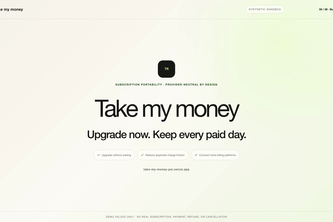
Take my money is a self-reported prototype project that demonstrates a subscription migration mechanism. The author states it enables users to transfer unused value from an existing subscription (e.g., Apple-billed) to a new direct billing provider, without refunding or duplicating charges.
What changed
The project was submitted as part of the OpenAI 2026 hackathon. It is described as a working prototype built with AI tools like Codex and GPT-5.6, using a full-stack web application architecture.
Single most important open question — commercial due-diligence read
Is there any evidence that this concept has traction, revenue, or adoption beyond the author’s own development of a demo? The description is entirely self-reported and unverified; no data on customers, usage, or monetization exists.
What The Product Actually Is
The description states that Take my money is a subscription migration system. It allows users to move from one billing provider (e.g., Apple) to another (e.g., direct subscription), preserving the value of unused time in the original subscription.
It does not attempt to refund or transfer funds out of the source provider. Instead, it calculates and applies an internal credit at the destination provider.
Key technical components include:
- A state machine managing migration steps from DRAFT to COMPLETED.
- An append-only ledger and audit trail for financial changes.
- AI integration, specifically GPT-5.6, used only for structured receipt extraction and user-facing explanations.
- A deterministic financial calculation engine, using integer-based monetary arithmetic and UTC timestamps.
- Provider adapters to verify source subscriptions.
The system is built as a full-stack web application using technologies like Next.js, React, TypeScript, PostgreSQL, Docker, Playwright, FFmpeg, and OpenAI APIs.
Claim: The product is described as a complete provider-neutral subscription migration mechanism.
Evidence: Author's own write-up.
Positioning & Claim Evolution
The author states that the project was inspired by their personal experience trying to upgrade from an Apple-billed ChatGPT subscription to a direct one — a common problem in subscription billing where users cannot immediately switch providers without losing value.
They frame this as a billing architecture issue, not a refund problem. The solution is positioned as enabling value recognition and transactional consistency across providers.
The project evolved from a simple prorating calculator into a full system with:
- Transactional state management,
- Idempotency protections,
- Reconciliation logic,
- AI-assisted extraction and explanation.
Claim: It solves the problem of subscription portability by recognizing unused value.
Evidence: Author's own write-up.
Target Customer & ICP
The description does not name specific customer segments or personas. However, it implies a target audience includes:
- Users who want to switch subscriptions between providers,
- Subscription service providers looking to improve migration experiences,
- Developers building financial systems or billing platforms.
It is unclear whether the product targets end-users directly or B2B clients (e.g., SaaS companies).
Claim: The system supports users switching from external providers to direct ones.
Evidence: Author's own write-up.
Business Model & Pricing Evidence
There is no evidence of a business model, pricing structure, or monetization strategy in the description.
The author mentions that the project was developed using paid credits (approximately $30), but this does not indicate any commercial offering or revenue generation.
Claim: No explicit business model or pricing data provided.
Evidence: Author's own write-up.
Technical & Delivery Signals
The system is described as:
- Built with a full-stack architecture using modern tools (Next.js, React, TypeScript, PostgreSQL).
- Using deterministic financial logic and integer-based arithmetic.
- Implementing transactional state machines and idempotency protections.
- Integrating AI only for vision-based receipt parsing and explanation — not for financial decisions or authorization.
It includes:
- A sandboxed demo with synthetic data,
- Automated browser testing via Playwright,
- An automated video pipeline for product demos,
- Security features like sanitized logs, schema validation, and no real payment credentials.
Claim: The system is production-ready in terms of architecture and logic.
Evidence: Author's own write-up.
Traction & Maturity Signals
There is no evidence of traction, revenue, or customer adoption beyond the author’s development work.
The project was submitted to a hackathon and is described as a prototype with no real-world usage or deployment history.
Claim: No traction or maturity data provided.
Evidence: Author's own write-up.
Competitive Context
The description does not mention any competitors or existing solutions in the subscription migration space.
It is unclear whether similar systems already exist, nor how Take my money would differentiate from them if they do.
Claim: No competitive context provided.
Evidence: Author's own write-up.
Open Questions & Risks
- Unverified claims: All information is self-reported and unverified.
- No commercial evidence: No revenue, customers, or adoption metrics.
- Prototype-only: The system is described as a demo with synthetic data; no real-world implementation or testing.
- AI dependency: While AI is used only for non-financial tasks, its presence raises questions about scalability and trust in edge cases.
- Limited scope: The project focuses on one specific use case (Apple → direct) and does not scale to broader ecosystems.
Inference: Without real-world usage or commercial traction, the project may be more of a proof-of-concept than a viable product.
Evidence: Author's own write-up.
Questions the description leaves open
- What is the actual business model behind this system? Is it intended for SaaS providers to integrate, or for end-users?
- Has there been any real-world testing with actual subscriptions and providers?
- How does the system handle edge cases like failed migrations, provider downtime, or API inconsistencies?
- Are there plans to expand beyond the current sandboxed demo to support real billing providers?
- What are the legal and compliance considerations around handling subscription data and financial credits?
Note: These questions are based on the lack of evidence in the description.
Overall Assessment
There is no evidence that Take my money has reached a stage where it can be considered for investment or partnership. The project is described as a hackathon submission, built with AI tools, and tested only in sandboxed conditions.
It demonstrates technical depth but lacks commercial traction, customer validation, or monetization strategy.
Inference: Not ready for investment or partnership unless further validated and scaled.
Evidence: Author's own write-up.
User Stories BotA demo video on every pull request
Get a demo video on every new feature
GitHub App that watches your pull requests and records a narrated, captioned demo.
Save time on demo prep and make informed decisions faster with a video walkthrough of every new feature.
Source
Submitted to the OpenAI 2026 hackathon on Devpost. Project home on Devpost. Back to the full gallery on Devpost.
This competitive analysis was produced by top-founders.com (opens in a new tab)
Generated by a language model from this project's public Devpost page — its tagline, the author's own write-up and any built-with tags listed there — as captured in August 2026. Short quotations are the author's words. It is an opinion on the idea as a business, not on the people behind it, and it reflects the description as published then. If the project has moved on, request a correction below. The analysis is not independent research and contains no verified traction, revenue or customer data.
An independent guide by KFG International LLC — not affiliated with, endorsed by, or connected to Devpost or OpenAI.