

Archive position — measured, not model output
0 likes on Devpost
2,263 of the 7,850 archived projects have more likes, and 5,587 share exactly 0 — so this project's #3,187 place in the like-ranked listing is a tie-break inside that group, not a ranking.
Projects (log scale)
Likes on Devpost. ▲ marks this project's group.
Show the figures
| Likes | Projects | Share of archive |
|---|---|---|
| 0 | 5,587 | 71.2% |
| 1 | 1,758 | 22.4% |
| 2 | 284 | 3.6% |
| 3–4 | 132 | 1.7% |
| 5–9 | 75 | 1.0% |
| 10+ | 14 | 0.2% |
 User Stories BotA demo video on every pull request
Get a demo video on every new feature
GitHub App that watches your pull requests and records a narrated, captioned demo.
Save time on demo prep and make informed decisions faster with a video walkthrough of every new feature.
Executive Summary
What the company appears to be: CEREBRO SAI is a self-described multilingual, evidence-grounded AI copilot for integrative health professionals. The author states it is designed to help practitioners retrieve, compare, review, and explain knowledge more efficiently across multiple domains such as nutrition, phytotherapy, Traditional Chinese Medicine, and others. It uses a hybrid architecture combining structured databases, knowledge graphs, rule-based logic, vector retrieval, and conversational AI.
What changed: The project was submitted as part of the OpenAI Build Week hackathon. The author describes it as an early prototype focused on drug–food and drug–plant interactions, with plans to expand into broader integrative health domains.
Single most important open question: Is there evidence that the system can reliably retrieve correct information across multiple domains at scale, or is this still a proof-of-concept?
Note: This analysis is based entirely on self-reported information from the project description. No independent verification, traction data, revenue figures, customer names, or third-party sources are available.
What The Product Actually Is
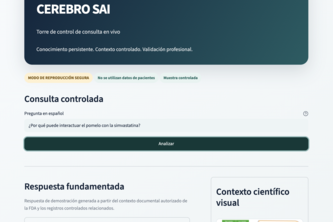
The description states that CEREBRO SAI is a multilingual, evidence-grounded knowledge copilot for integrative health professionals. It allows practitioners to ask questions in Spanish even when reference material is in English, and retrieves relevant knowledge fragments while preserving distinctions between types of evidence (human, animal, experimental, pending). The system produces clear professional explanations in Spanish and keeps technical evidence available for review.
It is not designed to diagnose or prescribe but to support preventive, educational, and decision-making processes. It separates three responsibilities:
- SAI stores persistent, structured, and authorized knowledge.
- The Director selects relevant memory, rules, relationships, and evidence.
- Conversational AI analyzes and explains only the retrieved and authorized context.
The system uses a hybrid architecture including:
- Structured databases
- Knowledge graph
- Rule-based logic
- Vector retrieval
- Conversational AI layer
- API layer
For the OpenAI Build Week prototype, it focuses on one controlled part of this larger architecture: multilingual retrieval of drug–food and drug–plant interaction knowledge followed by a grounded Spanish explanation.
Claim: The system is described as a "Living Consultation Control Tower" where professional work does not begin from a blank chat.
Evidence: Described in the project write-up under “A Living Consultation Control Tower”.
Inference: The architecture suggests a modular approach to knowledge management and retrieval.
Supporting evidence: Mentioned in “How I built it” section.
Positioning & Claim Evolution
The author positions CEREBRO SAI as an AI copilot that supports integrative health professionals by connecting scattered information sources, explaining them in natural language, and supporting decision-making without replacing the practitioner. It emphasizes safety, traceability, and evidence grounding.
It is described as not being a standalone chatbot or model storing professional records in its own memory. Instead, it acts as a controller of a dynamic professional workspace that can transform retrieved information into structured visual components like evidence cards, comparison tables, diagrams, and videos.
The author notes that the current demonstration focuses on one controlled domain (drug–food and drug–plant interactions), but the broader vision includes expanding across multiple connected domains such as nutrition, phytotherapy, Traditional Chinese Medicine, acupuncture, cofactors, biomarkers, physiological pathways, protocols, questionnaires, interaction safety, educational guidance, etc.
Claim: The system is designed to avoid unsupported diagnosis or prescription.
Evidence: Stated in the project write-up.
Inference: The positioning implies a shift from generic AI tools toward specialized, regulated knowledge systems for healthcare professionals.
Supporting evidence: Mentioned in “Context-aware safety” and “Safety and privacy” sections.
Target Customer & ICP
The target customer is described as integrative health professionals. These are practitioners who work with multiple therapeutic disciplines and need to consult scattered information across books, databases, spreadsheets, protocols, scientific references, and different therapeutic areas.
The system aims to help these users retrieve, compare, review, and explain knowledge more efficiently.
Claim: The system is for integrative health professionals.
Evidence: Stated in the tagline and project write-up.
Inference: The ICP likely includes practitioners working in fields like phytotherapy, Traditional Chinese Medicine, nutrition, osteopathy, biomagnetism, etc., who require cross-domain knowledge integration.
Supporting evidence: Mentioned in “What it does” and “From conversational AI to a multimodal professional workspace”.
Business Model & Pricing Evidence
Not evidenced.
The description does not contain any information about pricing models, monetization strategies, or business model assumptions. There is no mention of whether the system will be sold as a SaaS product, offered via subscription, or otherwise commercialized.
Claim: No explicit business model or pricing details provided.
Evidence: Absent from the project write-up.
Technical & Delivery Signals
The system uses a hybrid architecture:
- Structured databases for exact facts and entities
- Knowledge graph for relationships between concepts
- Rule-based logic for questionnaires, alerts, and workflows
- Vector retrieval for narrative knowledge and multilingual semantic search
- Conversational AI layer for synthesis and explanation
- API layer connecting the knowledge system with the SAI professional interface
For the Build Week prototype:
- Sample contains 200 interaction documents divided into 320 searchable knowledge fragments
- Encoded using a multilingual embedding model
- First retrieval evaluation showed:
- 8 correct results in first position out of 10 controlled questions
- 9 correct results within top three
- 9 correct results within top five
Hybrid retrieval was added to improve accuracy, combining semantic similarity, exact terminology, controlled aliases, cross-language synonyms, and entity-level prioritization.
Claim: The architecture combines multiple layers for safe and accurate knowledge retrieval.
Evidence: Described in “How I built it” section.
Inference: The system is designed to be modular and adaptable, allowing changes in conversational models without rebuilding the entire knowledge architecture.
Supporting evidence: Mentioned in “Challenges” and “What I learned”.
Traction & Maturity Signals
Not evidenced.
There is no mention of actual users, customers, revenue, ARR, or adoption metrics. The description refers to a prototype built for a hackathon and does not indicate any live deployment or operational use.
Claim: No traction or maturity data provided.
Evidence: Absent from the project write-up.
Competitive Context
Not evidenced.
The description does not reference existing competitors, market size, or competitive positioning. It does not discuss how CEREBRO SAI compares to other tools in the integrative health space or AI-assisted knowledge systems for healthcare professionals.
Claim: No competitive context provided.
Evidence: Absent from the project write-up.
Open Questions & Risks
- Single-founder model: The system is described as being built by one person (Manuel Ripolles), which raises concerns about scalability, development capacity, and long-term maintenance.
- Limited prototype scope: The current demonstration focuses only on a single domain (drug–food/plant interactions) and lacks real patient data or full integration with professional workflows.
- Safety assumptions: While the system claims to be designed for safety, there is no evidence of testing or validation procedures beyond the prototype's limited evaluation.
- Lack of commercialization strategy: No indication of how the product will be monetized or delivered to users beyond a hackathon prototype.
- Dependency on domain expertise: The author notes they are not a traditional developer and had to translate professional requirements into technical structures, suggesting potential challenges in scaling or maintaining the system.
Claim: Risks include single-founder dependency, limited scope, safety assumptions, lack of commercialization plan, and reliance on domain knowledge.
Evidence: Stated in “Challenges” and “What I learned” sections.
Questions the description leaves open
- What specific integrative health disciplines are you planning to support beyond drug–food/plant interactions?
- How do you plan to validate the accuracy of retrieved information across multiple domains?
- What mechanisms are in place to ensure that AI-generated content remains traceable and reviewed by professionals before being stored?
- How will you scale from a prototype to a production system without compromising safety or performance?
- Are there any partnerships or pilot programs with actual integrative health practitioners?
- What is your roadmap for monetization and go-to-market strategy?
- How do you intend to manage the complexity of integrating diverse knowledge sources (e.g., databases, documents, multimedia)?
- What are the key technical challenges that remain unresolved in moving from prototype to full functionality?
Overall Assessment
Not evidenced.
There is no information available regarding funding history, valuation, or investment interest. The project appears to be a hackathon submission with no indication of prior capitalization or strategic partnerships.
Claim: No investment or partnership data provided.
Evidence: Absent from the project write-up.
User Stories BotA demo video on every pull request
Get a demo video on every new feature
GitHub App that watches your pull requests and records a narrated, captioned demo.
Save time on demo prep and make informed decisions faster with a video walkthrough of every new feature.
Source
Submitted to the OpenAI 2026 hackathon on Devpost. Project home on Devpost. Back to the full gallery on Devpost.
This competitive analysis was produced by top-founders.com (opens in a new tab)
Generated by a language model from this project's public Devpost page — its tagline, the author's own write-up and any built-with tags listed there — as captured in August 2026. Short quotations are the author's words. It is an opinion on the idea as a business, not on the people behind it, and it reflects the description as published then. If the project has moved on, request a correction below. The analysis is not independent research and contains no verified traction, revenue or customer data.
An independent guide by KFG International LLC — not affiliated with, endorsed by, or connected to Devpost or OpenAI.