

Archive position — measured, not model output
1 like on Devpost
505 of the 7,850 archived projects have more likes, and 1,758 share exactly 1 — so this project's #1,224 place in the like-ranked listing is a tie-break inside that group, not a ranking.
Projects (log scale)
Likes on Devpost. ▲ marks this project's group.
Show the figures
| Likes | Projects | Share of archive |
|---|---|---|
| 0 | 5,587 | 71.2% |
| 1 | 1,758 | 22.4% |
| 2 | 284 | 3.6% |
| 3–4 | 132 | 1.7% |
| 5–9 | 75 | 1.0% |
| 10+ | 14 | 0.2% |
 User Stories BotA demo video on every pull request
Get a demo video on every new feature
GitHub App that watches your pull requests and records a narrated, captioned demo.
Save time on demo prep and make informed decisions faster with a video walkthrough of every new feature.
Executive Summary
What the company appears to be
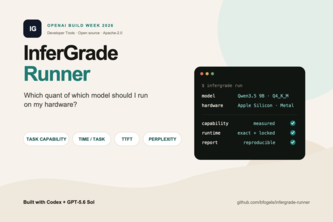
InferGrade Runner is a self-reported tool for benchmarking quantized GGUF models on local hardware. The author, Brian Fogelson, describes it as an automated capability benchmark that runs models directly on users' machines and reports performance metrics such as time per task, perplexity, TTFT, and memory use. It supports Apple Silicon with native llama.cpp + Metal acceleration, and containerized paths for Nvidia/AMD GPUs.
What changed
The project evolved from a personal workflow tool into a public-facing product during the OpenAI 2026 hackathon. The author reports using GPT-5.6 (via Codex) to refactor code, implement fixes, add tests, and prepare releases over a short period (July 13–21). This included architectural improvements like signed runtime catalogs, immutable runtime locks, and checkpointing for long-running benchmarks.
Single most important open question
Is there any evidence of traction, adoption, or usage beyond the author’s own development and testing?
What The Product Actually Is
The description states that InferGrade Runner:
- Runs quantized GGUF models on local hardware.
- Measures performance metrics including time per task, time to first token (TTFT), generation speed, memory use, and perplexity.
- Produces Markdown reports and structured result bundles for user review.
- Supports Apple Silicon natively with llama.cpp + Metal acceleration.
- Uses Docker containers for benchmarking on Nvidia/AMD GPUs.
- Is built primarily in Python and Rust, with a Tauri desktop app interface.
Inference The tool appears to be a local benchmarking utility aimed at developers working with local LLMs. It is not described as a marketplace or platform but rather as a self-contained tool for evaluating model performance on specific hardware.
Positioning & Claim Evolution
The author claims:
- Local models are important for developer workflows, especially for offline work and avoiding API costs.
- Choosing which quantized version of a model to run remains difficult due to lack of reliable local benchmarks.
- Existing benchmarks (e.g., Open LLM Leaderboard) do not answer the question: “Which quant of which model should I run on my hardware?”
- InferGrade Runner bridges this gap by running actual models locally and reporting real-world performance.
Inference The positioning is focused on solving a niche problem in local LLM usage — helping developers make informed decisions about quantization choices based on their hardware. It is positioned as a utility, not a platform or marketplace.
Target Customer & ICP
The description states:
- The tool targets developers who work with local models.
- These users may be concerned with offline access, cost control, and performance tradeoffs.
- The author mentions that he often relies on Reddit posts and Hugging Face notes to make decisions — suggesting a user base that is technically savvy but not necessarily enterprise or large-scale.
Inference The ICP likely includes individual developers or small teams using local LLMs for research, prototyping, or development. There is no indication of enterprise customers or B2B adoption.
Business Model & Pricing Evidence
Not evidenced.
Explanation
There is no mention of pricing, monetization strategy, or business model in the description. The project is described as open-source (Apache-2.0 licensed) and publicly available on Devpost.
Technical & Delivery Signals
The description states:
- Built with Python, Rust, Tauri, Docker, llama.cpp, Hugging Face, GPT-5.6 (via Codex), and other technologies.
- The tool migrated from Python to Rust for easier installation and dependency management.
- Uses JSON schemas to define result formats.
- Implements checkpointing, runtime identity locking, signed catalogs, and immutable runtimes.
- Supports Apple Silicon natively with Metal acceleration; containerized paths for Nvidia/AMD.
Inference The technical stack suggests a mature, well-thought-out tool that balances ease of use with performance. The use of GPT-5.6 in development indicates an experimental or iterative approach to building and refining the product.
Traction & Maturity Signals
Not evidenced.
Explanation
There is no evidence of revenue, customers, user base, or adoption beyond the author’s own development and testing. The project was submitted to a hackathon and is described as public and open-source, but there are no metrics or usage data provided.
Competitive Context
The description mentions:
- Projects like the Open LLM Leaderboard and Artificial Analysis as inspirations.
- These benchmarks focus on general capability comparisons rather than local hardware performance.
- InferGrade Runner fills a gap by providing local, hardware-specific benchmarking.
Inference It competes with general-purpose LLM benchmarking tools but focuses specifically on local model evaluation. The competitive landscape includes open-source and commercial benchmarking platforms, though none are named directly.
Open Questions & Risks
- No traction or adoption evidence: The tool is described as a personal project that evolved during a hackathon; no signs of real-world usage.
- Self-reported only: All claims are unverified and based on the author’s own account.
- Limited hardware support: Only Apple Silicon has native acceleration; other platforms rely on containers, which may limit usability.
- Unclear scalability or long-term vision: The author notes that “the next goal is to make the first successful run boring,” implying a focus on usability over scale.
Questions the description leaves open
- What are the actual performance differences between quantizations you've tested, and how do they vary across hardware?
- How does InferGrade Runner handle model compatibility issues or runtime errors during benchmarking?
- Are there any plans to expand beyond Apple Silicon or add support for Windows environments?
- Has the tool been used by others outside of your own development environment?
- What is the long-term roadmap for the project, and how do you plan to sustain it?
Overall Assessment
Not evidenced.
Explanation
There is no evidence of revenue, funding, or commercial traction to support an investment or partnership decision. The project is described as a personal tool that evolved during a hackathon, with no indication of market demand or business model beyond open-source availability. Any potential for investment or partnership would require further due diligence into user adoption, scalability, and monetization strategy.
User Stories BotA demo video on every pull request
Get a demo video on every new feature
GitHub App that watches your pull requests and records a narrated, captioned demo.
Save time on demo prep and make informed decisions faster with a video walkthrough of every new feature.
Source
Submitted to the OpenAI 2026 hackathon on Devpost. Project home on Devpost. Back to the full gallery on Devpost.
This competitive analysis was produced by top-founders.com (opens in a new tab)
Generated by a language model from this project's public Devpost page — its tagline, the author's own write-up and any built-with tags listed there — as captured in August 2026. Short quotations are the author's words. It is an opinion on the idea as a business, not on the people behind it, and it reflects the description as published then. If the project has moved on, request a correction below. The analysis is not independent research and contains no verified traction, revenue or customer data.
An independent guide by KFG International LLC — not affiliated with, endorsed by, or connected to Devpost or OpenAI.