

Archive position — measured, not model output
0 likes on Devpost
2,263 of the 7,850 archived projects have more likes, and 5,587 share exactly 0 — so this project's #7,112 place in the like-ranked listing is a tie-break inside that group, not a ranking.
Projects (log scale)
Likes on Devpost. ▲ marks this project's group.
Show the figures
| Likes | Projects | Share of archive |
|---|---|---|
| 0 | 5,587 | 71.2% |
| 1 | 1,758 | 22.4% |
| 2 | 284 | 3.6% |
| 3–4 | 132 | 1.7% |
| 5–9 | 75 | 1.0% |
| 10+ | 14 | 0.2% |
 User Stories BotA demo video on every pull request
Get a demo video on every new feature
GitHub App that watches your pull requests and records a narrated, captioned demo.
Save time on demo prep and make informed decisions faster with a video walkthrough of every new feature.
Executive Summary
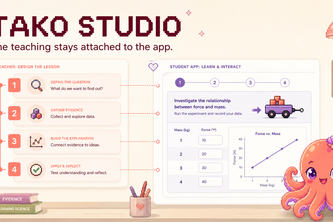
What the company appears to be: Tako Studio is a self-reported educational tool that enables users to build interactive learning applications from evidence using generative AI. The product is described as an "agentic canvas" that visualizes and connects learning science, design decisions, UI/UX, and student use data in one workspace.
What changed: The author reports building a prototype over 24 hours during a hackathon, using AI agents (Codex and GPT-5.6) to generate and review the system. It evolved from a static HTML prototype into a working system with visual design, UI preview, and student observation logging.
Single most important open question: Is there evidence of traction or adoption beyond the author's own use and development?
What The Product Actually Is
The description states that Tako Studio is "an agentic canvas for building pedagogically grounded interactive applications." It builds a "visible chain" from evidence → learning principle → pedagogical decision → interaction → generated UI → student observation → next design decision.
The system includes:
- A visual workspace where users can inspect how evidence becomes an application
- A preview of the resulting interface beside the reasoning that produced it
- Logging for intended learning interactions (student paths, answers, stops, explanations)
- Integration of student use data back into the original canvas for analysis and evolution
The author describes Tako as a "visual evidence and alignment layer for educational vibe coding."
Evidence: The description states this is an agentic canvas that visualizes and connects learning science, design decisions, UI/UX, and student use data in one workspace.
Inference: The system appears to be built around the concept of "evidence-aware design" where pedagogical theory is made executable through a visual interface.
Positioning & Claim Evolution
The author states that Tako Studio aims to:
- Let educators and researchers "stop being consumers of standardized EdTech and become creators of tools grounded in their own students, evidence, and judgment"
- Make the science "cheap to construct and validate" so human attention can return to the art: relationships, presence, contextual decisions
- Enable "human–AI collaboration paradigm" where expertise can be delegated and orchestrated without surrendering human agency
The positioning evolved from:
- A static HTML prototype (before Build Week)
- To a working prototype with visual canvas, UI preview, and student logging
- To a system that allows users to inspect how evidence becomes an application and participate in design decisions
Evidence: The description states Tako Studio is "an agentic canvas for building pedagogically grounded interactive applications" and aims to make "the science cheap to construct and validate."
Inference: The positioning appears to be shifting from a tool for solo developers to one that supports collaborative, evidence-based educational design.
Target Customer & ICP
The description states Tako Studio is intended for:
- Teachers
- Researchers
- EdTech product managers
- Learning designers
It also mentions that the system is not only for teachers but also for researchers who can operationalize theoretical constructs, and EdTech PMs who can connect requirements to learning mechanisms.
Evidence: The description states that Tako Studio is for educators, researchers, EdTech PMs, and learning designers.
Inference: The target customer appears to be professionals in education technology who want to build interactive applications grounded in evidence-based pedagogy.
Business Model & Pricing Evidence
Not evidenced. The description does not contain any information about pricing, monetization, or business model.
Evidence: No mention of pricing, revenue streams, or business model.
Inference: There is no indication of how the product would be monetized or whether it's intended to be a commercial offering.
Technical & Delivery Signals
The system was built using:
- Codex and GPT-5.6
- Next.js, React, TypeScript
- OpenAI Responses API, Structured Outputs
- PostgreSQL database
- Vercel for deployment
Key technical features include:
- Visual canvas that connects evidence to design decisions
- UI preview within the same workspace
- Student logging and observation data flow back into the canvas
- Sub-agents for expert review (learning-science reviewer, product critic, etc.)
- 46 focused tests covering places where logic could be distorted or trust could break
Evidence: The description lists the technologies used and describes how AI agents were used to build and review the system.
Inference: The technical approach suggests a hybrid human-AI development workflow with strong emphasis on alignment and traceability.
Traction & Maturity Signals
Not evidenced. The description does not contain any information about:
- Revenue
- Customers
- Adoption metrics
- Product usage data
- Market traction
The author mentions building more than twenty applications over three years, but these are described as personal projects, not commercial products with users.
Evidence: No mention of revenue, customers, or adoption metrics.
Inference: The product appears to be in early development stage, likely a prototype or proof-of-concept rather than a mature product with market traction.
Competitive Context
Not evidenced. The description does not contain any information about:
- Competitors
- Market positioning
- Competitive advantages
- Industry landscape
Evidence: No mention of competitors or market context.
Inference: There is no indication of how Tako Studio fits into the broader educational technology ecosystem or what its competitive position might be.
Open Questions & Risks
- Lack of traction evidence: The product appears to be a prototype with no demonstrated market adoption or user base.
- Solo builder risk: Only one team member is mentioned (ywEdAi Wang), which raises questions about scalability and long-term development capacity.
- Unverified claims: All information is self-reported and unverified, including the effectiveness of the system.
- Limited commercial viability: No evidence of pricing, revenue, or business model.
- AI dependency risk: Heavy reliance on AI agents (Codex, GPT-5.6) may create risks if those tools change or become unavailable.
Evidence: The description is entirely self-reported with no external validation or traction data.
Inference: The lack of any commercial evidence suggests this is likely an experimental or personal project rather than a scalable business opportunity.
Questions the description leaves open
- What specific educational outcomes have you observed from using Tako Studio?
- How do you plan to validate that the pedagogical decisions made in the system actually improve learning?
- Can you demonstrate how the system handles edge cases or unexpected user behavior?
- What is your roadmap for scaling beyond a single developer's use case?
- How do you intend to monetize this product, and what market research supports that approach?
- What are the key assumptions about AI alignment that underpin your system design?
- How does Tako Studio handle data privacy and student information security?
Evidence: These questions address gaps in the self-reported description.
Inference: These questions aim to uncover whether the claims made in the description can be substantiated with real-world evidence.
Overall Assessment
Not evidenced. The description does not contain any information about:
- Valuation
- Funding rounds
- Investment interest
- Partnership opportunities
The author states that this is a hackathon project and that they have "never experienced being led astray by the AI" but provides no evidence of commercial viability or market readiness.
Evidence: No mention of investment, funding, or partnership status.
Inference: Based on the lack of traction, revenue, or business model information, there is insufficient evidence to support an investment or partnership decision at this stage.
User Stories BotA demo video on every pull request
Get a demo video on every new feature
GitHub App that watches your pull requests and records a narrated, captioned demo.
Save time on demo prep and make informed decisions faster with a video walkthrough of every new feature.
Source
Submitted to the OpenAI 2026 hackathon on Devpost. Project home on Devpost. Back to the full gallery on Devpost.
This competitive analysis was produced by top-founders.com (opens in a new tab)
Generated by a language model from this project's public Devpost page — its tagline, the author's own write-up and any built-with tags listed there — as captured in August 2026. Short quotations are the author's words. It is an opinion on the idea as a business, not on the people behind it, and it reflects the description as published then. If the project has moved on, request a correction below. The analysis is not independent research and contains no verified traction, revenue or customer data.
An independent guide by KFG International LLC — not affiliated with, endorsed by, or connected to Devpost or OpenAI.