

Archive position — measured, not model output
0 likes on Devpost
2,263 of the 7,850 archived projects have more likes, and 5,587 share exactly 0 — so this project's #7,109 place in the like-ranked listing is a tie-break inside that group, not a ranking.
Projects (log scale)
Likes on Devpost. ▲ marks this project's group.
Show the figures
| Likes | Projects | Share of archive |
|---|---|---|
| 0 | 5,587 | 71.2% |
| 1 | 1,758 | 22.4% |
| 2 | 284 | 3.6% |
| 3–4 | 132 | 1.7% |
| 5–9 | 75 | 1.0% |
| 10+ | 14 | 0.2% |
 User Stories BotA demo video on every pull request
Get a demo video on every new feature
GitHub App that watches your pull requests and records a narrated, captioned demo.
Save time on demo prep and make informed decisions faster with a video walkthrough of every new feature.
Executive Summary
What the company appears to be
TailTrail is a self-reported local-first control layer for AI-assisted coding, built as a demo for the OpenAI 2026 hackathon. It positions itself as a structured workflow tool that guides Codex through planning, context narrowing, approval, change, testing, review and evidence generation. The author states it is not meant to replace existing tools like tests, CI or human review but instead to make AI-assisted coding more focused, reviewable and trustworthy.
What changed
The project began as a small workflow guidance tool and evolved into what the author describes as a "broader local toolchain for planning, graphing, validation, review, reporting, evaluation, and safer AI-assisted development". It includes features like navigator-first planning, code graphing, guardrails, focused validation and evidence labeling.
Single most important open question
Is there any evidence of real-world usage or adoption beyond the hackathon demo? The description contains no data on customers, revenue, traction or product-market fit beyond the author's own claims.
What The Product Actually Is
The description states that TailTrail is a local, approval-first development control layer for Codex. It helps developers move through a workflow involving:
- Task
- Navigator plan
- Focused context
- Approval
- Change
- Test
- Review
- Evidence
Key capabilities include:
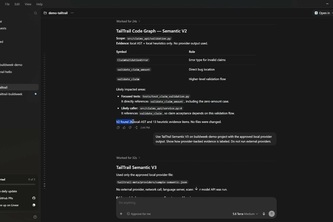
- Navigator-first planning so Codex starts by understanding the task instead of editing immediately.
- Code Graph mapping to identify relevant symbols, callers, and likely tests before changing code.
- Focused context to keep small changes small and avoid broad repository reads.
- Guardrails and local policy to preserve validation, dependency discipline, safety checks, and project conventions.
- Focused validation so the workflow proves the requested behavior before claiming success.
- Requirement-aware review that checks whether the implementation actually solves the original problem.
- Evidence labels that distinguish estimates, local evidence, and measured telemetry.
- Evaluation Harness scenarios that make the Build Week demo repeatable through local saved-artifact proof.
The author also notes it was built using Codex and GPT-5.6, with a core principle of keeping AI-assisted development structured without becoming heavy.
Inference TailTrail appears to be a prototype or proof-of-concept tool aimed at improving how AI agents interact with codebases in a controlled, reviewable way. It is not described as a commercial product or platform.
Positioning & Claim Evolution
The author states TailTrail is "not about forcing the AI to be perfect—it’s about giving it a clean, structured way in." The positioning emphasizes structure and control over automation, aiming to make AI-assisted coding more reliable without slowing down developers.
It started as a simple idea: "give Codex a clearer way into a codebase", evolving into a broader toolchain for AI-assisted development workflows. It is described as a "local-first control layer" that supports planning, graphing, validation, review, reporting, and evaluation.
The author claims TailTrail:
- Guides Codex through a small claims-service bug fix
- Keeps the workflow grounded in real source code and validation
- Makes the demo replayable and inspectable
- Is built to make AI-assisted coding more focused, reviewable, and trustworthy
Inference TailTrail's positioning has evolved from a narrow workflow helper to a broader framework for managing AI-assisted development. However, there is no evidence of how this evolved positioning was tested or validated outside the hackathon context.
Target Customer & ICP
The description states TailTrail is designed for developers working with Codex, particularly those who want to:
- Keep planning separate from implementation approval
- Use AI-assisted coding in a more controlled and reviewable way
- Maintain privacy and safety boundaries through local-first practices
It is not described as targeting enterprise customers or teams, nor does it specify any particular industry or use case beyond developer tooling.
Inference The primary user base appears to be individual developers using Codex for AI-assisted coding. The ICP is likely narrow—early adopters of AI tools in software development who value structure and control over full automation.
Business Model & Pricing Evidence
There is no evidence provided regarding any business model or pricing strategy. The description focuses entirely on the technical aspects and workflow design, without mentioning monetization, licensing, subscriptions, or sales channels.
Inference No commercial information was shared; this remains unknown.
Technical & Delivery Signals
TailTrail is built using:
- Codex
- GPT-5.6
- AST-based code graphing
- CLI tools
- Local-first architecture
- Plugin profiles for integration with Codex workflows
It includes features such as:
- Navigator-first planning
- Code graph mapping to find relevant files and tests
- Focused context limiting
- Guardrails and policy guidance
- Evaluation harness scenarios
- Evidence labels distinguishing estimates, local evidence, and telemetry
The author notes that installation was made practical for Codex users, not just idealistic.
Inference TailTrail is a technical prototype built around developer tooling and AI integration. It uses modern tools like AST parsing and LLMs but lacks any indication of scalability or production deployment.
Traction & Maturity Signals
There is no evidence of traction, revenue, customers, or adoption beyond the hackathon submission. The project is described as a demo with no mention of usage metrics, user feedback, or product iteration history outside the Build Week event.
The author mentions:
- A roadmap showing how it evolved from small workflow guidance to a broader toolchain
- A deterministic evaluation harness scenario for judges to replay
But these are not indicators of real-world traction or maturity.
Inference TailTrail is at a very early stage—likely a prototype or proof-of-concept. No signs of product-market fit, customer engagement, or commercial viability are evident.
Competitive Context
There is no evidence provided about competitors or competitive positioning. The description does not reference other tools in the AI-assisted coding space, nor does it compare TailTrail to existing solutions like GitHub Copilot, Tabnine, or similar platforms.
Inference No competitive analysis or differentiation strategy was shared; this remains unknown.
Open Questions & Risks
- Lack of traction: No evidence of real-world usage or adoption beyond a hackathon demo.
- Unproven commercial viability: No business model, pricing, or revenue data.
- Limited scope: The tool is described as a workflow control layer, not a full-fledged platform or product.
- No third-party validation: Everything is self-reported and unverified.
- Unclear path to market: No indication of how the project would scale beyond a single developer’s use case.
Inference TailTrail is a conceptually interesting idea but lacks any evidence of traction, scalability, or commercial readiness. It may be a valuable research prototype, but it does not yet demonstrate product-market fit or investment potential.
Questions the description leaves open
- What specific problems in AI-assisted coding are you trying to solve, and how do you know they matter?
- Have you tested TailTrail with real developers beyond the hackathon?
- How does TailTrail integrate into existing workflows? Is it designed for individual use or team collaboration?
- What is your plan for scaling beyond a single developer’s workflow?
- Are there any early adopters or pilot users who have provided feedback?
- Do you have plans to monetize or commercialize this tool?
- How do you intend to measure success beyond the demo?
- What are the biggest technical challenges in making TailTrail production-ready?
Overall Assessment
Not evidenced.
The description provides no data on financials, traction, customer base, or market opportunity that would support an investment or partnership decision. The project is presented as a hackathon demo with no indication of commercial viability or product-market fit.
This is a conceptual prototype, not a product ready for investment or strategic partnership. Any potential value lies in its underlying ideas and future development, but there is no evidence of current traction or scalability.
Confidence level Low — based entirely on self-reported claims with no external validation or data.
User Stories BotA demo video on every pull request
Get a demo video on every new feature
GitHub App that watches your pull requests and records a narrated, captioned demo.
Save time on demo prep and make informed decisions faster with a video walkthrough of every new feature.
Source
Submitted to the OpenAI 2026 hackathon on Devpost. Project home on Devpost. Back to the full gallery on Devpost.
This competitive analysis was produced by top-founders.com (opens in a new tab)
Generated by a language model from this project's public Devpost page — its tagline, the author's own write-up and any built-with tags listed there — as captured in August 2026. Short quotations are the author's words. It is an opinion on the idea as a business, not on the people behind it, and it reflects the description as published then. If the project has moved on, request a correction below. The analysis is not independent research and contains no verified traction, revenue or customer data.
An independent guide by KFG International LLC — not affiliated with, endorsed by, or connected to Devpost or OpenAI.