

Archive position — measured, not model output
0 likes on Devpost
2,263 of the 7,850 archived projects have more likes, and 5,587 share exactly 0 — so this project's #7,110 place in the like-ranked listing is a tie-break inside that group, not a ranking.
Projects (log scale)
Likes on Devpost. ▲ marks this project's group.
Show the figures
| Likes | Projects | Share of archive |
|---|---|---|
| 0 | 5,587 | 71.2% |
| 1 | 1,758 | 22.4% |
| 2 | 284 | 3.6% |
| 3–4 | 132 | 1.7% |
| 5–9 | 75 | 1.0% |
| 10+ | 14 | 0.2% |
 User Stories BotA demo video on every pull request
Get a demo video on every new feature
GitHub App that watches your pull requests and records a narrated, captioned demo.
Save time on demo prep and make informed decisions faster with a video walkthrough of every new feature.
Executive Summary
What the company appears to be
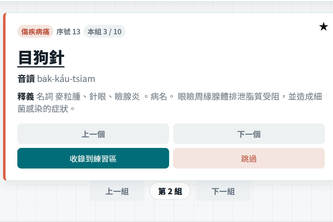
TâiMed is an AI-powered educational tool designed to help Mandarin-speaking medical students and young clinicians learn Taiwanese (Tâi-gí) vocabulary relevant to patient care. It is described as a learning companion focused on clinical terminology, not a translation or decision-support tool.
What changed
The project was submitted as part of the OpenAI 2026 hackathon. The author states that it began with a question about how language barriers affect patient-clinician communication in Taiwan and evolved into an interactive vocabulary-learning platform.
Single most important open question
Is there evidence of real-world usage or feedback from medical students, clinicians, or Taiwanese-speaking patients to validate the relevance and utility of its content?
What The Product Actually Is
The description states that TâiMed is:
- An interactive Taiwanese medical-vocabulary learning tool
- For Mandarin-speaking medical students and young clinicians
- Built using Next.js, React, TypeScript, and other web technologies
- Designed to help users learn 790 terms in two categories: body-structure (407) and illness-and-pain (383)
- Uses an active-recall flashcard workflow for practice
- Allows learners to mark familiar terms or add them to a personal queue
- Provides access to Ministry of Education Taiwan Language Dictionary entries
- Offers optional ChatGPT sign-in and progress persistence
It is described as:
- Not a clinical decision-support system
- Not a translation service
- A tool for preparing for patient interactions, not replacing them
Inference The product appears to be a web-based, self-contained learning app with minimal backend infrastructure, likely built in a short timeframe.
Positioning & Claim Evolution
The author states:
- TâiMed was inspired by the gap between patient language (Taiwanese) and clinician training (Mandarin)
- It aims to make language more approachable before clinical conversations begin
- The goal is to support patient-centred care through better communication
- It positions itself as a learning companion, not a diagnostic or translation tool
Inference TâiMed’s positioning evolved from a problem-solving idea (language barrier) into a practical educational solution, emphasizing humility and source transparency.
Target Customer & ICP
The description states:
- Primary users: Mandarin-speaking medical students and young clinicians
- Secondary context: Older adults who speak Taiwanese and may be patients
Inference The core customer is likely a subset of medical education or training programs in Taiwan, possibly including universities or clinical institutions.
Business Model & Pricing Evidence
The description states:
- No pricing information is provided
- Progress can be saved with optional ChatGPT sign-in
- It is described as an educational companion, not a commercial product
- The app allows guest access without requiring sign-up
Inference There is no evidence of monetization or business model. It appears to be a prototype or educational tool, possibly intended for internal use or demonstration.
Technical & Delivery Signals
The description states:
- Built with Next.js, React, TypeScript, vinext, Vite
- Uses OpenAI Codex for rapid iteration
- Vocabulary dataset is stored as a local TSV file
- Links each term to the Ministry of Education Taiwan Language Dictionary
- Interface designed around a simple decision: “Do I know this, or do I need to practise it?”
- Supports guest access, with optional ChatGPT integration
Inference The tech stack suggests a lightweight, frontend-heavy application. The use of open-source tools and AI for development indicates a rapid prototyping approach.
Traction & Maturity Signals
The description states:
- It is a shipped, usable learning experience
- It was submitted to the OpenAI 2026 hackathon
- No data on user engagement or adoption is provided
- The team size is listed as 1 person
Inference There is no evidence of traction, users, or real-world deployment beyond its submission to a hackathon. The product is likely in early-stage development.
Competitive Context
The description does not mention any competitors.
Inference No competitive landscape is evident from the provided text. It’s unclear whether similar tools exist for medical language learning or vocabulary practice in Taiwan.
Open Questions & Risks
- No evidence of real-world usage or feedback: The product is described as a hackathon submission with no mention of adoption by students, clinicians, or patients.
- Single-founder team: With only one member listed, there are risks around scalability and execution.
- No monetization strategy: No indication of how the tool would be funded or scaled beyond its current form.
- Limited scope: The focus is on vocabulary only; future plans include communication practice, but no evidence of progress in that direction.
Questions the description leaves open
- What is the source of the 790 vocabulary terms? Are they vetted by medical professionals or language experts?
- Have you tested this with actual medical students or clinicians in Taiwan?
- How do you plan to scale beyond a single developer and a hackathon prototype?
- Is there any feedback from older adults who speak Taiwanese and are patients?
- What is the long-term vision for monetization or sustainability?
- Are there any partnerships or institutional ties with medical schools or health institutions in Taiwan?
Overall Assessment
The description states that TâiMed is a hackathon submission, not a commercial product, and lacks evidence of traction, revenue, or customer feedback.
Inference At this stage, it is more of an idea or prototype than a viable business. It may have potential as an educational tool or pilot for future development, but there is no evidence to support investment or partnership at this time.
User Stories BotA demo video on every pull request
Get a demo video on every new feature
GitHub App that watches your pull requests and records a narrated, captioned demo.
Save time on demo prep and make informed decisions faster with a video walkthrough of every new feature.
Source
Submitted to the OpenAI 2026 hackathon on Devpost. Project home on Devpost. Back to the full gallery on Devpost.
This competitive analysis was produced by top-founders.com (opens in a new tab)
Generated by a language model from this project's public Devpost page — its tagline, the author's own write-up and any built-with tags listed there — as captured in August 2026. Short quotations are the author's words. It is an opinion on the idea as a business, not on the people behind it, and it reflects the description as published then. If the project has moved on, request a correction below. The analysis is not independent research and contains no verified traction, revenue or customer data.
An independent guide by KFG International LLC — not affiliated with, endorsed by, or connected to Devpost or OpenAI.