

Archive position — measured, not model output
0 likes on Devpost
2,263 of the 7,850 archived projects have more likes, and 5,587 share exactly 0 — so this project's #3,185 place in the like-ranked listing is a tie-break inside that group, not a ranking.
Projects (log scale)
Likes on Devpost. ▲ marks this project's group.
Show the figures
| Likes | Projects | Share of archive |
|---|---|---|
| 0 | 5,587 | 71.2% |
| 1 | 1,758 | 22.4% |
| 2 | 284 | 3.6% |
| 3–4 | 132 | 1.7% |
| 5–9 | 75 | 1.0% |
| 10+ | 14 | 0.2% |
 User Stories BotA demo video on every pull request
Get a demo video on every new feature
GitHub App that watches your pull requests and records a narrated, captioned demo.
Save time on demo prep and make informed decisions faster with a video walkthrough of every new feature.
Executive Summary
What the company appears to be
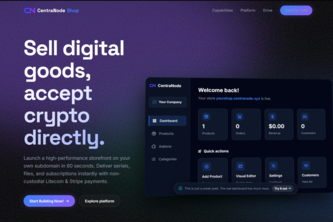
Centranode-shop is a self-reported digital marketplace platform for indie creators to sell digital products. The author states it supports Stripe and cryptocurrency payments, custom domains, and multi-tenant architecture. It was built by one person using PHP, Node.js, MySQL, and AI coding agents over months.
What changed
The project was submitted as part of the OpenAI 2026 hackathon. The author describes building a functional prototype with core features like crypto payments, domain provisioning, and multi-tenancy in a short timeframe, using AI-assisted development.
Single most important open question
Is there any evidence of actual users or revenue generation beyond the author’s self-reported build?
What The Product Actually Is
The description states that Centranode-shop is “a digital marketplace for you to sell your digital products!” It claims to support Stripe and cryptocurrency payments, custom domains (via Cloudflare), and digital product delivery. The platform allows users to set up their shop in 30 seconds and offers a drag-and-drop storefront editor.
The author says it was built using PHP, Node.js, MySQL, Nginx, Cloudflare, Stripe Connect, Alchemy, Libsodium, and AI coding agents (Codex CLI). It is described as a multi-tenant system with automatic custom domain provisioning and secure crypto checkout across multiple blockchains.
Evidence
- The author states the platform supports digital product sales.
- It includes features like Stripe and crypto payments.
- Custom domains are supported via Cloudflare.
- Multi-tenancy and real tenant isolation are claimed.
- Drag-and-drop editor is mentioned.
- AI agents were used in development.
Inference The system appears to be a SaaS-style storefront with infrastructure for hosting, payment processing, and domain management. However, no evidence of actual user adoption or product functionality beyond the author’s account exists.
Positioning & Claim Evolution
The project is positioned as an alternative to expensive marketplace platforms or self-built solutions. The author claims it allows creators to launch a shop quickly without fees, complicated setup, or reliance on large platforms.
Evidence
- “Indie creators selling digital products often have to choose between expensive platforms or building everything themselves.”
- “It takes only 30 seconds for you to setup your shop.”
- “You have free will on how you build your shop like you run and build it yourself without big fees and complicated setup.”
Inference The positioning is that of a low-cost, self-service SaaS platform aimed at indie creators. The evolution of claims focuses on ease-of-use, cost-efficiency, and flexibility in building shops.
Target Customer & ICP
The author states the platform is for “indie creators selling digital products.” It is described as a solution for those who want to avoid expensive platforms or the complexity of building from scratch.
Evidence
- “Indie creators selling digital products”
- “Anyone to sell digital products without additional fees”
Inference The ICP appears to be small-scale digital product sellers, likely freelancers or solo entrepreneurs. No segmentation beyond this is evident.
Business Model & Pricing Evidence
There is no evidence of pricing structure, monetization model, or revenue streams in the description. The author claims there are “no additional fees” and that users have “free will on how you build your shop,” but does not specify if the platform charges for access, usage, or features.
Evidence
- “No additional fees”
- “You have free will on how you build your shop like you run and build it yourself without big fees”
Inference The business model is unclear. It may be freemium, subscription-based, or ad-supported, but no details are provided.
Technical & Delivery Signals
The platform was built using PHP, Node.js, MySQL, Nginx, Cloudflare, Stripe Connect, Alchemy, Libsodium, and AI coding agents (Codex CLI). It supports multi-tenant architecture, secure crypto checkout, and automatic domain provisioning.
Evidence
- Built with: PHP, Node.js, MySQL, Nginx, Cloudflare, Stripe Connect, Alchemy, Libsodium
- Multi-tenant architecture
- Crypto payment support across multiple blockchains
- Custom domain provisioning via Cloudflare
- Drag-and-drop editor
Inference The technical stack suggests a modern SaaS platform with infrastructure for payments, domains, and multi-tenancy. However, no evidence of production deployment or scalability is provided.
Traction & Maturity Signals
There is no evidence of traction, customers, revenue, or user adoption beyond the author’s own account. The project was submitted to a hackathon and is described as a prototype built in months.
Evidence
- Submitted to OpenAI 2026 hackathon
- Built by one person (Ashton Huntley)
- No mention of users, customers, or revenue
Inference The product is at a very early stage. It may be a proof-of-concept or prototype with no commercial traction.
Competitive Context
No direct competitors are named in the description. However, the positioning implies it competes with platforms like Gumroad, Etsy, Shopify, or other marketplace solutions for digital products.
Evidence
- “Indie creators selling digital products often have to choose between expensive platforms or building everything themselves.”
Inference It likely competes with low-cost or self-hosted alternatives. The lack of competitor names or market positioning is not evidenced.
Open Questions & Risks
- No traction or revenue: No evidence of users, customers, or monetization.
- Unverified claims: All features and functionality are self-reported.
- Single-person build: No team or external support implies limited scalability.
- AI-assisted development: While novel, it’s unclear how this impacts product quality or long-term maintainability.
- No infrastructure details: No mention of monitoring, security, or deployment practices beyond basic tools.
Inference The project is unproven in the market and may not have a sustainable path to growth without further validation.
Questions the description leaves open
- What is your actual user base or any early adopters?
- How do you plan to monetize the platform?
- What are the technical challenges you’ve faced in scaling beyond the prototype?
- Have you conducted any market research or customer interviews?
- What is your roadmap for moving from a hackathon project to a viable product?
Overall Assessment
Not evidenced.
The description provides no data on revenue, customers, traction, or business model validation. It is a self-reported prototype built by one person in a hackathon context. No evidence supports the commercial viability or scalability of Centranode-shop.
Confidence Low This analysis is based entirely on a single author’s account, with no external verification or data to support claims of traction, revenue, or product-market fit.
User Stories BotA demo video on every pull request
Get a demo video on every new feature
GitHub App that watches your pull requests and records a narrated, captioned demo.
Save time on demo prep and make informed decisions faster with a video walkthrough of every new feature.
Source
Submitted to the OpenAI 2026 hackathon on Devpost. Project home on Devpost. Back to the full gallery on Devpost.
This competitive analysis was produced by top-founders.com (opens in a new tab)
Generated by a language model from this project's public Devpost page — its tagline, the author's own write-up and any built-with tags listed there — as captured in August 2026. Short quotations are the author's words. It is an opinion on the idea as a business, not on the people behind it, and it reflects the description as published then. If the project has moved on, request a correction below. The analysis is not independent research and contains no verified traction, revenue or customer data.
An independent guide by KFG International LLC — not affiliated with, endorsed by, or connected to Devpost or OpenAI.