

Archive position — measured, not model output
0 likes on Devpost
2,263 of the 7,850 archived projects have more likes, and 5,587 share exactly 0 — so this project's #7,100 place in the like-ranked listing is a tie-break inside that group, not a ranking.
Projects (log scale)
Likes on Devpost. ▲ marks this project's group.
Show the figures
| Likes | Projects | Share of archive |
|---|---|---|
| 0 | 5,587 | 71.2% |
| 1 | 1,758 | 22.4% |
| 2 | 284 | 3.6% |
| 3–4 | 132 | 1.7% |
| 5–9 | 75 | 1.0% |
| 10+ | 14 | 0.2% |
 User Stories BotA demo video on every pull request
Get a demo video on every new feature
GitHub App that watches your pull requests and records a narrated, captioned demo.
Save time on demo prep and make informed decisions faster with a video walkthrough of every new feature.
Executive Summary
What the company appears to be
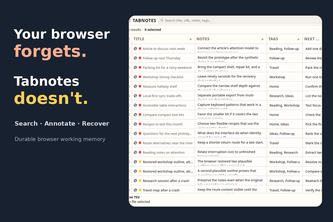
Tabnotes is a self-reported browser extension that aims to preserve tab context across browser sessions, allowing users to add notes, tags, and actions to tabs while maintaining local storage. It was built as part of an OpenAI 2026 hackathon submission.
What changed
The author reports building the tool from scratch in less than a month (starting July 13), using GPT-5.6 Sol in Codex CLI for development, and implementing features like local data persistence, side-panel UI, and tab recovery logic. The project is at v0.1.1 with 128 tests passing.
Single most important open question
Is there any evidence of user adoption or commercial traction beyond the author’s personal use case?
What The Product Actually Is
The description states that Tabnotes is a browser extension for Chrome or Edge, designed to preserve tab context across browser sessions. It provides:
- A searchable side-panel table (or standalone tab) listing all open tabs.
- Ability to add custom fields such as notes, tags, next actions, and priorities.
- Preservation of data across browser crashes and restarts.
- Local-only operation — no server communication or account required.
- Export options including JSON backup, TSV snapshot, or live TSV file.
It uses technologies like Manifest V3, IndexedDB, Chrome DevTools Protocol, and service workers. The author also mentions using GPT-5.6 Sol in Codex CLI to generate code from specifications.
Inference: Based on the self-reported build process, it appears to be a minimal viable product (MVP) focused on solving personal tab management issues rather than enterprise or large-scale use cases.
Positioning & Claim Evolution
The author states that Tabnotes was built as a personal experiment due to their own experience with having over 100 tabs open simultaneously. The core positioning is:
- “Your browser forgets. Tabnotes doesn’t.”
- It bridges the gap between bookmarks (too permanent) and tabs (too fragile).
- Emphasis on privacy, locality, and context preservation.
There is no indication of a broader market positioning or branding beyond this personal use case.
Claim vs Fact: The author claims Tabnotes solves a real problem for them, but there is no evidence of external validation or customer feedback.
Target Customer & ICP
The description does not provide any information about target customers or ideal customer profiles (ICP). It only describes the author’s own behavior:
- They usually have more than 100 tabs open.
- Some are research, some reminders, and others unresolved tasks.
No data on:
- Who else might use it
- Whether there is a segment of users beyond the founder
- Any persona or user journey described
Not evidenced: No evidence of target customer segments, personas, or usage patterns outside of the author’s own experience.
Business Model & Pricing Evidence
There is no mention of pricing, monetization strategy, or business model in the description. The extension is described as:
- Free to use
- Local-only operation
- No account required
- No data sent to servers
Not evidenced: No evidence of any revenue streams, subscriptions, or paid features.
Technical & Delivery Signals
The author reports:
- Built with Manifest V3, IndexedDB, service workers, and Chrome DevTools Protocol
- Used GPT-5.6 Sol in Codex CLI to generate code from rules-based specifications
- Implemented local data persistence, tab recovery logic, and UI components
- Passed 128 tests across eight suites
- Fixed issues related to performance (e.g., large table rendering) and race conditions
Inference: The technical implementation suggests a focused, developer-oriented MVP with attention to correctness and privacy. However, no evidence of scalability or production-grade infrastructure.
Traction & Maturity Signals
The project is at version v0.1.1, and the author reports:
- 128 passing tests
- A detailed build log including prompts and session IDs
- Fixes for performance and race conditions
However, there is no evidence of:
- User adoption or downloads
- Customer feedback or usage metrics
- Any form of market validation or traction beyond personal use
Not evidenced: No data on user base, retention, or engagement.
Competitive Context
The description does not mention any competitors. It only describes the author’s own motivations and solution.
Not evidenced: No competitive analysis, market positioning, or awareness of existing tab managers or browser tools.
Open Questions & Risks
- No external validation or traction — the product is described as a personal experiment with no evidence of adoption.
- Single-person team — only one member (Anand S) involved in development.
- Self-reported only — all claims are unverified and lack third-party corroboration.
- Limited scope — built for personal use, not scalable or commercialized.
- No pricing or monetization model — unclear if the tool will ever be monetized.
Inference: This is a proof-of-concept or prototype, not a product with commercial viability or traction.
Questions the description leaves open
- What specific problem are you trying to solve for users beyond your own?
- How many people have tried this tool? Do you have any feedback from early adopters?
- Are there plans to expand beyond Chrome/Edge browsers or add cloud sync capabilities?
- What is the long-term vision for Tabnotes — is it intended as a commercial product or a personal utility?
- Have you considered how users might interact with the extension at scale, especially around performance and data handling?
Overall Assessment
This is a self-reported prototype built by one individual over a short period (less than a month) for personal use. There is no evidence of:
- Revenue
- Customers
- Traction
- Market validation
- Commercial strategy
Assessment: Not suitable for investment or partnership at this stage. It may evolve into something more substantial, but currently lacks any commercial due-diligence signals.
User Stories BotA demo video on every pull request
Get a demo video on every new feature
GitHub App that watches your pull requests and records a narrated, captioned demo.
Save time on demo prep and make informed decisions faster with a video walkthrough of every new feature.
Source
Submitted to the OpenAI 2026 hackathon on Devpost. Project home on Devpost. Back to the full gallery on Devpost.
This competitive analysis was produced by top-founders.com (opens in a new tab)
Generated by a language model from this project's public Devpost page — its tagline, the author's own write-up and any built-with tags listed there — as captured in August 2026. Short quotations are the author's words. It is an opinion on the idea as a business, not on the people behind it, and it reflects the description as published then. If the project has moved on, request a correction below. The analysis is not independent research and contains no verified traction, revenue or customer data.
An independent guide by KFG International LLC — not affiliated with, endorsed by, or connected to Devpost or OpenAI.