

Archive position — measured, not model output
0 likes on Devpost
2,263 of the 7,850 archived projects have more likes, and 5,587 share exactly 0 — so this project's #7,101 place in the like-ranked listing is a tie-break inside that group, not a ranking.
Projects (log scale)
Likes on Devpost. ▲ marks this project's group.
Show the figures
| Likes | Projects | Share of archive |
|---|---|---|
| 0 | 5,587 | 71.2% |
| 1 | 1,758 | 22.4% |
| 2 | 284 | 3.6% |
| 3–4 | 132 | 1.7% |
| 5–9 | 75 | 1.0% |
| 10+ | 14 | 0.2% |
 User Stories BotA demo video on every pull request
Get a demo video on every new feature
GitHub App that watches your pull requests and records a narrated, captioned demo.
Save time on demo prep and make informed decisions faster with a video walkthrough of every new feature.
Executive Summary
What the company appears to be
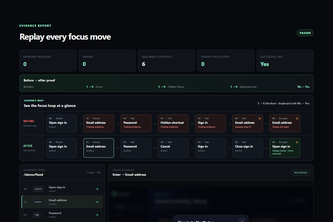
TabTrace is a developer tool that records keyboard accessibility journeys in real browsers, visualizes focus transitions, detects blockers with evidence, and generates Playwright regression tests and Codex fix briefings. It was built as a hackathon project by one person (Dennis Wisocki) during OpenAI Build Week.
What changed
The author states this is an MVP for a tool that records keyboard journeys rather than static scanning, and that it was developed using AI tools like Codex and GPT-5.6 to prototype and validate ideas.
The single most important open question
Is there any evidence of traction, revenue, or customer adoption beyond the author's own use case? The description does not state whether TabTrace has been used by other developers, teams, or organizations.
What The Product Actually Is
- The description states that TabTrace is a "visual flight recorder for keyboard accessibility."
- It records keyboard journeys in real browsers using Playwright Core and Chromium.
- It captures focus transitions, dialog states, and screenshots for each step.
- It generates:
- Portable JSON documents
- Playwright regression tests
- Codex fix briefings
- It includes a deterministic "jury mode" that compares broken and repaired interfaces.
- The tool runs locally without requiring accounts or cloud services.
Inference TabTrace appears to be a developer-focused accessibility testing tool, not a commercial product with customers or revenue. It is described as an MVP built for a hackathon.
Positioning & Claim Evolution
- The author states that static scanners miss keyboard barriers that are journeys rather than isolated elements.
- TabTrace aims to make those journeys "visible, reproducible, and useful to developers."
- It does not claim to certify complete WCAG compliance.
- It emphasizes that automation cannot replace human judgment but can provide evidence-backed insights.
Inference The positioning is that of a tool for developers to test accessibility more accurately than static scanners, with an emphasis on visual evidence and reproducibility. The author explicitly distances it from certification claims.
Target Customer & ICP
- The description states that TabTrace is intended for developers.
- It is designed to help developers understand keyboard accessibility issues in real browser environments.
- It generates artifacts (Playwright tests, Codex briefings) useful in development workflows.
Inference The target customer is likely frontend or accessibility engineers working on web applications. No evidence of specific team sizes, enterprise adoption, or user personas.
Business Model & Pricing Evidence
- The description states that TabTrace runs locally without an account, cloud service, API key, or build step.
- It includes a tested, installable Windows release.
- There is no mention of pricing, subscriptions, or monetization.
Inference No evidence of a commercial business model. The tool appears to be open-source or freeware for developers.
Technical & Delivery Signals
- Built with Node.js, Playwright Core, HTML5, CSS3, JavaScript.
- Uses browser-native accessibility and layout data.
- Generates portable JSON documents as the source of truth.
- Uses Codex and GPT-5.6 for prototyping and validation during development.
- The tool is deterministic and locally testable.
Inference The technical stack is developer-oriented and lightweight. It uses modern web tools and integrates with Playwright and AI tools, but no evidence of production-grade infrastructure or scalability.
Traction & Maturity Signals
- The project was built in a hackathon (OpenAI Build Week).
- It includes a tested, installable Windows release.
- It is described as an MVP.
- No evidence of revenue, customers, user base, or adoption beyond the author’s own use case.
Inference There is no evidence of traction or commercial maturity. The project appears to be a prototype with no known users or monetization.
Competitive Context
- The description mentions that static accessibility scanners can identify DOM-level problems but miss keyboard barriers.
- It contrasts its approach with "static scanners" and emphasizes the visual, journey-based nature of its tooling.
- No mention of competitors or market positioning beyond this contrast.
Inference TabTrace appears to target a niche within accessibility testing — specifically keyboard journeys — but there is no evidence of existing tools in that space or competitive analysis.
Open Questions & Risks
- The project is described as an MVP built by one person during a hackathon.
- No evidence of revenue, customers, or adoption.
- The tool is local-only and does not appear to be a commercial product.
- The author states that the tool was developed using AI tools but does not indicate whether it has been used in production or at scale.
Inference The biggest risk is that this is a prototype with no commercial traction. It may not have evolved into a product suitable for enterprise use or developer teams.
Questions the description leaves open
- What is the actual use case for TabTrace beyond your own development workflow?
- Have you tested it with other developers or teams? If so, what feedback did you get?
- Are there any plans to monetize or scale this tool beyond its current MVP?
- How does TabTrace handle edge cases in keyboard navigation that are not covered by the current implementation?
- What is the long-term vision for the tool — is it intended to be a standalone product or integrated into other workflows?
Overall Assessment
- The description states that this is an MVP built during a hackathon.
- There is no evidence of revenue, customers, or traction.
- It is described as a local tool with no cloud or API components.
- No commercial model or monetization strategy is evident.
Inference This project is not ready for investment or partnership at this stage. It is a prototype with no demonstrated market fit or commercial viability. The author's own account indicates it was built for experimentation, not productization.
User Stories BotA demo video on every pull request
Get a demo video on every new feature
GitHub App that watches your pull requests and records a narrated, captioned demo.
Save time on demo prep and make informed decisions faster with a video walkthrough of every new feature.
Source
Submitted to the OpenAI 2026 hackathon on Devpost. Project home on Devpost. Back to the full gallery on Devpost.
This competitive analysis was produced by top-founders.com (opens in a new tab)
Generated by a language model from this project's public Devpost page — its tagline, the author's own write-up and any built-with tags listed there — as captured in August 2026. Short quotations are the author's words. It is an opinion on the idea as a business, not on the people behind it, and it reflects the description as published then. If the project has moved on, request a correction below. The analysis is not independent research and contains no verified traction, revenue or customer data.
An independent guide by KFG International LLC — not affiliated with, endorsed by, or connected to Devpost or OpenAI.