

Archive position — measured, not model output
0 likes on Devpost
2,263 of the 7,850 archived projects have more likes, and 5,587 share exactly 0 — so this project's #7,102 place in the like-ranked listing is a tie-break inside that group, not a ranking.
Projects (log scale)
Likes on Devpost. ▲ marks this project's group.
Show the figures
| Likes | Projects | Share of archive |
|---|---|---|
| 0 | 5,587 | 71.2% |
| 1 | 1,758 | 22.4% |
| 2 | 284 | 3.6% |
| 3–4 | 132 | 1.7% |
| 5–9 | 75 | 1.0% |
| 10+ | 14 | 0.2% |
 User Stories BotA demo video on every pull request
Get a demo video on every new feature
GitHub App that watches your pull requests and records a narrated, captioned demo.
Save time on demo prep and make informed decisions faster with a video walkthrough of every new feature.
Executive Summary
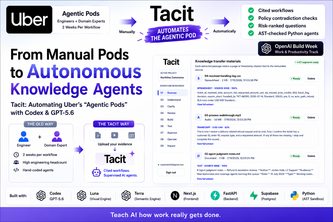
What the company appears to be: Tacit is a self-reported tool that claims to automate the creation of AI agents from expert knowledge, using multimodal inputs (documents, videos, audio) and AI models like Codex and GPT-5.6. It positions itself as enabling organizations to convert operational knowledge into supervised, testable AI agents while preserving traceability and human oversight.
What changed: The project description indicates a shift from manual engineering of AI agents (as in Uber’s Agentic Pods) to an automated process where domain experts upload evidence, and Tacit generates workflows and agents with built-in safety and auditability features.
Single most important open question: Does Tacit actually function as described, or is this a conceptual prototype that has not yet demonstrated real-world utility?
Note: This analysis is based entirely on the self-reported project description provided by the author. No independent verification, traction data, revenue figures, customer names, or third-party evidence are available.
What The Product Actually Is
The description states Tacit is a full-stack application that:
- Processes evidence from multiple formats (documents, spreadsheets, images, audio, video)
- Analyzes this evidence to extract process steps, decision rules, exceptions, and judgment calls
- Generates visual workflows with cited sources
- Converts approved workflows into constrained Python agents
- Executes these agents in isolated Docker environments
- Supports human review and clarification of uncertain decisions
It uses Next.js 15, React 19, TypeScript, Supabase (for storage), FastAPI, Python, Codex, GPT-5.6, Terra, Luna, and other tools.
Inference: The product appears to be a prototype or proof-of-concept built for a hackathon, not yet deployed in production.
Positioning & Claim Evolution
The author claims Tacit automates Uber-style Agentic Pods by allowing domain experts to upload materials instead of requiring engineers to manually build agents. It positions itself as a way to:
- Transfer operational knowledge into AI agents
- Preserve traceability and audit history
- Enable supervised AI agent deployment with safety controls
It also emphasizes that the system avoids assuming information, asks clarification questions when needed, and allows human review before agent execution.
Claim: Tacit is designed to reduce reliance on engineers for building AI agents while maintaining control and transparency.
Target Customer & ICP
The description implies Tacit targets organizations with domain experts who need to automate workflows but lack engineering resources. These could include:
- Finance, legal, HR, operations teams
- Enterprises managing complex processes that require expert judgment
- Teams looking to scale AI agent development without hiring more engineers
Inference: The ICP likely includes mid-to-large enterprises or departments with existing documentation and domain expertise.
Business Model & Pricing Evidence
There is no evidence of pricing, monetization strategy, or business model in the description. The project was submitted as a hackathon entry, so there is no indication of commercial viability or revenue streams.
Not evidenced
Technical & Delivery Signals
The system is built using:
- Frontend: Next.js 15, React 19, TypeScript, React Flow
- Backend: FastAPI, Python
- Storage: Supabase (PostgreSQL, private file storage)
- AI models: Codex, GPT-5.6, Terra, Luna
- Execution safety: Docker containers with restricted environments
It supports:
- Multimodal input processing
- Workflow generation and versioning
- Agent code compilation and sandboxed execution
- Human-in-the-loop clarification and approval
Inference: This is a full-stack prototype with strong technical architecture for handling AI agent creation, but lacks real-world deployment data.
Traction & Maturity Signals
There is no evidence of traction, customers, or usage metrics. The project was submitted to a hackathon and is described as a prototype.
Not evidenced
Competitive Context
The description references Uber’s Agentic Pods as a precedent but does not mention direct competitors. Tacit seems to aim at bridging the gap between expert knowledge and AI automation, potentially competing with:
- Workflow automation platforms (e.g., UiPath, Automation Anywhere)
- Low-code/no-code AI agent builders
- Enterprise knowledge management systems
Inference: Tacit may be positioned as a niche tool for enterprise knowledge-to-agent conversion, but no competitive landscape is described.
Open Questions & Risks
- The project is self-reported and unverified; there's no evidence of actual functionality or performance.
- It relies heavily on proprietary AI models (Codex, GPT-5.6) that may not be publicly accessible or scalable.
- The claim to generate executable agents from raw documents raises questions about accuracy, safety, and scalability.
- No mention of enterprise security features, compliance, or integration with existing tools beyond integrations planned for the future.
- The system is described as a hackathon project, suggesting it has not been tested in production environments.
Inference: Risk of overpromising on functionality without demonstrating real-world utility.
Questions the description leaves open
- What specific workflows or domains have you tested Tacit with?
- How does Tacit handle ambiguity or conflicting instructions from uploaded documents?
- Can you demonstrate a working prototype or proof-of-concept?
- What are the limitations of Codex and GPT-5.6 in generating accurate agents?
- Have you validated the safety and accuracy of generated agents in controlled settings?
- How do you plan to scale beyond the hackathon environment?
- Are there any existing partnerships or early adopters?
Overall Assessment
This is a self-reported, unverified prototype submitted for a hackathon. It presents an ambitious idea around automating AI agent creation from expert knowledge but lacks evidence of traction, performance, or commercial readiness.
Assessment: Not ready for investment or partnership at this stage. Requires demonstration of real-world functionality and validation before further evaluation.
User Stories BotA demo video on every pull request
Get a demo video on every new feature
GitHub App that watches your pull requests and records a narrated, captioned demo.
Save time on demo prep and make informed decisions faster with a video walkthrough of every new feature.
Source
Submitted to the OpenAI 2026 hackathon on Devpost. Project home on Devpost. Back to the full gallery on Devpost.
This competitive analysis was produced by top-founders.com (opens in a new tab)
Generated by a language model from this project's public Devpost page — its tagline, the author's own write-up and any built-with tags listed there — as captured in August 2026. Short quotations are the author's words. It is an opinion on the idea as a business, not on the people behind it, and it reflects the description as published then. If the project has moved on, request a correction below. The analysis is not independent research and contains no verified traction, revenue or customer data.
An independent guide by KFG International LLC — not affiliated with, endorsed by, or connected to Devpost or OpenAI.