

Archive position — measured, not model output
0 likes on Devpost
2,263 of the 7,850 archived projects have more likes, and 5,587 share exactly 0 — so this project's #7,104 place in the like-ranked listing is a tie-break inside that group, not a ranking.
Projects (log scale)
Likes on Devpost. ▲ marks this project's group.
Show the figures
| Likes | Projects | Share of archive |
|---|---|---|
| 0 | 5,587 | 71.2% |
| 1 | 1,758 | 22.4% |
| 2 | 284 | 3.6% |
| 3–4 | 132 | 1.7% |
| 5–9 | 75 | 1.0% |
| 10+ | 14 | 0.2% |
 User Stories BotA demo video on every pull request
Get a demo video on every new feature
GitHub App that watches your pull requests and records a narrated, captioned demo.
Save time on demo prep and make informed decisions faster with a video walkthrough of every new feature.
Executive Summary
What the company appears to be
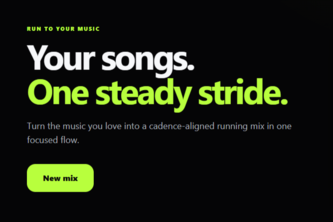
Tadak is a self-reported project that claims to enable users to turn existing songs into running mixes aligned with cadence (pace). It was submitted as part of the OpenAI 2026 hackathon.
What changed
The description provides no evidence of prior versions, evolution or changes in product scope. The only information available is a tagline and a list of technologies used.
Single most important open question
Is there any evidence that Tadak has traction, revenue, customers or adoption beyond the single author's submission to a hackathon?
The analysis is based entirely on self-reported information from the project description provided by the caller. No third-party verification or historical data are available. The lack of detailed product description, customer data, pricing, or business model details makes it impossible to assess commercial viability or maturity.
What The Product Actually Is
The description states that Tadak is a tool that turns songs users already love into cadence-aligned running mixes before they head out. It was built for the OpenAI 2026 hackathon and submitted to Devpost.
Evidence Tagline and project context provided by author.
Inference The product appears to be software-based, likely a desktop or web application, using AI/ML tools such as GPT-5.6, PyTorch, and librosa for audio processing.
Not evidenced No detailed functionality, UI, features, or use cases beyond the tagline are provided.
Positioning & Claim Evolution
The author states that Tadak allows users to "turn the songs you already love into a cadence-aligned running mix before you head out."
Evidence Tagline only.
Inference The positioning appears to be centered on personal fitness and music customization, targeting runners or athletes who want to align their playlists with their pace. It may have evolved from a general music tool to one focused on athletic performance.
Not evidenced No evidence of prior positioning, evolution, or claims about market differentiation or competitive advantages.
Target Customer & ICP
The description states that Tadak is for users who "head out" and want to create running mixes aligned with cadence. It implies a personal user base rather than enterprise customers.
Evidence Tagline only.
Inference The target customer appears to be individual runners or athletes, possibly with a focus on casual or recreational users who already have a music library they enjoy.
Not evidenced No evidence of specific demographics, user personas, or segmentation strategy. No indication of whether the tool targets professional athletes, fitness enthusiasts, or general consumers.
Business Model & Pricing Evidence
The description does not include any information about pricing, monetization, or business model.
Evidence None provided.
Inference If Tadak is a consumer-facing product, it may be free-to-use with optional premium features or ad-supported. However, this is speculative and not supported by the description.
Not evidenced No evidence of revenue streams, pricing tiers, subscriptions, or monetization strategy.
Technical & Delivery Signals
The author lists several technologies used in building Tadak: beat-this, codex, electron, ffmpeg, gpt-5.6, lame, librosa, pytest, python, pytorch, react, signalsmith, typescript, vitest.
Evidence Technology stack declared by the author.
Inference The product likely uses AI/ML for audio processing (e.g., librosa, PyTorch, GPT-5.6), with a frontend built using React and TypeScript, and backend tools like Electron for desktop delivery or ffmpeg for audio manipulation.
Not evidenced No evidence of architecture, scalability, performance metrics, or technical delivery timeline beyond the list of technologies used.
Traction & Maturity Signals
The description provides no evidence of traction, adoption, or maturity. It only states that the project was submitted to a hackathon.
Evidence Submission to OpenAI 2026 hackathon.
Inference The project is likely in an early stage, possibly a prototype or proof-of-concept, given its hackathon origin and lack of further development details.
Not evidenced No evidence of user base, revenue, customer feedback, product usage data, or any signs of market traction.
Competitive Context
The description does not mention any competitors or competitive landscape.
Evidence None provided.
Inference Tadak may compete with existing music playlist tools or fitness apps that allow users to customize their workout playlists. However, this is speculative without further context.
Not evidenced No evidence of market analysis, competitor identification, or positioning relative to existing solutions.
Open Questions & Risks
- Lack of commercial traction: The project was submitted to a hackathon and lacks any evidence of real-world adoption.
- Unverified claims: All information is self-reported and unverified; no third-party validation exists.
- Limited team size: Only one member (Inside Park) is listed, suggesting limited development capacity or resources.
- No business model: No indication of how the product will generate revenue or sustain itself.
Evidence Self-reporting only, no external data.
Questions the description leaves open
- What specific problem are you solving, and how does Tadak address it differently from existing tools?
- Have you conducted any user research or testing with potential customers?
- How do you plan to monetize the product?
- What is your roadmap for development beyond this hackathon submission?
- Are there any early adopters or users who have tested the tool?
Overall Assessment
Assessment Not evidenced.
The description provides no evidence of commercial viability, traction, or maturity. It is unclear whether Tadak represents a viable business opportunity or a prototype with limited potential for growth. The lack of any revenue, customer data, or detailed product information makes it difficult to assess its investment or partnership potential.
Confidence Low — based entirely on self-reported and unverified information from a hackathon submission.
User Stories BotA demo video on every pull request
Get a demo video on every new feature
GitHub App that watches your pull requests and records a narrated, captioned demo.
Save time on demo prep and make informed decisions faster with a video walkthrough of every new feature.
Source
Submitted to the OpenAI 2026 hackathon on Devpost. Project home on Devpost. Back to the full gallery on Devpost.
This competitive analysis was produced by top-founders.com (opens in a new tab)
Generated by a language model from this project's public Devpost page — its tagline and any built-with tags listed there, since the author published no write-up — as captured in August 2026. Short quotations are the author's words. It is an opinion on the idea as a business, not on the people behind it, and it reflects the description as published then. If the project has moved on, request a correction below. The analysis is not independent research and contains no verified traction, revenue or customer data.
An independent guide by KFG International LLC — not affiliated with, endorsed by, or connected to Devpost or OpenAI.