

Archive position — measured, not model output
0 likes on Devpost
2,263 of the 7,850 archived projects have more likes, and 5,587 share exactly 0 — so this project's #3,178 place in the like-ranked listing is a tie-break inside that group, not a ranking.
Projects (log scale)
Likes on Devpost. ▲ marks this project's group.
Show the figures
| Likes | Projects | Share of archive |
|---|---|---|
| 0 | 5,587 | 71.2% |
| 1 | 1,758 | 22.4% |
| 2 | 284 | 3.6% |
| 3–4 | 132 | 1.7% |
| 5–9 | 75 | 1.0% |
| 10+ | 14 | 0.2% |
 User Stories BotA demo video on every pull request
Get a demo video on every new feature
GitHub App that watches your pull requests and records a narrated, captioned demo.
Save time on demo prep and make informed decisions faster with a video walkthrough of every new feature.
Executive Summary
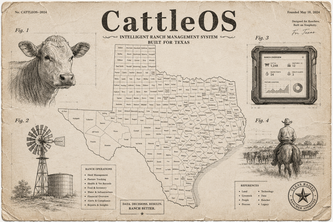
CattleOS is a self-reported Google Apps Script application built by one developer (Phillip Martinez) to help small-scale ranchers manage cattle records and receive local screwworm alerts using open outbreak data and herd information. The system integrates with Google Sheets, uses geospatial analysis tools, and leverages GPT-5.6 for architecture planning and content generation. It is described as a container-bound application that accesses ArcGIS layers through the Texas Animal Health Commission (TAHC), provides risk prioritization, and links to USDA resources.
The project has no demonstrated traction, revenue, or customer base. The author states it is still a work in progress and not yet perfect. There is no evidence of funding rounds, partnerships, or commercial adoption. It was submitted as part of the OpenAI 2026 hackathon.
Most Important Open Question: Is there any evidence that CattleOS has been adopted by ranchers or integrated into real-world operations? The description does not indicate this.
What The Product Actually Is
The description states that CattleOS is a Google Apps Script application built inside Google Sheets, designed to turn Google Sheets into a cattle-management system. It includes functionality for:
- Herd, health, breeding, forage, expense, and sales records
- A "New World Screwworm Watch" feature using ZIP code to display local risk
- Integration with official data sources like TAHC and USDA
- Use of GPT-5.6 for architecture planning and content generation
It also mentions integration with ArcGIS layers, Google Maps Geocoding API, OpenAI Responses API, and Netlify for deployment.
The system is described as a container-bound application, meaning it runs within Google Sheets, and uses deterministic logic for geospatial calculations and workflow management. It also includes structured outputs from GPT-5.6 and a fallback to a USDA dashboard.
Inference: The product appears to be an early-stage prototype or proof-of-concept built in a hackathon context, not yet deployed at scale.
Positioning & Claim Evolution
The author states that CattleOS aims to:
- Help ranchers stay financially stable and prepared for biological outbreaks like the New Screwworm
- Provide local screwworm alerts, smarter inspections, and a practical operating system for 21st-century ranching
- Enable ranchers to keep track of inventory as their stock matures
- Potentially prevent the spread of New Screwworm
It is positioned as a tool that combines open outbreak data with herd records to provide actionable insights.
The claim evolution shows a progression from a personal family project (inspiration) to a potential solution for broader agricultural resilience, but there is no evidence of market validation or adoption beyond the author's own use case.
Inference: The positioning is aspirational and self-reported; it does not reflect any real-world traction or customer feedback.
Target Customer & ICP
The description states that CattleOS is intended for small-scale ranchers, particularly those with small herds. It is described as a tool to help them keep tabs on their livestock more intelligently, especially in the context of biological threats like the New Screwworm.
It is also aimed at less tech-savvy ranchers, who may benefit from an integrated system within Google Sheets.
There is no evidence of segmentation beyond this general description, nor any indication of specific customer personas or buyer profiles.
Inference: The ICP is likely small to mid-sized ranches in the U.S., particularly in areas affected by screwworm outbreaks. No data on actual customers or usage patterns.
Business Model & Pricing Evidence
There is no evidence in the description of a business model or pricing structure. The author states that the project is not yet perfect, and that it’s intended to be open source for public use.
The system is described as a Google Apps Script application, which suggests it may be free to use, but there is no indication of monetization or paid features.
Inference: No business model or pricing is evident. The project appears to be in early development and not yet commercialized.
Technical & Delivery Signals
The system is built using:
- Google Apps Script
- GPT-5.6 for architecture planning
- Codex 5.6 Sol for code verification
- ArcGIS layers from TAHC
- Google Maps Geocoding API
- OpenAI Responses API
- Netlify for deployment
It is described as a container-bound application, with deterministic logic for geospatial calculations and workflow management.
The author notes challenges such as:
- Unstable public data sources
- Difficulty fitting large boundary geometries in Google Sheets
- Need to isolate demo data from real records
- Maintaining safety boundaries that do not diagnose animals or determine movement permissions
Inference: The technical stack is basic but functional for a prototype. It uses modern tools like GPT and ArcGIS, but the system is not yet production-ready.
Traction & Maturity Signals
There is no evidence of traction, revenue, or customer adoption. The author states that:
- CattleOS is still a work in progress
- It’s not perfect
- It was built for a hackathon
- It is intended to be open source and available for public use
No metrics, user feedback, or performance data are provided.
Inference: The project is at an early stage of development and lacks any measurable traction or maturity indicators.
Competitive Context
There is no evidence in the description of existing competitive products or market positioning. The author does not reference competitors or similar tools in the agricultural or livestock management space.
The system is described as a new tool, built to address a specific issue (screwworm alerts), but no comparison with other platforms or solutions is made.
Inference: No competitive context is evident. It is unclear whether there are existing tools that do similar things, or if this is a novel approach.
Open Questions & Risks
Key risks and open questions include:
- No demonstrated traction or adoption
- Single developer team (1 person)
- Hackathon project, not yet production-ready
- Unstable public data sources used for risk assessment
- No pricing, monetization, or business model
- Reliance on GPT-5.6, which may not be available or reliable in production
- Limited scalability due to Google Sheets constraints
There is also a potential data accuracy and safety issue: the system is described as not diagnosing animals or determining legal movement permissions, but it still relies on potentially inaccurate public data.
Inference: The project is highly speculative and not yet proven in real-world use. It may be more of a prototype than a viable product.
Questions the description leaves open
- What is the current status of CattleOS? Is it being used by any ranchers or farms?
- How does the system handle data privacy and security, especially with Google Sheets integration?
- Are there plans to monetize or commercialize the product?
- What are the limitations of the public data sources used for screwworm risk assessment?
- Has the system been tested in real-world conditions or with actual ranchers?
- How does CattleOS plan to scale beyond Google Sheets and into more robust platforms?
Overall Assessment
Not evidenced.
There is no evidence of revenue, customers, traction, or a clear path to monetization. The project is described as a hackathon prototype, not yet ready for commercial use. It lacks any indication of funding, partnerships, or business model.
The author states that the system is still a work in progress and not yet perfect, and intends to make it open source for public use.
Inference: At this stage, CattleOS is not a viable investment or partnership opportunity. It requires further development, validation, and evidence of real-world adoption before any commercial due diligence can be conducted.
User Stories BotA demo video on every pull request
Get a demo video on every new feature
GitHub App that watches your pull requests and records a narrated, captioned demo.
Save time on demo prep and make informed decisions faster with a video walkthrough of every new feature.
Source
Submitted to the OpenAI 2026 hackathon on Devpost. Project home on Devpost. Back to the full gallery on Devpost.
This competitive analysis was produced by top-founders.com (opens in a new tab)
Generated by a language model from this project's public Devpost page — its tagline, the author's own write-up and any built-with tags listed there — as captured in August 2026. Short quotations are the author's words. It is an opinion on the idea as a business, not on the people behind it, and it reflects the description as published then. If the project has moved on, request a correction below. The analysis is not independent research and contains no verified traction, revenue or customer data.
An independent guide by KFG International LLC — not affiliated with, endorsed by, or connected to Devpost or OpenAI.