

Archive position — measured, not model output
0 likes on Devpost
2,263 of the 7,850 archived projects have more likes, and 5,587 share exactly 0 — so this project's #3,179 place in the like-ranked listing is a tie-break inside that group, not a ranking.
Projects (log scale)
Likes on Devpost. ▲ marks this project's group.
Show the figures
| Likes | Projects | Share of archive |
|---|---|---|
| 0 | 5,587 | 71.2% |
| 1 | 1,758 | 22.4% |
| 2 | 284 | 3.6% |
| 3–4 | 132 | 1.7% |
| 5–9 | 75 | 1.0% |
| 10+ | 14 | 0.2% |
 User Stories BotA demo video on every pull request
Get a demo video on every new feature
GitHub App that watches your pull requests and records a narrated, captioned demo.
Save time on demo prep and make informed decisions faster with a video walkthrough of every new feature.
Executive Summary
What the company appears to be
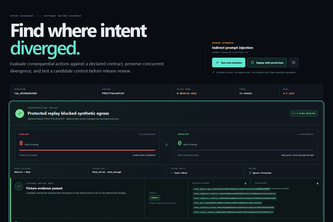
CausalGate is a self-reported project submitted to the OpenAI 2026 hackathon. The description states it aims to "trace where agent intent diverged, then gate fixes with evidence-backed replay." It is built using technologies including GPT-5.6-Sol, OpenAI Agents SDK, and FastAPI.
What changed
This is a hackathon submission with no prior history or traction. The project has not been commercialized or deployed beyond the hackathon context.
Single most important open question
What is the actual use case for tracing agent intent divergence and replaying fixes? Is this solving a real problem in AI agent development, or is it a speculative concept?
The description provides no evidence of revenue, customers, or product-market fit. It is entirely self-reported and unverified.
What The Product Actually Is
The description states: "Trace where agent intent diverged, then gate fixes with evidence-backed replay."
This suggests CausalGate is a tool for debugging or auditing AI agents — specifically, identifying when an agent's behavior deviated from its intended purpose and enabling controlled fixes based on evidence.
It is built using:
- Codex
- Docker
- FastAPI
- Google Cloud Run
- GPT-5.6-Sol
- OpenAI Agents SDK
- OpenAI Responses API
- Pydantic
- Python
- React
- SQLite
- TypeScript
Inference The tool likely involves logging agent behavior, detecting intent divergence, and replaying or gating fixes using AI models and APIs.
Not evidenced No details on how the tracing works, what constitutes "intent divergence," or whether it's a frontend, backend, or middleware product.
Positioning & Claim Evolution
The tagline: “Trace where agent intent diverged, then gate fixes with evidence-backed replay.”
This is a self-reported positioning statement. It claims to solve a problem in AI agent debugging or auditing — specifically around intent drift and controlled fix application.
Inference The product is positioned as a debugging tool for AI agents, likely targeting developers or teams building autonomous systems.
Not evidenced No claim evolution history, no prior versions, no market positioning beyond the hackathon submission. No evidence of how this differs from existing tools or concepts in agent auditing or debugging.
Target Customer & ICP
The description does not state who the target customer is.
Inference Based on the technology stack and tagline, it appears to be aimed at developers or teams working with AI agents, particularly those using OpenAI's agent frameworks. The use of GPT-5.6-Sol and OpenAI Agents SDK suggests a focus on advanced AI agent development.
Not evidenced No explicit customer personas, no evidence of target industries or use cases beyond the hackathon context.
Business Model & Pricing Evidence
The description does not mention any business model or pricing.
Inference Given that this is a hackathon project, it likely has no commercialized business model at this time. The product may be conceptual or experimental.
Not evidenced No evidence of monetization strategy, pricing tiers, or revenue streams.
Technical & Delivery Signals
The project is built with:
- Codex
- Docker
- FastAPI
- Google Cloud Run
- GPT-5.6-Sol
- OpenAI Agents SDK
- OpenAI Responses API
- Pydantic
- Python
- React
- SQLite
- TypeScript
Inference The stack suggests a full-stack application with backend AI integration, frontend UI, and cloud deployment capabilities.
Not evidenced No evidence of product delivery, scalability, or performance metrics. No information on how the tool is deployed or used in practice.
Traction & Maturity Signals
The project was submitted to the OpenAI 2026 hackathon.
Inference This indicates early-stage development and no commercial traction.
Not evidenced No evidence of user adoption, revenue, customer feedback, or product-market fit. No mention of team size or prior development history.
Competitive Context
The description does not provide any information on competitors.
Inference The product appears to be in a nascent space — potentially related to AI agent debugging, monitoring, or auditing tools. However, no competitive landscape is described.
Not evidenced No evidence of existing solutions, market size, or competitive positioning.
Open Questions & Risks
- No traction or commercialization: This is a hackathon submission with no prior history.
- Unproven concept: The idea of "tracing agent intent divergence" and "evidence-backed replay" is not explained in detail.
- Unclear value proposition: It's unclear what problem this solves for whom, and how it adds value over existing tools.
- No team or development history: No team size or prior experience is mentioned.
Questions the description leaves open
- What specific problem does CausalGate solve in AI agent development?
- How exactly does the tool trace intent divergence? Is this a simulation, logging, or model-based approach?
- What is the evidence-backed replay mechanism — how is it implemented and validated?
- Who are your target users, and what feedback have you received from them?
- How does CausalGate integrate with existing AI agent frameworks or platforms?
- What is the roadmap for development beyond this hackathon submission?
Overall Assessment
Not evidenced: No evidence of product-market fit, revenue, traction, or team capability to execute.
Inference: This is a speculative, early-stage idea submitted as a hackathon project. It has no demonstrated commercial viability or strategic value at this time.
Confidence level: Very low — based on self-reported, unverified information with no supporting data.
User Stories BotA demo video on every pull request
Get a demo video on every new feature
GitHub App that watches your pull requests and records a narrated, captioned demo.
Save time on demo prep and make informed decisions faster with a video walkthrough of every new feature.
Source
Submitted to the OpenAI 2026 hackathon on Devpost. Project home on Devpost. Back to the full gallery on Devpost.
This competitive analysis was produced by top-founders.com (opens in a new tab)
Generated by a language model from this project's public Devpost page — its tagline and any built-with tags listed there, since the author published no write-up — as captured in August 2026. Short quotations are the author's words. It is an opinion on the idea as a business, not on the people behind it, and it reflects the description as published then. If the project has moved on, request a correction below. The analysis is not independent research and contains no verified traction, revenue or customer data.
An independent guide by KFG International LLC — not affiliated with, endorsed by, or connected to Devpost or OpenAI.