

Archive position — measured, not model output
0 likes on Devpost
2,263 of the 7,850 archived projects have more likes, and 5,587 share exactly 0 — so this project's #3,181 place in the like-ranked listing is a tie-break inside that group, not a ranking.
Projects (log scale)
Likes on Devpost. ▲ marks this project's group.
Show the figures
| Likes | Projects | Share of archive |
|---|---|---|
| 0 | 5,587 | 71.2% |
| 1 | 1,758 | 22.4% |
| 2 | 284 | 3.6% |
| 3–4 | 132 | 1.7% |
| 5–9 | 75 | 1.0% |
| 10+ | 14 | 0.2% |
 User Stories BotA demo video on every pull request
Get a demo video on every new feature
GitHub App that watches your pull requests and records a narrated, captioned demo.
Save time on demo prep and make informed decisions faster with a video walkthrough of every new feature.
Executive Summary
What the company appears to be
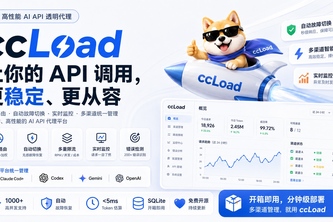
ccLoad is a self-reported AI API gateway designed to simplify multi-provider AI infrastructure for developers. It supports Claude Code, Codex, Gemini, and OpenAI-compatible tools through a single endpoint, offering smart routing, automatic failover, protocol conversion, observability, and cost control.
What changed
The project was submitted as part of the OpenAI 2026 hackathon, indicating it is in an early development or prototype phase. It has no evidence of revenue, customers, or traction beyond its own description.
Single most important open question
Is there any evidence that ccLoad has been used in production environments or by developers outside of its creator’s immediate context?
What The Product Actually Is
The description states that ccLoad is an AI API gateway. It supports four major AI protocol families: Claude Code, Codex, Gemini, and OpenAI.
It claims to:
- Manage upstream complexity for these providers.
- Provide smart routing with weighted round-robin.
- Offer automatic failover at granular levels (key, model, channel, URL).
- Convert protocols between the four families.
- Include live observability via a built-in dashboard.
- Support cost and access control features.
It is built in Go, uses Gin for HTTP routing, and includes support for SQLite, MySQL, PostgreSQL, and Docker deployments.
The author describes it as a single binary with embedded SQLite, suitable for local deployment, but also supports larger deployments using external databases.
Inference This is a developer tool intended to abstract away the complexity of managing multiple AI APIs. It does not appear to be a commercial product or SaaS offering at this stage.
Positioning & Claim Evolution
The author positions ccLoad as:
- A reliable API gateway for AI tools.
- An alternative to manual scripts and client-side switching.
- A solution that makes failure domains explicit and keeps workflows running.
It is framed as a developer tool, not a commercial product, with no mention of pricing or monetization.
The claim evolution shows:
- Initial focus on solving infrastructure fragility in AI coding agents.
- Expansion into protocol conversion and observability.
- Emphasis on operational simplicity and debugging ease.
Inference The positioning is focused on developer utility rather than enterprise adoption. There is no indication that it targets business users or has evolved beyond a hackathon prototype.
Target Customer & ICP
The description states that ccLoad is intended for developers using AI coding agents, particularly those working with Claude Code, Codex, Gemini, and OpenAI tools.
It is described as solving problems in the daily development loop, where developers may encounter:
- Expired keys
- Rate limits
- Overloaded models
- Broken streaming connections
Inference The ICP appears to be technical users or developers who are building or integrating AI tools into their workflows. No evidence of enterprise customers, B2B sales, or specific personas is provided.
Business Model & Pricing Evidence
There is no evidence in the description of:
- A pricing model
- Revenue streams
- Monetization strategy
- Customer acquisition plans
- Subscription tiers or usage-based billing
The project is described as a single-binary tool, suggesting it may be open-source or freemium, but this is not stated.
Inference No business model is evident. The tool appears to be self-reported as a developer utility with no commercial traction or pricing structure.
Technical & Delivery Signals
The project is built in Go, using:
- Gin for HTTP routing
- Sonic for JSON processing
- Support for SQLite, MySQL, PostgreSQL
- Docker and multi-architecture builds
- Embedded dashboard for configuration and logs
It includes:
- Protocol registry with native pass-through and local transformation
- Request attempt loop with scoped cooldown and failover
- Streaming normalization at the gateway boundary
- Error classification and soft-error detection
Inference The technical stack suggests a lightweight, modular, and deployable system. The use of Go and embedded SQLite implies ease of deployment but also limits scalability assumptions.
Traction & Maturity Signals
There is no evidence of:
- Revenue or ARR
- Customers or user base
- Product adoption or usage metrics
- Deployment in production environments
- Feedback from users beyond the author’s own account
The project was submitted to a hackathon, indicating it is likely in an early prototype stage.
Inference No traction or maturity signals are evident. The tool has not been validated in real-world use cases.
Competitive Context
The description does not mention:
- Direct competitors
- Market positioning relative to other API gateways
- Comparison with existing tools like LangChain, LlamaIndex, or similar infrastructure projects
It is implied that ccLoad addresses a gap in managing multi-provider AI APIs, but no competitive landscape is described.
Inference No competitive context is provided. The tool may be unique in its approach to protocol conversion and failover, but this cannot be confirmed without external references.
Open Questions & Risks
- No evidence of real-world usage or adoption
- Self-reported only: No third-party validation or independent sources
- Single-person team suggests limited resources for scaling or commercialization
- Hackathon submission implies prototype, not production-ready product
- Lack of pricing or monetization strategy raises questions about long-term viability
- Protocol conversion complexity may introduce bugs or inconsistencies
Inference The project is in a very early stage with no commercial traction. Risks include lack of validation, scalability concerns, and unclear path to monetization.
Questions the description leaves open
- What specific use cases are you solving for developers?
- Have you tested protocol conversion in real-world scenarios?
- How do you plan to scale beyond a single binary deployment?
- Are there any existing users or early adopters of ccLoad?
- What is your roadmap for monetization or commercialization?
- How does ccLoad handle edge cases in streaming and tool-call semantics?
- Have you considered integration with existing AI infrastructure tools like LangChain?
Overall Assessment
Not evidenced.
The project description provides no evidence of:
- Revenue, ARR, or funding
- Customers or user adoption
- Product-market fit or commercial traction
- Team experience or track record
- Strategic partnerships or integrations
It is a self-reported hackathon submission, built by one person, with no indication of commercial viability or scalability.
Inference This project is in an early prototype phase and lacks the evidence required to assess investment or partnership potential. It may be a useful tool for developers but does not yet show signs of being a viable business or product.
User Stories BotA demo video on every pull request
Get a demo video on every new feature
GitHub App that watches your pull requests and records a narrated, captioned demo.
Save time on demo prep and make informed decisions faster with a video walkthrough of every new feature.
Source
Submitted to the OpenAI 2026 hackathon on Devpost. Project home on Devpost. Back to the full gallery on Devpost.
This competitive analysis was produced by top-founders.com (opens in a new tab)
Generated by a language model from this project's public Devpost page — its tagline, the author's own write-up and any built-with tags listed there — as captured in August 2026. Short quotations are the author's words. It is an opinion on the idea as a business, not on the people behind it, and it reflects the description as published then. If the project has moved on, request a correction below. The analysis is not independent research and contains no verified traction, revenue or customer data.
An independent guide by KFG International LLC — not affiliated with, endorsed by, or connected to Devpost or OpenAI.