

Archive position — measured, not model output
0 likes on Devpost
2,263 of the 7,850 archived projects have more likes, and 5,587 share exactly 0 — so this project's #3,183 place in the like-ranked listing is a tie-break inside that group, not a ranking.
Projects (log scale)
Likes on Devpost. ▲ marks this project's group.
Show the figures
| Likes | Projects | Share of archive |
|---|---|---|
| 0 | 5,587 | 71.2% |
| 1 | 1,758 | 22.4% |
| 2 | 284 | 3.6% |
| 3–4 | 132 | 1.7% |
| 5–9 | 75 | 1.0% |
| 10+ | 14 | 0.2% |
 User Stories BotA demo video on every pull request
Get a demo video on every new feature
GitHub App that watches your pull requests and records a narrated, captioned demo.
Save time on demo prep and make informed decisions faster with a video walkthrough of every new feature.
Executive Summary
What the company appears to be
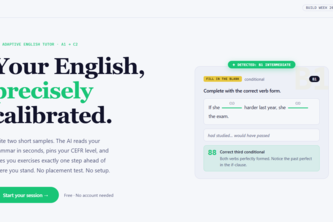
CEFR Coach — Adaptive English Tutor is a self-reported tool that claims to offer an adaptive English learning experience using AI. The author states it uses a fine-tuned classifier to detect a learner’s CEFR level and then generates exercises one step above that level, based on Krashen's i+1 theory. It leverages GPT-5.6 for feedback and exercise generation, with a RAG pipeline powered by ChromaDB and a classifier trained via QLoRA.
What changed
The project is presented as a personal solution to the author’s own language learning pain points — specifically, dissatisfaction with apps that do not adapt to individual levels. It is described as built for a single developer (the author) over a hackathon period, using open-source and cloud-based tools.
Single most important open question
Does the system actually function as described? The description states that it uses a classifier to detect CEFR level and an LLM to generate exercises, but there is no evidence of real-world usage, performance metrics, or validated learning outcomes. The author’s own write-up indicates they built automated evaluation suites, but no data on how well the system performs in practice is provided.
What The Product Actually Is
The description states that CEFR Coach is an adaptive English tutor that:
- Takes two short writing samples from a learner.
- Uses a fine-tuned classifier to predict the learner’s CEFR level (A1–C2).
- Generates exercises one step above the detected level using GPT-5.6.
- Provides corrections, explanations, and feedback via LLM.
- Updates the estimated CEFR level over time based on new writing samples.
The system is described as using:
- A 1.5B transformer fine-tuned with QLoRA.
- ChromaDB for RAG (Retrieval-Augmented Generation) with a grammar corpus.
- GPT-5.6 for exercise generation and feedback.
- FastAPI, React, TypeScript, and other tools for development.
Inference The product is a prototype or proof-of-concept built in a hackathon setting, not a commercial offering.
Positioning & Claim Evolution
The author claims CEFR Coach:
- Is inspired by Krashen’s i+1 theory.
- Adapts to the learner's actual level rather than forcing a generic curriculum.
- Uses a classifier to determine level and an LLM for tutoring — keeping those roles separate.
- Was built to solve personal language learning challenges, especially with technical content.
Inference The positioning is that of a personalized, AI-powered English tutor. It is not described as part of a larger platform or ecosystem, but rather as a standalone tool focused on adaptive writing practice.
Target Customer & ICP
The description does not state who the intended users are beyond “learners” in general. However, it implies:
- Learners who want to improve their English writing.
- Users who have already learned some English through technical documentation or videos.
- People looking for a system that adapts to their level.
Inference The ICP is likely self-directed English learners with intermediate to advanced goals, particularly those interested in technical English. No explicit segmentation or persona data is provided.
Business Model & Pricing Evidence
The description does not mention any business model or pricing structure.
Not evidenced.
Technical & Delivery Signals
The author states:
- The classifier was fine-tuned with QLoRA on a balanced CEFR dataset.
- Accuracy of the classifier is 84.9% (based on 12 tests).
- RAG pipeline uses YAML grammar corpus indexed with ChromaDB.
- GPT-5.6 is used for feedback and exercise generation.
- The system includes automated evaluation suites using RAGAS metrics.
- Deployment stack includes FastAPI, React, TypeScript, ChromaDB, Render, and Vercel.
Inference The technical architecture is built around open-source tools and LLMs, with a focus on modular components. However, no evidence of production deployment or scalability is provided.
Traction & Maturity Signals
The description does not provide any traction data:
- No user base.
- No revenue or monetization.
- No customer feedback or usage metrics.
- No evidence of product-market fit or adoption.
Not evidenced.
Competitive Context
The description does not mention competitors or the broader market landscape for English learning tools.
Not evidenced.
Open Questions & Risks
- Unverified claims: The system is described as working, but no real-world performance data is provided.
- No commercialization: The project is a hackathon submission and not presented as a product in development or launch.
- Limited validation: While automated tests are mentioned, there is no evidence of user testing or learning outcome validation.
- Self-reported accuracy: Classifier accuracy (84.9%) is based on internal tests, not external validation.
- No pricing or monetization model: No indication of how the tool would be monetized if developed further.
Questions the description leaves open
- What real-world data supports the classifier’s 84.9% accuracy?
- How does the system handle edge cases, such as very short writing samples or inconsistent predictions?
- Has the system been tested with actual learners, and what were the results?
- Is there any plan to monetize or scale this beyond a prototype?
- What are the limitations of GPT-5.6 in generating accurate feedback for language learning?
- How does the system ensure consistency across different writing samples over time?
Overall Assessment
The description presents CEFR Coach as a hackathon project with no evidence of traction, revenue, or commercial viability. It is not clear whether this is a prototype being developed into a product or simply an idea.
Not evidenced.
This is a self-reported, unverified account of a personal project. There is no indication that the system has been validated in real-world use or that it is ready for investment or partnership. The author’s own write-up indicates they built automated evaluation suites, but no data on learning outcomes or user experience is shared.
Confidence: Low.
User Stories BotA demo video on every pull request
Get a demo video on every new feature
GitHub App that watches your pull requests and records a narrated, captioned demo.
Save time on demo prep and make informed decisions faster with a video walkthrough of every new feature.
Source
Submitted to the OpenAI 2026 hackathon on Devpost. Project home on Devpost. Back to the full gallery on Devpost.
This competitive analysis was produced by top-founders.com (opens in a new tab)
Generated by a language model from this project's public Devpost page — its tagline, the author's own write-up and any built-with tags listed there — as captured in August 2026. Short quotations are the author's words. It is an opinion on the idea as a business, not on the people behind it, and it reflects the description as published then. If the project has moved on, request a correction below. The analysis is not independent research and contains no verified traction, revenue or customer data.
An independent guide by KFG International LLC — not affiliated with, endorsed by, or connected to Devpost or OpenAI.