

Archive position — measured, not model output
0 likes on Devpost
2,263 of the 7,850 archived projects have more likes, and 5,587 share exactly 0 — so this project's #3,184 place in the like-ranked listing is a tie-break inside that group, not a ranking.
Projects (log scale)
Likes on Devpost. ▲ marks this project's group.
Show the figures
| Likes | Projects | Share of archive |
|---|---|---|
| 0 | 5,587 | 71.2% |
| 1 | 1,758 | 22.4% |
| 2 | 284 | 3.6% |
| 3–4 | 132 | 1.7% |
| 5–9 | 75 | 1.0% |
| 10+ | 14 | 0.2% |
 User Stories BotA demo video on every pull request
Get a demo video on every new feature
GitHub App that watches your pull requests and records a narrated, captioned demo.
Save time on demo prep and make informed decisions faster with a video walkthrough of every new feature.
Executive Summary
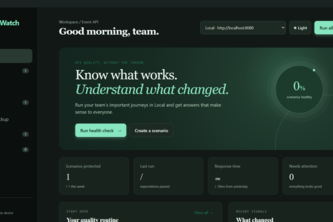
What the company appears to be: CentralWatch is a self-reported local-first desktop application for API testing, built as a hackathon project by one developer (Ben Samuel J. U). It supports REST and GraphQL APIs, with features like multi-step scenarios, environment management, secure credential handling, and CI-ready outputs.
What changed: The project was submitted to the OpenAI 2026 hackathon, indicating it is in early development or prototype stage. No commercial traction, revenue, or customer data is evidenced.
Single most important open question: Is there a viable market need for a local-first API testing tool that balances simplicity with technical capability, and can this be scaled beyond a single-person hackathon effort?
Analysis basis: This report is based entirely on the self-reported description provided by the author. No external verification or historical data is available.
What The Product Actually Is
- The description states that CentralWatch is a "local-first desktop API-testing workspace".
- Users create multi-step scenarios, run them against named environments, and get pass/fail results with request, response, and expectation details.
- It supports REST and GraphQL APIs.
- Features include authentication, variables and captures, Postman and OpenAPI imports, response baselines, reports, scheduled monitoring, Teams alerts, and CI-ready JSON/JUnit output.
- The tool is built using Vue 3, TypeScript, Vite for the frontend; Go for backend logic and HTTP/GraphQL runner; Wails for desktop shell; and SQLite for local storage.
- Credentials are stored in the OS keychain.
Confidence: High — the description clearly outlines the product's functionality and architecture.
Positioning & Claim Evolution
- The tagline is “API testing, made easy”.
- The author claims that API testing should be accessible to non-specialists (product, QA, support, engineering teams), not just those comfortable with raw requests or scripts.
- The project emphasizes a scenario-first workflow that turns technical checks into readable business outcomes.
- It positions itself as a tool that explains outcomes instead of only exposing technical details.
- The author notes that the tool balances flexibility and simplicity, aiming to be approachable without sacrificing capabilities for advanced users.
Confidence: Medium — claims are self-reported and lack evidence of adoption or feedback from target users.
Target Customer & ICP
- The description states that CentralWatch targets product, QA, support, and engineering teams—not just specialists.
- It aims to make API testing accessible to non-experts while retaining functionality for technical users.
- There is no explicit mention of enterprise customers, specific industries, or personas beyond general roles.
Confidence: Low — no evidence of defined customer segments or ICP beyond broad team categories.
Business Model & Pricing Evidence
- No pricing information, subscription model, or monetization strategy is mentioned in the description.
- The tool is described as a desktop application with local-first design and no indication of cloud-based services or SaaS components.
- There is no evidence of revenue streams, licensing models, or commercial plans.
Confidence: Very low — no business model or pricing data is provided.
Technical & Delivery Signals
- Built using Vue 3, TypeScript, Vite, Go, Wails, and SQLite.
- Uses Codex with GPT-5.6 for code inspection and refinement during development.
- Supports Postman and OpenAPI imports.
- Has CI-ready JSON/JUnit output.
- Credentials are stored in the OS keychain.
- Local-first architecture is emphasized, including local workspace and run-history storage.
Confidence: High — detailed technical stack and delivery approach are described.
Traction & Maturity Signals
- The project was submitted to a hackathon (OpenAI 2026).
- It has one team member: Ben Samuel J. U.
- No evidence of users, customers, or adoption metrics is provided.
- No mention of funding, partnerships, or product releases beyond the hackathon submission.
Confidence: Very low — no traction or maturity indicators are evident.
Competitive Context
- The description does not name competitors or reference existing tools in the API testing space.
- It implies a niche for local-first, scenario-driven API testing that is accessible to non-experts.
- No comparison with other tools such as Postman, Insomnia, or Swagger is made.
Confidence: Low — no competitive analysis or positioning against existing solutions.
Open Questions & Risks
- The project is a single-person hackathon submission; there is no evidence of team scaling or long-term commitment.
- No commercial traction, revenue, or customer feedback is evident.
- The tool is local-first and lacks cloud features, which may limit its appeal for teams requiring shared workspaces or centralized monitoring.
- The use of GPT-5.6 in development raises questions about whether the core logic is human-written or AI-generated, though this is not a risk per se.
Confidence: Medium — risks are inferred from lack of evidence and project scope.
Questions the description leaves open
- What specific user pain points does CentralWatch solve that existing tools do not?
- How does the local-first design impact scalability or team collaboration?
- Are there any plans to move beyond a desktop application into cloud-based features?
- Has the tool been tested with actual users from product, QA, or engineering teams?
- What is the long-term roadmap for monetization and growth?
Note: These are open-ended questions designed to probe assumptions and uncover hidden signals.
Overall Assessment
- The project is in an early stage (hackathon submission) with no demonstrated traction or revenue.
- It shows potential in addressing a gap in API testing accessibility, but lacks evidence of market validation.
- The single-person team and local-first approach raise questions about scalability and commercial viability.
- No clear business model or pricing strategy is evident.
Assessment: Not ready for investment or partnership at this time. Further due diligence would require evidence of user feedback, product-market fit, and team expansion.
Confidence: Low — conclusions are based on minimal self-reported data with no external corroboration.
User Stories BotA demo video on every pull request
Get a demo video on every new feature
GitHub App that watches your pull requests and records a narrated, captioned demo.
Save time on demo prep and make informed decisions faster with a video walkthrough of every new feature.
Source
Submitted to the OpenAI 2026 hackathon on Devpost. Project home on Devpost. Back to the full gallery on Devpost.
This competitive analysis was produced by top-founders.com (opens in a new tab)
Generated by a language model from this project's public Devpost page — its tagline, the author's own write-up and any built-with tags listed there — as captured in August 2026. Short quotations are the author's words. It is an opinion on the idea as a business, not on the people behind it, and it reflects the description as published then. If the project has moved on, request a correction below. The analysis is not independent research and contains no verified traction, revenue or customer data.
An independent guide by KFG International LLC — not affiliated with, endorsed by, or connected to Devpost or OpenAI.