

Archive position — measured, not model output
0 likes on Devpost
2,263 of the 7,850 archived projects have more likes, and 5,587 share exactly 0 — so this project's #3,182 place in the like-ranked listing is a tie-break inside that group, not a ranking.
Projects (log scale)
Likes on Devpost. ▲ marks this project's group.
Show the figures
| Likes | Projects | Share of archive |
|---|---|---|
| 0 | 5,587 | 71.2% |
| 1 | 1,758 | 22.4% |
| 2 | 284 | 3.6% |
| 3–4 | 132 | 1.7% |
| 5–9 | 75 | 1.0% |
| 10+ | 14 | 0.2% |
 User Stories BotA demo video on every pull request
Get a demo video on every new feature
GitHub App that watches your pull requests and records a narrated, captioned demo.
Save time on demo prep and make informed decisions faster with a video walkthrough of every new feature.
Executive Summary
Project: CCTF Change Sentinel
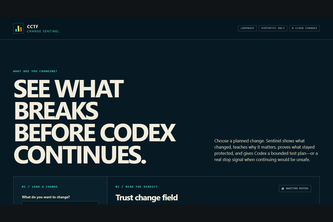
Author's Self-Description: A cross-cloud change monitoring and validation tool built for developer teams to prevent unsafe cloud changes by mapping trust ripple, blocking unsafe continuations, and independently verifying zero unintended changes.
Key Claim: The system maps dependencies, waits for evidence freshness, blocks unsafe continuation with HTTP 409, and generates a verified change kit for Codex. It uses deterministic evidence as authority, not AI output.
What Changed: The project evolved from a cross-cloud trust framework into a focused developer tool during a Build Week hackathon.
Most Important Open Question: Does the described architecture actually enforce deterministic gates in practice, or is it an idealized model that may fail under real-world complexity?
What The Product Actually Is
The description states that CCTF Change Sentinel:
- Maps dependencies and provenance for planned cross-cloud changes.
- Waits when propagation or freshness cannot be proven.
- Blocks unsafe continuation with HTTP 409.
- Generates a verified change kit for Codex.
- Reproduces fingerprints and detects tampering in a separate process.
- Uses a standard-library Python judge path with no rebuild or package installation.
- Includes UI, CLI, synthetic scenarios, secret/path scan, dependency guard, and integrity receipts.
- Optionally includes a local Ollama model for human-description-to-proposed-rehearsal, which is schema-validated, editable, and approval-gated.
Inference: The tool appears to be a developer-focused change control system that enforces deterministic checks before cloud changes are allowed. It separates AI use from decision-making authority.
Not Evidenced: No details on how the "trust ripple" is defined or measured, how evidence freshness is determined, or what constitutes a "safe test."
Positioning & Claim Evolution
The author states:
- CCTF began as a cross-cloud trust framework.
- It was refocused into a developer tool during Build Week.
- The tool is designed to prevent unsafe cloud changes by mapping the trust ripple and blocking unsafe continuations.
- It uses deterministic evidence as authority, not AI output.
Inference: The positioning has evolved from a broad trust framework to a narrow but specific developer tool for change validation.
Not Evidenced: No information on prior versions or how the product evolved beyond the hackathon. No mention of market positioning or target use cases beyond developer teams.
Target Customer & ICP
The description states:
- The tool is built for developer teams.
- It is designed to prevent unsafe cloud changes in cross-cloud environments.
- It includes a UI and CLI, suggesting it targets developers who interact with cloud infrastructure directly.
Inference: The primary customer is a developer or DevOps team working in multi-cloud environments where change control is critical.
Not Evidenced: No information on specific industries, company sizes, or use cases beyond developer teams. No evidence of customer personas or segmentation.
Business Model & Pricing Evidence
The description states:
- The tool is built as a hackathon project.
- It uses Python and standard libraries.
- It includes UI, CLI, synthetic scenarios, and change kit generation.
- There is no mention of pricing, monetization, or business model.
Inference: No commercial model is evident. It appears to be a proof-of-concept or prototype.
Not Evidenced: No information on revenue streams, pricing tiers, or monetization strategy.
Technical & Delivery Signals
The description states:
- Built with Python.
- Uses Codex and GPT-5.6 for development.
- Includes a standard-library Python judge path.
- Has a deterministic gate and an independent-process verifier.
- Uses HTTP 409 to deny unsafe continuations.
- Separates AI use from decision-making authority.
- Includes UI, CLI, synthetic scenarios, secret/path scan, dependency guard, and integrity receipts.
Inference: The tool is built with Python and integrates AI for development but not for decision-making. It enforces deterministic checks via a separate process.
Not Evidenced: No details on how the deterministic gate works in practice, or whether it has been tested under real-world conditions.
Traction & Maturity Signals
The description states:
- The project was submitted to the OpenAI 2026 hackathon.
- It includes 48 deterministic tests passing.
- It has a UI, CLI, synthetic scenarios, and integrity receipts.
- It is a single-developer project (team size: 1).
Inference: This is a prototype or proof-of-concept, not a mature product.
Not Evidenced: No evidence of customers, revenue, adoption, or usage beyond the hackathon submission. No data on performance, scalability, or real-world deployment.
Competitive Context
The description states:
- The tool is built for cross-cloud change control.
- It uses deterministic evidence as authority.
- It integrates AI only for proposal and not decision-making.
Inference: It competes in the space of cloud change governance and security tools, but with a focus on deterministic checks over AI-driven decisions.
Not Evidenced: No mention of competitors or market analysis. No indication of how it differentiates from existing tools like Terraform, AWS Config, or similar.
Open Questions & Risks
- The tool is described as a hackathon project with no commercial traction.
- It uses AI only for proposal, not decision-making — but the description does not clarify whether this is sufficient to avoid security risks.
- The system is built on a single developer’s work and lacks evidence of scalability or real-world testing.
- No mention of integration with existing CI/CD pipelines or cloud platforms.
- The claim that it enforces deterministic gates without live cloud mutation may be idealized; real-world complexity could undermine this.
Inference: The tool may not yet be ready for production use, and its architecture may not scale beyond a prototype.
Not Evidenced: No evidence of risk mitigation strategies or testing under real-world conditions.
Questions the description leaves open
- How does the deterministic gate actually function in practice? Is it tested with real cloud environments?
- What are the limitations of the current implementation, and how would it scale to enterprise-level use?
- Are there any known edge cases where the system might fail to detect unsafe changes?
- How is evidence freshness determined, and what happens when that evidence is unavailable or stale?
- Has the tool been tested with real cloud providers (e.g., AWS, GCP, Azure)?
- What are the plans for integrating with existing CI/CD tools or platforms?
Overall Assessment
The description states:
- The project is a hackathon submission.
- It is built by one developer.
- It includes UI, CLI, synthetic scenarios, and integrity receipts.
- It uses deterministic evidence as authority.
Inference: This is a prototype with potential but not yet proven commercial viability or traction. It may be suitable for early-stage investment or partnership if the team can demonstrate scalability and real-world applicability.
Not Evidenced: No data on revenue, customers, or market fit. No indication of whether the tool has moved beyond prototype stage or is ready for production use.
User Stories BotA demo video on every pull request
Get a demo video on every new feature
GitHub App that watches your pull requests and records a narrated, captioned demo.
Save time on demo prep and make informed decisions faster with a video walkthrough of every new feature.
Source
Submitted to the OpenAI 2026 hackathon on Devpost. Project home on Devpost. Back to the full gallery on Devpost.
This competitive analysis was produced by top-founders.com (opens in a new tab)
Generated by a language model from this project's public Devpost page — its tagline, the author's own write-up and any built-with tags listed there — as captured in August 2026. Short quotations are the author's words. It is an opinion on the idea as a business, not on the people behind it, and it reflects the description as published then. If the project has moved on, request a correction below. The analysis is not independent research and contains no verified traction, revenue or customer data.
An independent guide by KFG International LLC — not affiliated with, endorsed by, or connected to Devpost or OpenAI.