

Archive position — measured, not model output
1 like on Devpost
505 of the 7,850 archived projects have more likes, and 1,758 share exactly 1 — so this project's #1,213 place in the like-ranked listing is a tie-break inside that group, not a ranking.
Projects (log scale)
Likes on Devpost. ▲ marks this project's group.
Show the figures
| Likes | Projects | Share of archive |
|---|---|---|
| 0 | 5,587 | 71.2% |
| 1 | 1,758 | 22.4% |
| 2 | 284 | 3.6% |
| 3–4 | 132 | 1.7% |
| 5–9 | 75 | 1.0% |
| 10+ | 14 | 0.2% |
 User Stories BotA demo video on every pull request
Get a demo video on every new feature
GitHub App that watches your pull requests and records a narrated, captioned demo.
Save time on demo prep and make informed decisions faster with a video walkthrough of every new feature.
Executive Summary
What the company appears to be
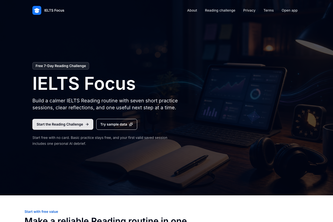
IELTS Focus is an AI-powered educational platform designed to help IELTS learners practice and improve their English language skills through adaptive feedback and structured learning paths. It positions itself as an affordable alternative to private tutoring, using AI to provide personalized coaching while maintaining a strong emphasis on privacy and learner autonomy.
What changed
The project was extended during the OpenAI 2026 hackathon build week. Key additions include Supabase authentication, Stripe billing integration, offline access for desktop app users, and a public-facing free trial experience (the 7-Day Reading Challenge). The founder also implemented privacy-safe ML research infrastructure and ensured compliance with data handling standards.
Single most important open question
Is there evidence that the product delivers measurable improvement in IELTS scores or learning outcomes, and how does it plan to scale beyond a single founder's personal use case?
This analysis is based solely on the self-reported project description provided by the author. No third-party verification, traction data, revenue figures, or customer feedback are available.
What The Product Actually Is
The description states that IELTS Focus follows a learning loop:
- study
- capture evidence
- diagnose weakness
- prescribe repair
- verify progress
- repeat
It includes:
- Timed practice sessions (Writing, Reading, Listening, Speaking)
- Coach Brief, Review, adaptive planning
- Vocabulary and Weekly Review features
- Archive that acts as a study memory
AI is used for:
- Explaining evidence
- Comparing learner attempts
- Supporting scoring and generation workflows
- Helping learners act on feedback
It also includes:
- A desktop app built with Electron
- Web-based components using React, TypeScript, Tailwind, Vite
- Supabase backend with PostgreSQL
- Stripe integration for payments
- Playwright for testing
- Codex and GPT-5.6 for development assistance
The product is described as a hybrid local-first + hosted model, where learner history remains local by default but identity, backups, and billing are managed remotely.
Positioning & Claim Evolution
The project claims to offer:
- An affordable AI IELTS coach
- Personalized feedback based on learner practice history
- Focused repairs and clear learning paths
- A deterministic teacher layer that owns diagnosis and progression decisions
It emphasizes:
- Memory: what went wrong, which weakness matters most, what to try next
- Avoiding repetition of mistakes
- Not relying on general chat models for curriculum control
The founder notes that the product was initially built for personal use during IELTS preparation, achieving an IELTS score of 7.5 and securing university offers.
These claims are self-reported and not independently verified. The project does not make guarantees about outcomes or official affiliations.
Target Customer & ICP
The target customer is:
- Learners preparing for the IELTS exam
- Individuals who cannot afford private tutoring (priced at over $100/month)
- People seeking structured, adaptive learning with AI support
The ICP appears to be:
- Self-motivated learners who prefer independent study
- Those looking for affordable alternatives to expensive coaching
- Users interested in privacy-preserving tools
No explicit segmentation or persona data is provided. The description does not indicate whether the tool targets specific demographics, proficiency levels, or regions.
Business Model & Pricing Evidence
The business model includes:
- A free trial experience (7-Day Reading Challenge)
- Paid subscription via Stripe
- Recurring billing with idempotent webhook handling for subscriptions, invoices, refunds, and disputes
- Self-service billing portal
Key features related to monetization:
- Trial AI debrief with atomic one-per-learner claims
- Signed 30-day offline access for paid desktop product
- Optional, revocable marketing consent
- Public privacy, terms, non-affiliation, and no-score-guarantee language
There is no evidence of pricing tiers, revenue models beyond subscriptions, or customer acquisition costs. The description does not mention any paid features beyond the subscription model.
Technical & Delivery Signals
Technical elements include:
- Built with Electron, React, TypeScript, Tailwind, Vite
- Supabase backend with PostgreSQL
- Stripe integration for payments
- Playwright for automated testing
- Codex and GPT-5.6 used in development
- Row Level Security (RLS) on database tables
- Idempotent webhook handling for Stripe events
- Offline access via signed entitlements
Delivery signals:
- Unit tests (302), browser tests (96), ML pipeline tests (4)
- UI policy checks, TypeScript checking, production build validation
- Public privacy, terms, and no-score-guarantee disclosures
- Anonymous demo with synthetic data for judges
There is no evidence of scalability, performance metrics, or infrastructure beyond the current build week extension.
Traction & Maturity Signals
The project has:
- A live public site, Reading Challenge, and anonymous demo
- A working prototype used by the founder during personal IELTS prep
- Achieved an IELTS score of 7.5 (not guaranteed or causally linked to product use)
- Unit and browser tests covering core functionality
- Repository passing multiple test suites
However:
- No customer base, user engagement data, or retention metrics are reported
- No revenue figures or paid users are mentioned
- The founder’s personal success is not presented as a promised outcome
The maturity of the product is limited to a functional prototype with no external validation or real-world usage.
Competitive Context
The description does not provide any information about competitors, market size, or competitive positioning. It does not mention:
- Other IELTS prep platforms
- AI-powered language learning tools
- Educational SaaS offerings in the test prep space
No competitive landscape is described; this is a gap in the evidence.
Open Questions & Risks
Key risks and open questions include:
- Single-founder dependency: The team size is listed as one.
- Unverified claims: Personal success (IELTS 7.5) is not tied to product use.
- No outcome guarantees: The product explicitly states it does not claim official affiliation or guaranteed scores.
- Limited testing: No evidence of controlled trials, A/B tests, or user feedback loops.
- Privacy vs. AI utility trade-off: The ML layer is intentionally not presented as authoritative, limiting its potential impact.
- No commercial traction: No revenue, customers, or usage data beyond the founder’s experience.
These issues suggest a high risk of failure if scaling beyond personal use without external validation.
Questions the description leaves open
- What specific learning outcomes have you observed from users who completed the 7-Day Reading Challenge?
- How do you plan to validate that AI feedback improves actual IELTS scores?
- Can you demonstrate any evidence of learner engagement or retention beyond your own use case?
- What is your strategy for expanding beyond a single founder and building a sustainable team?
- Are there plans to integrate with official IELTS content or organizations like Cambridge or the British Council?
- How do you intend to scale the product beyond the current build week extension?
- What are your long-term goals for AI integration, especially regarding machine learning models that could enhance adaptive guidance?
These questions aim to uncover whether the founder has a realistic path from prototype to scalable product.
Overall Assessment
Confidence Level: Low
The project is described as a functional prototype built during a hackathon. While it shows technical capability and thoughtful design around privacy, there is no evidence of:
- Revenue or customer traction
- Measurable learning outcomes
- Scalable commercial operations
- Competitor analysis or market positioning
It is unclear whether the founder has the resources or experience to move beyond this initial version into a viable business.
The project may be an early-stage idea with potential, but lacks the evidence required for investment or partnership consideration at this time.
User Stories BotA demo video on every pull request
Get a demo video on every new feature
GitHub App that watches your pull requests and records a narrated, captioned demo.
Save time on demo prep and make informed decisions faster with a video walkthrough of every new feature.
Source
Submitted to the OpenAI 2026 hackathon on Devpost. Project home on Devpost. Back to the full gallery on Devpost.
This competitive analysis was produced by top-founders.com (opens in a new tab)
Generated by a language model from this project's public Devpost page — its tagline, the author's own write-up and any built-with tags listed there — as captured in August 2026. Short quotations are the author's words. It is an opinion on the idea as a business, not on the people behind it, and it reflects the description as published then. If the project has moved on, request a correction below. The analysis is not independent research and contains no verified traction, revenue or customer data.
An independent guide by KFG International LLC — not affiliated with, endorsed by, or connected to Devpost or OpenAI.