

Archive position — measured, not model output
1 like on Devpost
505 of the 7,850 archived projects have more likes, and 1,758 share exactly 1 — so this project's #1,605 place in the like-ranked listing is a tie-break inside that group, not a ranking.
Projects (log scale)
Likes on Devpost. ▲ marks this project's group.
Show the figures
| Likes | Projects | Share of archive |
|---|---|---|
| 0 | 5,587 | 71.2% |
| 1 | 1,758 | 22.4% |
| 2 | 284 | 3.6% |
| 3–4 | 132 | 1.7% |
| 5–9 | 75 | 1.0% |
| 10+ | 14 | 0.2% |
 User Stories BotA demo video on every pull request
Get a demo video on every new feature
GitHub App that watches your pull requests and records a narrated, captioned demo.
Save time on demo prep and make informed decisions faster with a video walkthrough of every new feature.
Executive Summary
What the company appears to be
Orion is a self-reported personal reflection tool that uses AI to analyze diary entries and surface hidden drivers, recurring loops, and inner tensions in a user's thoughts. The author states it is built as part of a larger suite of metacognition products.
What changed
The project description shows a single founder (Sneha Prajapati) building an AI-powered personal reflection system from scratch, using tools like ChatGPT 5.6 Sol, Codex, FastAPI, Next.js, and React. It represents the author's own personal development journey and experimentation with AI for introspection.
Single most important open question
Is there any evidence of user adoption or traction beyond the single founder's personal use case?
What The Product Actually Is
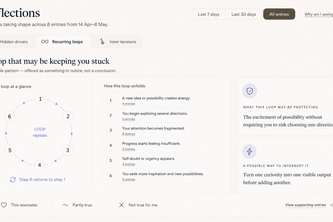
The description states that Orion is a "reflective intelligence system" that analyzes diary entries to surface hidden drivers, recurring loops, and inner tensions. It claims to convert scattered thoughts into patterns and behavioral insights.
The author describes building three reflection headers:
- Hidden Drivers
- Recurring Loops
- Inner Tensions
And eight themes for analysis:
- Career
- Wealth
- Health
- Romantic Relationships
- Family and Friends
- Personal Growth
- Fun
- Home and Lifestyle
The system is described as reverse-engineering the user experience and backend architecture from these reflection headers and themes.
Evidence The author's own write-up, self-reported.
Confidence Low — this is a single-person project with no external validation or evidence of actual product use.
Positioning & Claim Evolution
The author states that Orion helps users see "what we cannot easily notice by looking at only one week or one month of our lives." It aims to make "hidden mental blockers" visible through longitudinal analysis of thoughts.
The positioning appears to be:
- Personal development
- AI-powered introspection
- Longitudinal pattern recognition
- Metacognition tool
The claim evolution shows a progression from personal insight (diary entries) to a structured system that can detect patterns over time, with the goal of helping users understand their own behavior.
Evidence The author's own write-up, self-reported.
Confidence Low — no external validation or market positioning data provided.
Target Customer & ICP
The description states that Orion is designed for individuals who keep diary entries and want to see patterns in their thoughts over time. It targets people interested in personal growth and introspection.
The author does not specify any细分 customer segments beyond "users" or "people with diary entries." There is no evidence of a defined ICP, target persona, or customer segmentation.
Evidence The author's own write-up, self-reported.
Confidence Low — no evidence of specific customer targeting or market research.
Business Model & Pricing Evidence
The description does not contain any information about pricing, monetization, or business model. There is no mention of subscriptions, freemium tiers, or revenue streams.
Evidence Not evidenced.
Confidence Very low — no indication of how the project would generate revenue.
Technical & Delivery Signals
The author reports building Orion using:
- ChatGPT 5.6 Sol
- Codex
- FastAPI
- Next.js
- React
- TypeScript
- Python
They also mention reverse-engineering user experience and backend architecture from reflection headers and themes.
The project was built for the OpenAI 2026 hackathon, suggesting it is a prototype or proof-of-concept rather than a production-ready product.
Evidence The author's own write-up, self-reported.
Confidence Low — this appears to be a hackathon submission with no indication of scalability or delivery maturity.
Traction & Maturity Signals
There is no evidence of user adoption, customer base, or traction beyond the single founder’s personal use. The project is described as a "first product in a larger suite" but there is no information about any prior users or usage metrics.
Evidence Not evidenced.
Confidence Very low — no signs of traction or market validation.
Competitive Context
The description does not mention any competitors or existing solutions in the personal reflection, journaling, or AI introspection space. There is no evidence of competitive analysis or positioning relative to other tools.
Evidence Not evidenced.
Confidence Very low — no indication of competitive landscape awareness.
Open Questions & Risks
- Single-founder project: No team or external validation.
- No revenue or traction: The product appears to be personal experimentation, not a scalable business.
- Unverified claims: All descriptions are self-reported and unverified.
- Limited scope: Built for a hackathon, not production-ready.
- Privacy concerns: Handling diary entries raises data privacy issues without clear safeguards described.
- No pricing or monetization strategy: No indication of how the product would be monetized.
Evidence Self-reported, inferred from lack of evidence.
Confidence Medium to high — based on absence of key signals and self-reported nature.
Questions the description leaves open
- What is your actual user base or adoption rate beyond personal use?
- How do you plan to scale this product beyond a single-person prototype?
- What are the privacy and data protection measures for handling sensitive diary entries?
- Are there any existing customers or users who have provided feedback on the AI analysis?
- What is your roadmap for monetization and business model development?
- How do you intend to validate that the AI-generated insights are accurate and actionable?
- Have you considered how to prevent over-reliance on AI for personal reflection?
Evidence Inferred from lack of evidence in description.
Overall Assessment
The project is described as a single-person hackathon submission with no evidence of traction, revenue, or customer adoption. It appears to be an experimental tool built by one person for personal use, not a scalable business opportunity.
Confidence Very low — the description does not support any commercial due-diligence conclusions.
Assessment Not suitable for investment or partnership at this stage. The project lacks evidence of market demand, scalability, or business viability beyond the founder’s personal experimentation.
User Stories BotA demo video on every pull request
Get a demo video on every new feature
GitHub App that watches your pull requests and records a narrated, captioned demo.
Save time on demo prep and make informed decisions faster with a video walkthrough of every new feature.
Source
Submitted to the OpenAI 2026 hackathon on Devpost. Project home on Devpost. Back to the full gallery on Devpost.
This competitive analysis was produced by top-founders.com (opens in a new tab)
Generated by a language model from this project's public Devpost page — its tagline, the author's own write-up and any built-with tags listed there — as captured in August 2026. Short quotations are the author's words. It is an opinion on the idea as a business, not on the people behind it, and it reflects the description as published then. If the project has moved on, request a correction below. The analysis is not independent research and contains no verified traction, revenue or customer data.
An independent guide by KFG International LLC — not affiliated with, endorsed by, or connected to Devpost or OpenAI.