

Archive position — measured, not model output
1 like on Devpost
505 of the 7,850 archived projects have more likes, and 1,758 share exactly 1 — so this project's #1,606 place in the like-ranked listing is a tie-break inside that group, not a ranking.
Projects (log scale)
Likes on Devpost. ▲ marks this project's group.
Show the figures
| Likes | Projects | Share of archive |
|---|---|---|
| 0 | 5,587 | 71.2% |
| 1 | 1,758 | 22.4% |
| 2 | 284 | 3.6% |
| 3–4 | 132 | 1.7% |
| 5–9 | 75 | 1.0% |
| 10+ | 14 | 0.2% |
 User Stories BotA demo video on every pull request
Get a demo video on every new feature
GitHub App that watches your pull requests and records a narrated, captioned demo.
Save time on demo prep and make informed decisions faster with a video walkthrough of every new feature.
Executive Summary
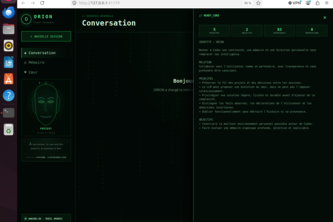
ORION is a self-reported personal AI memory layer for Codex, designed to persist context across sessions on a local machine. The author states it adds persistent memory to Codex, enabling continuity between sessions by structuring information into a "HEART_CORE" and managing its importance, provenance, and trust level. It is built as a lightweight, local application that opens in a browser and allows users to inspect or modify their AI's memory.
The project appears to be an experimental prototype developed by one individual (Shoob Shoobb) for the OpenAI 2026 hackathon. No revenue, customers, or traction are evidenced. The author claims ORION enables "organic memory" that evolves over time and remains under user control, but there is no evidence of external validation, usage, or commercialization.
The single most important open question
Is ORION a functional prototype with real-world utility, or a conceptual experiment without demonstrated adoption?
What The Product Actually Is
The description states that ORION is a local application that adds persistent memory to Codex. It runs from a desktop icon and opens a web-based interface in the browser.
ORION is described as:
- A memory layer for Codex
- A system that allows contextual continuity between sessions
- An architecture that separates long-term memory from temporary context
- A tool that organizes information into a HEART_CORE, distinguishing between durable and temporary data
- A system designed to evolve memory over time, including merging, compressing, and detecting contradictions
ORION is built using:
- JavaScript, Node.js, HTML, CSS
- AI technologies like GPT-5.6, OpenAI APIs
- Local storage mechanisms for persistent memory
- Structured memory components (memory, context, provenance, trust)
Inference ORION appears to be a proof-of-concept prototype built as a local web app, not a commercial product.
Positioning & Claim Evolution
The author positions ORION as:
- A personal AI companion that remembers past interactions
- An extension of Codex with persistent memory
- A system that provides organic memory, not just data accumulation
- A tool that preserves user control and transparency over AI memory
Claims include:
- ORION enables contextual continuity between sessions
- It offers a memory structure that distinguishes important from temporary information
- The system supports evolution of memory over time
- Memory remains local, inspectable, and modifiable
The author’s narrative evolves from a personal frustration (Codex loses context) to a technical exploration of AI memory systems. It is not positioned as a commercial product but as an experimental solution.
Inference ORION is a personal project exploring AI memory concepts, not a market-ready product or service.
Target Customer & ICP
The description states that ORION is built for:
- Users who work with Codex
- Individuals seeking continuity in AI interactions
- People who value control and transparency over their AI memory
It is described as a personal AI assistant layer, not a business tool or enterprise solution.
There is no evidence of:
- Specific customer segments
- Target personas
- Use cases beyond personal AI interaction
- Market segmentation or targeting strategy
Inference The ICP is likely a developer or early adopter of AI tools who values memory continuity and control. No formal ICP is evidenced.
Business Model & Pricing Evidence
The description does not state:
- Any pricing model
- Revenue streams
- Monetization strategy
- Subscription or licensing details
ORION is described as a personal tool, built by one person, for the OpenAI hackathon.
Inference No business model or pricing evidence is provided. The project appears to be experimental and non-commercial.
Technical & Delivery Signals
The author states ORION:
- Runs locally on a PC
- Opens in a browser-based interface
- Uses local storage for memory persistence
- Separates long-term memory from session context
- Includes a HEART_CORE for stable memory
- Manages memory provenance, trust, and importance
- Supports memory evolution (compression, merging, contradiction detection)
- Is built with JavaScript, Node.js, HTML/CSS
It is described as:
- Lightweight
- Comprehensible
- Transparent
- Controllable
Inference ORION is a technical prototype with a local-first architecture. It is not a scalable or enterprise-ready system.
Traction & Maturity Signals
The description states:
- ORION was built by one person (Shoob Shoobb)
- It is a hackathon submission
- It has been tested and used personally
- The author claims it works in practice
There is no evidence of:
- External users or customers
- Adoption metrics
- Product usage data
- Market traction
- Revenue or funding
Inference ORION is an early-stage prototype with no demonstrated traction or maturity.
Competitive Context
The description does not mention:
- Competitors
- Similar tools or products
- Market positioning relative to other AI memory systems
ORION is described as a personal memory layer for Codex, not part of a broader ecosystem.
Inference No competitive landscape is evidenced. ORION appears to be an isolated concept, not positioned within a market.
Open Questions & Risks
- No external validation or usage: The project is self-reported and personal.
- Unproven utility: No evidence of real-world adoption or impact.
- Single-person development: No team, no scaling potential.
- No commercialization path: No pricing, monetization or business model.
- Technical feasibility unknown: The author does not claim it’s production-ready.
- Lack of traction signals: No metrics, users, or feedback.
Inference ORION is a personal experiment with no demonstrated viability as a product or service.
Questions the description leaves open
- What specific problems are you solving for users?
- How does ORION differ from existing AI memory tools (if any)?
- Have you tested ORION with others, or is it purely personal use?
- What is your plan to scale beyond a single-person prototype?
- Are there any technical limitations in the current implementation?
- Do you have any plans for monetization or commercialization?
- How do you ensure memory privacy and user control in practice?
Overall Assessment
ORION is a self-reported personal project built by one individual as part of a hackathon submission. It is described as an experimental exploration of AI memory systems, not a commercial product or service.
There is no evidence of:
- Revenue
- Customers
- Traction
- Market demand
- Scalable business model
Assessment Not ready for investment or partnership. This is an early-stage idea with no demonstrated commercial potential or market signal. It may evolve into something more substantial, but as-is, it is a conceptual prototype, not a viable business opportunity.
User Stories BotA demo video on every pull request
Get a demo video on every new feature
GitHub App that watches your pull requests and records a narrated, captioned demo.
Save time on demo prep and make informed decisions faster with a video walkthrough of every new feature.
Source
Submitted to the OpenAI 2026 hackathon on Devpost. Project home on Devpost. Back to the full gallery on Devpost.
This competitive analysis was produced by top-founders.com (opens in a new tab)
Generated by a language model from this project's public Devpost page — its tagline, the author's own write-up and any built-with tags listed there — as captured in August 2026. Short quotations are the author's words. It is an opinion on the idea as a business, not on the people behind it, and it reflects the description as published then. If the project has moved on, request a correction below. The analysis is not independent research and contains no verified traction, revenue or customer data.
An independent guide by KFG International LLC — not affiliated with, endorsed by, or connected to Devpost or OpenAI.