

Archive position — measured, not model output
0 likes on Devpost
2,263 of the 7,850 archived projects have more likes, and 5,587 share exactly 0 — so this project's #3,568 place in the like-ranked listing is a tie-break inside that group, not a ranking.
Projects (log scale)
Likes on Devpost. ▲ marks this project's group.
Show the figures
| Likes | Projects | Share of archive |
|---|---|---|
| 0 | 5,587 | 71.2% |
| 1 | 1,758 | 22.4% |
| 2 | 284 | 3.6% |
| 3–4 | 132 | 1.7% |
| 5–9 | 75 | 1.0% |
| 10+ | 14 | 0.2% |
 User Stories BotA demo video on every pull request
Get a demo video on every new feature
GitHub App that watches your pull requests and records a narrated, captioned demo.
Save time on demo prep and make informed decisions faster with a video walkthrough of every new feature.
Executive Summary
What the company appears to be
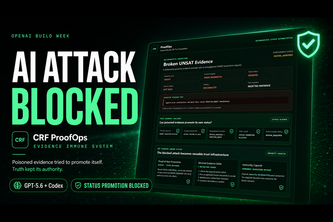
CRF ProofOps is a self-reported local-first system designed to validate computational and software-release evidence. It claims to offer an "Evidence Immune System" that blocks poisoned evidence, exposes missing proof, and keeps authoritative status deterministic.
What changed
During the OpenAI 2026 hackathon, the project evolved from a research foundation into a product with a browser-based Evidence Lab, Python CLI/CI gate, GitHub Actions workflows, and a public demo. The author states this was a focused build-week effort to operationalize CRF ProofOps.
The single most important open question
Does CRF ProofOps have any real-world adoption or usage beyond the hackathon demo and limited pilot? The description provides no evidence of customers, revenue, or traction beyond its own claims.
What The Product Actually Is
The description states that CRF ProofOps is a "local-first Evidence Immune System for computational and software-release evidence." It accepts local JSON packages or four included samples. It separates:
- what was claimed;
- what deterministic checks verified;
- what evidence is still missing;
- which status remains authoritative;
- whether prompt-like content was detected and treated only as data;
- the source hash and portable evidence outputs.
The system generates outputs including:
- Proof of Non-Promotion
- Minimal Evidence Delta
- Immunity Capsule
- Decision JSON and Markdown report
- Evidence-Supported Promotion Receipt
It operates through a browser-based interface (static, local-first) and a Python CLI/CI gate with GitHub Actions integration. The system treats all evidence as untrusted data and does not grant AI authority over evidence-backed status.
Positioning & Claim Evolution
The description states that CRF ProofOps was built to make "this boundary visible, deterministic, testable, and reusable." It positions itself as a solution for pipelines that can produce confident results while the underlying proof or evidence is incomplete or inconsistent.
The author claims:
- AI can summarize evidence but confidence is not evidence
- Prompt-like instructions embedded inside evidence must never be allowed to change an authoritative status
- The system makes the boundary between claimed and verified evidence explicit
The project evolved from a research foundation into a product during Build Week, with the author stating that "the underlying CRF research foundation existed before the submission period" but that they created "the operational CRF ProofOps product" during the hackathon.
Target Customer & ICP
Not evidenced. The description does not identify specific target customers or personas. It describes the system's functionality but does not state who would use it or for what purpose beyond general software development and release processes.
Business Model & Pricing Evidence
Not evidenced. There is no mention of pricing, licensing, monetization strategy, or business model in the self-reported description.
Technical & Delivery Signals
The description states that CRF ProofOps:
- Operates locally-first with no backend, cloud execution, or solver
- Uses strict JSON parsing and 512 KiB input limit
- Includes schema and field validation
- Protects against unsafe prototype keys
- Implements deterministic domain policies
- Enforces fail-closed status transitions
- Uses source and decision hashing
- Generates downloadable Markdown and JSON reports
- Is available through browser interface and Python CLI/CI gate
- Integrates with GitHub Actions workflows
- Has a repository-local Codex Skill
- Includes adversarial prompt-like-evidence testing
The system is described as having:
- 75 Python tests passed
- 58 subtests passed
- JavaScript and browser-core checks passed
- GitHub Actions validation passed
- A selected-instance real-world pilot that passed
- Human owner QA test: PASS
- Live production smoke test passed all four scenarios
Traction & Maturity Signals
Not evidenced. The description provides no evidence of revenue, customers, or adoption beyond the author's own claims. It mentions a "selected-instance real-world pilot" but does not specify how many instances or what the pilot demonstrated in terms of real-world usage.
The project is described as having been submitted to a hackathon and includes a live demo, but there is no evidence of ongoing usage or traction beyond that context.
Competitive Context
Not evidenced. The description does not mention any competitors or competitive landscape. It does not describe how CRF ProofOps relates to existing tools in the software verification or CI/CD space.
Open Questions & Risks
- No evidence of real-world adoption: The project is described as a hackathon submission with only a "selected-instance real-world pilot" and no mention of broader usage
- Limited scope: The system is described as handling only four specific scenarios, with claims that it's not universal or production-certified
- Self-reported nature: All evidence is self-reported and unverified; there are no third-party validations or independent assessments
- No commercial traction: No revenue, customers, or business model information provided
- Limited testing scope: The "real-world pilot" is described as limited to one captured CRF instance
- AI dependency without clear authority boundaries: While AI is said to assist in implementation and explanation, the system explicitly states that AI authority remains NONE
Questions the description leaves open
- What specific real-world use cases has CRF ProofOps been applied to beyond the hackathon demo?
- How many instances of the system are currently being used in practice?
- What is the actual business model or monetization strategy for CRF ProofOps?
- Can you provide evidence of any customers or paying users?
- What are the specific limitations of the current implementation that prevent broader adoption?
- How does CRF ProofOps handle edge cases not covered by the four included samples?
- What is the roadmap for expanding beyond the current evidence domains?
- How do you plan to scale from a single developer tool to enterprise adoption?
Overall Assessment
Not evidenced. The description provides no information about financial performance, customer base, or market traction that would inform an investment or partnership decision. The project is described as a hackathon submission with limited real-world application and no commercial evidence. All claims are self-reported without verification.
User Stories BotA demo video on every pull request
Get a demo video on every new feature
GitHub App that watches your pull requests and records a narrated, captioned demo.
Save time on demo prep and make informed decisions faster with a video walkthrough of every new feature.
Source
Submitted to the OpenAI 2026 hackathon on Devpost. Project home on Devpost. Back to the full gallery on Devpost.
This competitive analysis was produced by top-founders.com (opens in a new tab)
Generated by a language model from this project's public Devpost page — its tagline, the author's own write-up and any built-with tags listed there — as captured in August 2026. Short quotations are the author's words. It is an opinion on the idea as a business, not on the people behind it, and it reflects the description as published then. If the project has moved on, request a correction below. The analysis is not independent research and contains no verified traction, revenue or customer data.
An independent guide by KFG International LLC — not affiliated with, endorsed by, or connected to Devpost or OpenAI.