

Archive position — measured, not model output
0 likes on Devpost
2,263 of the 7,850 archived projects have more likes, and 5,587 share exactly 0 — so this project's #7,494 place in the like-ranked listing is a tie-break inside that group, not a ranking.
Projects (log scale)
Likes on Devpost. ▲ marks this project's group.
Show the figures
| Likes | Projects | Share of archive |
|---|---|---|
| 0 | 5,587 | 71.2% |
| 1 | 1,758 | 22.4% |
| 2 | 284 | 3.6% |
| 3–4 | 132 | 1.7% |
| 5–9 | 75 | 1.0% |
| 10+ | 14 | 0.2% |
 User Stories BotA demo video on every pull request
Get a demo video on every new feature
GitHub App that watches your pull requests and records a narrated, captioned demo.
Save time on demo prep and make informed decisions faster with a video walkthrough of every new feature.
Executive Summary
What the company appears to be
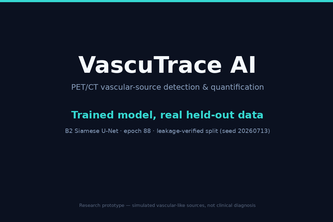
VASCTRACE AI is a self-reported research prototype that uses AI and medical imaging to simulate and detect subtle vascular FDG abnormalities in PET/CT scans. It is not a diagnostic tool, but an end-to-end pipeline for controlled research using simulated data.
What changed
The project was built as part of the OpenAI 2026 hackathon submission. The authors describe a methodological approach that integrates AI agents (Codex + GPT-5.6) into scientific research workflows, with a focus on reproducibility and determinism in measurement code.
Single most important open question
Is there any evidence of traction, revenue, or adoption beyond the hackathon project description? The self-reported nature of this information means that no commercial or clinical deployment is evidenced.
What The Product Actually Is
The description states that VASCTRACE AI is a physics-informed PET/CT research copilot. It is described as:
- A research prototype, not a diagnostic system.
- Trained and evaluated on simulated vascular-like FDG sources.
- Built using a 2.5-D shared-weight Siamese U-Net for detecting abnormalities.
- Uses controlled synthetic-source engine to insert parameterized FDG sources into raw SUV data.
- Includes deterministic 3-D quantification, returning SUV statistics or structured nulls with QC reasons.
- Operates on a public QUADRA healthy test/retest cohort (Zenodo 16686025).
- Implements a verifier that rejects generated reports if numbers or claims drift.
The system is described as an end-to-end pipeline, not a product for clinical use, and is explicitly labeled as a research prototype.
Claim: VascuTrace AI is a research tool.
Evidence: The description states it is a "research prototype trained and evaluated on simulated vascular-like sources" and that “no result here establishes clinical sensitivity, specificity, or patient benefit.”
Positioning & Claim Evolution
The project’s positioning is rooted in:
- Research methodology — using AI to automate parts of scientific research (planning, architecture, review, writing).
- Reproducibility — emphasizing deterministic code and a verifier that ensures numbers are not altered by generated language.
- Controlled experimentation — focusing on simulated data under controlled conditions rather than clinical diagnostics.
The claim evolution is:
- Initial claim: A method to detect vascular-like FDG abnormalities in healthy scans using AI.
- Refinement: The system is a research pipeline, not a diagnostic tool.
- Clarification: It uses simulated data and is not clinically validated.
Claim: VascuTrace AI is a research copilot for medical imaging.
Evidence: The description states it “owns the parts of research that usually bottleneck a small team” and uses Codex + GPT-5.6 to automate scientific workflows.
Target Customer & ICP
The description does not identify any specific customer or target market beyond the project’s own use case as a research tool.
Claim: The product is for researchers in medical imaging.
Inference: Based on the domain (PET/CT, vascular FDG abnormalities), it likely targets those working in radiology or medical imaging research.
Evidence: Not directly stated. The description focuses on the technical pipeline and not on end-users.
Business Model & Pricing Evidence
There is no evidence of a business model or pricing structure.
Claim: No commercial business model is evident.
Evidence: The project is described as a research prototype, not a product for sale or licensing. No mention of revenue, pricing, or monetization.
Technical & Delivery Signals
The system uses:
- Python 3.13, PyTorch + MONAI, NumPy/SciPy, nibabel/SimpleITK, Streamlit, Pydantic, Model Context Protocol
- Codex + GPT-5.6 for planning, architecture, and report writing
- A Siamese U-Net (B2, deep supervision) for detection
- Deterministic measurement code separate from language generation
- Auditable tool trace, executable evaluation suite, and verifier
- Controlled synthetic-source engine with ground truth by construction
Claim: The system is built with a focus on reproducibility, determinism, and scientific rigor.
Evidence: The description states that “measurement code is physically separate from generated prose” and that “numbers come from pure, side-effect-free functions.”
Traction & Maturity Signals
There is no evidence of traction or commercial adoption.
Claim: No traction or adoption beyond the hackathon project.
Evidence: The project was submitted to a hackathon. No revenue, customers, or usage data are reported.
Competitive Context
The description does not mention any direct competitors.
Claim: No competitive landscape is described.
Evidence: No mention of existing tools or systems in the same domain (medical imaging research with AI).
Open Questions & Risks
- No clinical validation — The system is explicitly a research prototype, not a diagnostic tool.
- Limited scope — Built for simulated data only; no evidence of real-world deployment.
- Self-reported only — No independent verification or external data to confirm performance claims.
- Hackathon project — Not a commercial product or venture, but a demonstration.
Claim: The system is not ready for clinical use.
Evidence: The description explicitly states that “no result here establishes clinical sensitivity, specificity, or patient benefit.”
Questions the description leaves open
- What are the next steps to move from research prototype to a product or service?
- Are there any plans to validate this system on real-world data or with clinical partners?
- Has the team considered how to scale this beyond the current hackathon-level implementation?
- Is there any interest in licensing or commercializing this research pipeline?
- What would be required to make this suitable for clinical deployment?
Overall Assessment
Not evidenced — There is no evidence of revenue, customers, traction, or a clear path to monetization.
Claim: No investment or partnership potential is evident from the description.
Evidence: The project is described as a hackathon submission and research prototype with no commercial or clinical deployment.
User Stories BotA demo video on every pull request
Get a demo video on every new feature
GitHub App that watches your pull requests and records a narrated, captioned demo.
Save time on demo prep and make informed decisions faster with a video walkthrough of every new feature.
Source
Submitted to the OpenAI 2026 hackathon on Devpost. Project home on Devpost. Back to the full gallery on Devpost.
This competitive analysis was produced by top-founders.com (opens in a new tab)
Generated by a language model from this project's public Devpost page — its tagline, the author's own write-up and any built-with tags listed there — as captured in August 2026. Short quotations are the author's words. It is an opinion on the idea as a business, not on the people behind it, and it reflects the description as published then. If the project has moved on, request a correction below. The analysis is not independent research and contains no verified traction, revenue or customer data.
An independent guide by KFG International LLC — not affiliated with, endorsed by, or connected to Devpost or OpenAI.