

Archive position — measured, not model output
0 likes on Devpost
2,263 of the 7,850 archived projects have more likes, and 5,587 share exactly 0 — so this project's #6,953 place in the like-ranked listing is a tie-break inside that group, not a ranking.
Projects (log scale)
Likes on Devpost. ▲ marks this project's group.
Show the figures
| Likes | Projects | Share of archive |
|---|---|---|
| 0 | 5,587 | 71.2% |
| 1 | 1,758 | 22.4% |
| 2 | 284 | 3.6% |
| 3–4 | 132 | 1.7% |
| 5–9 | 75 | 1.0% |
| 10+ | 14 | 0.2% |
 User Stories BotA demo video on every pull request
Get a demo video on every new feature
GitHub App that watches your pull requests and records a narrated, captioned demo.
Save time on demo prep and make informed decisions faster with a video walkthrough of every new feature.
Executive Summary
What the company appears to be
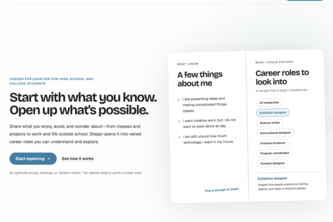
Steppi is a self-reported AI-powered tool designed to help high-school and college students explore career possibilities through conversational intake and personalized role discovery. It uses GPT-5.6 Luna to process student input into structured profiles, then generates 12–15 unranked career roles for exploration.
What changed
The original product vision was reworked from a graph-based recommendation engine (showing only 3 career branches) to an open-ended discovery experience focused on breadth before depth. The redesign emphasized helping students see more possible futures rather than making decisions for them.
Single most important open question — the commercial due-diligence read
Is there a viable market need for this type of personalized, conversational career guidance tool, and does the author have sufficient understanding of student needs to build a product that actually helps them?
What The Product Actually Is
The description states that Steppi is an AI-powered tool built with Next.js, React, TypeScript, Tailwind CSS, OpenAI APIs (specifically GPT-5.6 Luna), Zod, and Vitest. It begins with a conversational intake process where students describe their interests, classes, projects, strengths, and practical considerations.
GPT-5.6 Luna synthesizes this conversation into a structured profile and reflection. The system then generates 12 to 15 varied career possibilities presented visually in an unranked format. Students can explore each role through a personalized conversation that explains what the role involves, why it fits or doesn’t fit their interests, its day-to-day experience, and how they might explore it further.
The interface supports natural follow-up questions and allows students to confirm or rewrite what Steppi understood before proceeding.
Evidence
- The product uses GPT-5.6 Luna for core AI processing.
- It builds a structured profile from conversational input.
- It presents 12–15 unranked roles for exploration.
- Conversations are used to explain role fit and next steps.
- All OpenAI calls run server-side with validation via Zod schemas.
Inference The tool is built around a loop of conversation → profile → discovery → exploration, which suggests a focus on user engagement over immediate decision-making.
Positioning & Claim Evolution
The author positions Steppi as a tool that helps students discover career paths they didn’t know existed, through thoughtful, personalized conversation. It aims to expand possibilities rather than narrow choices, and it is rooted in the creator’s personal experience as an international student navigating U.S. education.
Initially, the product was envisioned as a recommendation engine with only three branches. However, this evolved into a broader discovery model after realizing that students needed to see more options before deciding.
Claim
Steppi helps students explore career roles without forcing them to choose immediately.
Evidence
- The author explicitly states: “Steppi is built around breadth before depth.”
- Earlier version generated only 3 branches; redesigned for 12–15 unranked roles.
- The goal is not to predict the correct career but to help students see more possible futures.
Inference The positioning reflects a shift from AI-driven prediction toward AI-assisted exploration, aligning with the creator’s background in education research and personal need for better guidance.
Target Customer & ICP
The description states that Steppi targets high-school and college students, particularly those who lack access to personalized guidance — such as international students or others without institutional support.
It also mentions a focus on students who may not have access to guidance that understands their circumstances.
Claim
Steppi is for students seeking personalized career exploration, especially those without traditional mentorship.
Evidence
- The tool is designed for high-school and college students.
- The author’s own experience as an international student informs the product.
- It aims to help students who “did not always have access to guidance that understood [their] situation.”
Inference The ICP likely includes students in transition phases (e.g., from high school to college, or exploring majors), particularly those with limited institutional support.
Business Model & Pricing Evidence
There is no evidence provided about a business model or pricing structure. The description does not mention monetization, subscriptions, licensing, or any revenue streams.
Not evidenced
Technical & Delivery Signals
Steppi is built using modern web technologies including Next.js, React, TypeScript, Tailwind CSS, and OpenAI APIs (specifically GPT-5.6 Luna). It includes server-side API handling, Zod schema validation, bounded retries, deterministic checks, and automated testing with Vitest.
The interface supports keyboard navigation, reduced motion settings, and mobile/desktop compatibility. The author notes that over 200 automated tests were used to verify functionality.
Evidence
- Built with Next.js, React, TypeScript, Tailwind CSS, OpenAI APIs.
- Uses GPT-5.6 Luna for core AI processing.
- All API calls run server-side with Zod validation and retry logic.
- Includes loading, retry, failure, and malformed-output states.
- Supports keyboard navigation and reduced motion.
- Over 200 automated tests.
Inference The technical stack indicates a modern, scalable web application. The inclusion of robust error handling and testing suggests attention to reliability and user experience.
Traction & Maturity Signals
There is no evidence of traction or maturity in terms of users, revenue, customers, or adoption metrics. The project is described as a hackathon submission by one individual (Pope Cruz) with no mention of real-world usage or feedback loops.
Not evidenced
Competitive Context
The description does not provide any information about existing competitors or market positioning relative to other tools for career exploration or AI guidance platforms.
Not evidenced
Open Questions & Risks
- Lack of traction: No evidence of users, customers, or real-world impact.
- Unproven market need: The author’s claims are based on personal experience and self-reporting; there is no external validation.
- AI reliability concerns: Despite schema validation and retries, the description notes that valid outputs can still be unhelpful or repetitive.
- Single-person development: With only one team member (Pope Cruz), scalability and long-term maintenance may be uncertain.
- Unclear monetization path: No indication of how the product would generate revenue or sustain itself beyond a prototype.
Inference The lack of external validation, user data, or business model makes it difficult to assess whether Steppi addresses a real market need or can evolve into a viable product.
Questions the description leaves open
- What specific feedback have you received from students who tested the tool?
- How do you plan to validate that the generated career roles are actually useful and relevant to students?
- Have you identified any potential institutional partnerships (e.g., schools, universities)?
- What is your strategy for scaling beyond a single developer?
- Are there any regulatory or ethical considerations around using AI in educational settings?
Overall Assessment
There is no evidence of revenue, customers, traction, or validated demand for Steppi. The project is described as a hackathon submission by one person and lacks any indication of commercial viability or product-market fit.
Assessment Not evidenced. This is an early-stage idea with no demonstrated traction or business model. It requires further validation through user testing, market research, and evidence of demand before any investment or partnership consideration can be made.
User Stories BotA demo video on every pull request
Get a demo video on every new feature
GitHub App that watches your pull requests and records a narrated, captioned demo.
Save time on demo prep and make informed decisions faster with a video walkthrough of every new feature.
Source
Submitted to the OpenAI 2026 hackathon on Devpost. Project home on Devpost. Back to the full gallery on Devpost.
This competitive analysis was produced by top-founders.com (opens in a new tab)
Generated by a language model from this project's public Devpost page — its tagline, the author's own write-up and any built-with tags listed there — as captured in August 2026. Short quotations are the author's words. It is an opinion on the idea as a business, not on the people behind it, and it reflects the description as published then. If the project has moved on, request a correction below. The analysis is not independent research and contains no verified traction, revenue or customer data.
An independent guide by KFG International LLC — not affiliated with, endorsed by, or connected to Devpost or OpenAI.