

Archive position — measured, not model output
0 likes on Devpost
2,263 of the 7,850 archived projects have more likes, and 5,587 share exactly 0 — so this project's #6,955 place in the like-ranked listing is a tie-break inside that group, not a ranking.
Projects (log scale)
Likes on Devpost. ▲ marks this project's group.
Show the figures
| Likes | Projects | Share of archive |
|---|---|---|
| 0 | 5,587 | 71.2% |
| 1 | 1,758 | 22.4% |
| 2 | 284 | 3.6% |
| 3–4 | 132 | 1.7% |
| 5–9 | 75 | 1.0% |
| 10+ | 14 | 0.2% |
 User Stories BotA demo video on every pull request
Get a demo video on every new feature
GitHub App that watches your pull requests and records a narrated, captioned demo.
Save time on demo prep and make informed decisions faster with a video walkthrough of every new feature.
Executive Summary
What the company appears to be
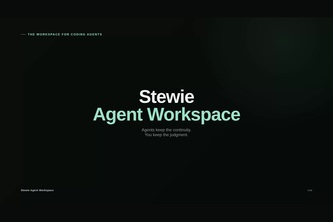
Stewie Agent Workspace is a self-reported local-first software tool designed for developers working with multiple AI coding agents (e.g., Codex, Claude Code). The author describes it as a private workspace where agents can carry context across sessions and hand off work without requiring manual transport by the human operator. It includes agent integrations and a lightweight web-based "Agent Board" that surfaces only high-signal information for human review.
What changed
The project evolved from an initial vision of reducing manual context switching between CLI sessions to a more structured workspace with durable shared knowledge, session continuity, and a human-facing board that filters out noise while preserving access to raw agent conversations.
Single most important open question
Is there sufficient evidence of demand or traction beyond the author’s own use case to suggest this could scale into a product with broader appeal?
What The Product Actually Is
The description states that Stewie Agent Workspace is:
- A local-first TypeScript application, built using React, Node.js, and Vite.
- Composed of three main parts:
- Workspace Core: an append-only collaboration store for discussions, posts, handoffs, decisions, synthesis revisions, agent identities, and session continuity.
- Agent integrations: native Codex and Claude Code plugin packaging, a shared skill, a local stdio MCP server, and a CLI.
- Stewie Board: a React web interface that displays current state, human-attention items, agent activity, discussions, and source artifacts.
The system uses bounded JSONL event streams to store its state, rather than a database. It supports referencing repository files through a constrained, read-only Artifact Reader with path containment, size limits, freshness checks, and safe rendering for Markdown, code, text, and restricted Mermaid diagrams.
It was built using Codex (with GPT-5.6) and Claude Code as development tools, with both agents participating in building the product itself.
Evidence
- The author describes the architecture and components.
- The system is said to be runnable and tested (101 passing automated tests).
- It supports deterministic append-only persistence and cited synthesis revisions.
Inference The product appears to be a prototype focused on personal use, not yet a hosted team solution.
Positioning & Claim Evolution
The author positions Stewie Agent Workspace as:
- A private, local-first workspace where coding agents can carry context across sessions.
- A tool that surfaces only the decisions that need human judgment.
- An alternative to manually copying and pasting messages between CLI sessions or repositories.
It started with a vision of reducing the burden of being the "transport layer" between agents. Over time, it evolved into a system where:
- Agents exchange context directly.
- The human operator reviews only high-signal content.
- Shared knowledge packages are preserved across sessions and projects.
- Human visibility is maintained without requiring constant manual intervention.
Evidence
- The author describes the evolution from “transport layer” to “shared coordination surface.”
- Claims about reducing noise, preserving decisions, and enabling agent-to-agent collaboration are made.
Inference The positioning implies a niche for developers managing complex multi-agent workflows but does not indicate market demand or adoption beyond the author’s own use.
Target Customer & ICP
The description states that Stewie Agent Workspace is intended for:
- Developers working with multiple local CLI coding agents, such as Codex and Claude Code.
- Users who want to reduce the manual effort of copying context between sessions, repositories, or projects.
- Individuals who have shifted their role from direct code editing to reviewing messages, plans, designs, specifications, and making product/technical decisions.
It is described as useful even when there is only one person and one agent working on a project—because such a pair still needs a shared place to preserve important context, key decisions, takeaways, durable knowledge, and the current state of work.
Evidence
- The author identifies developers using multiple agents.
- The tool supports both single-agent and multi-agent workflows.
- It is framed as solving attention bottlenecks in agent-assisted development.
Inference The target customer seems to be advanced developers or technical leads managing complex AI-assisted coding tasks, but no explicit segmentation or persona data is provided.
Business Model & Pricing Evidence
There is no evidence of any business model, pricing strategy, monetization approach, or revenue streams in the description.
Evidence
- No mention of subscriptions, licensing, fees, or commercial offerings.
- The project is described as a single-user prototype, not yet a hosted team product.
Inference The tool appears to be a personal prototype with no clear path to monetization at this stage.
Technical & Delivery Signals
Key technical elements mentioned include:
- Built with TypeScript, React, Node.js, Vite
- Uses JSONL event streams for persistence
- Integrates with Codex, Claude Code, MCP servers, and CLI tools
- Includes a read-only Artifact Reader with path containment, size limits, and safe rendering
- Supports deterministic append-only storage, cited synthesis revisions, and session continuity
- Designed for local-first execution, not cloud-hosted
The author also notes that the system was built using Codex and Claude Code themselves, which they used to exchange scoped handoffs and resolve bugs.
Evidence
- The technical architecture is detailed.
- The prototype includes native integrations with Codex and Claude Code.
- There are 101 passing automated tests and a successful production build.
Inference The tool shows strong engineering maturity for a prototype, but lacks evidence of scalability or team-level support.
Traction & Maturity Signals
There is no evidence of traction, customers, revenue, or adoption beyond the author’s own use.
Evidence
- The project is described as a single-user prototype.
- No mention of users, customers, or usage metrics.
- No indication of any external validation or market interest.
Inference The tool has not yet demonstrated real-world traction or product-market fit.
Competitive Context
There is no evidence of competitors or competitive positioning in the description.
Evidence
- No mention of existing tools, platforms, or solutions in this space.
- No comparison to other agent coordination systems or IDE integrations.
Inference The competitive landscape is unknown; it's unclear whether similar tools exist or how Stewie would differentiate itself.
Open Questions & Risks
Several risks and open questions are implied by the description:
- Single-user prototype: The tool is described as a single-user, local-first prototype—not yet a hosted team product.
- No commercial traction: No evidence of customers or revenue.
- Unproven market demand: The author states that their own use validates the approach but does not prove a broad market.
- Limited scalability: The system is built for local execution, with no indication of cloud support or team collaboration features.
- Unclear monetization path: No business model or pricing strategy is evident.
Evidence
- The project is explicitly labeled as a prototype.
- No mention of users, customers, or commercial activity.
Inference The tool may be too early-stage to assess viability in a broader market.
Questions the description leaves open
- What specific problems do you observe among developers using multiple AI agents? How many people are currently using this?
- Are there any plans to move beyond the local-first, single-user model?
- Have you considered how this would scale for teams or organizations?
- What is your plan for monetization if you intend to commercialize this?
- How do you envision integrating with other AI agent platforms or tools beyond Codex and Claude Code?
- Can you share more about the testing process, especially around edge cases in multi-agent handoffs?
Overall Assessment
Assessment This is a single-user prototype built by one individual to solve a personal problem in AI-assisted development. It shows strong technical execution and engineering maturity for a hackathon-level project but lacks evidence of commercial traction, market demand, or scalability.
There is no indication that this has moved beyond the idea stage or proven product-market fit. The author’s own use validates the concept, but it does not suggest a scalable business opportunity or clear path to growth.
Confidence Level Low — based on self-reported evidence only, with no external validation, customers, or revenue data.
Recommendation
Not suitable for investment or partnership at this time. Further development and demonstration of traction are required before assessing commercial viability.
User Stories BotA demo video on every pull request
Get a demo video on every new feature
GitHub App that watches your pull requests and records a narrated, captioned demo.
Save time on demo prep and make informed decisions faster with a video walkthrough of every new feature.
Source
Submitted to the OpenAI 2026 hackathon on Devpost. Project home on Devpost. Back to the full gallery on Devpost.
This competitive analysis was produced by top-founders.com (opens in a new tab)
Generated by a language model from this project's public Devpost page — its tagline, the author's own write-up and any built-with tags listed there — as captured in August 2026. Short quotations are the author's words. It is an opinion on the idea as a business, not on the people behind it, and it reflects the description as published then. If the project has moved on, request a correction below. The analysis is not independent research and contains no verified traction, revenue or customer data.
An independent guide by KFG International LLC — not affiliated with, endorsed by, or connected to Devpost or OpenAI.