

Archive position — measured, not model output
0 likes on Devpost
2,263 of the 7,850 archived projects have more likes, and 5,587 share exactly 0 — so this project's #3,031 place in the like-ranked listing is a tie-break inside that group, not a ranking.
Projects (log scale)
Likes on Devpost. ▲ marks this project's group.
Show the figures
| Likes | Projects | Share of archive |
|---|---|---|
| 0 | 5,587 | 71.2% |
| 1 | 1,758 | 22.4% |
| 2 | 284 | 3.6% |
| 3–4 | 132 | 1.7% |
| 5–9 | 75 | 1.0% |
| 10+ | 14 | 0.2% |
 User Stories BotA demo video on every pull request
Get a demo video on every new feature
GitHub App that watches your pull requests and records a narrated, captioned demo.
Save time on demo prep and make informed decisions faster with a video walkthrough of every new feature.
Executive Summary
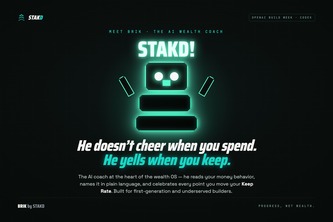
What the company appears to be: BRIK is described as an AI Wealth Reasoning Layer for STAKD, a financial operating system focused on helping underserved individuals understand what they "keep" in their finances — i.e., how much of their income they actually retain after expenses. It is positioned as a reasoning layer that explains changes in a user's "Monthly Keep Rate", why those changes occurred, and what actions might be taken next.
What changed: The project was submitted to the OpenAI 2026 Build Week hackathon by one founder (Ty Penson), who describes it as an extension of STAKD’s existing financial engine. It includes a live GPT-5.6 Sol Analyst, deterministic logic for other roles in its reasoning system (e.g., Strategist, Guardian), and a native integration with React Native/Expo.
Single most important open question: Is there any evidence that BRIK or STAKD has moved beyond the Build Week prototype stage, including whether it has real users, revenue, or traction?
Note: This analysis is based entirely on the self-reported project description provided by the author. No external verification or historical data are available.
What The Product Actually Is
The description states that BRIK is:
- An AI Wealth Reasoning Layer for STAKD
- A system that explains what changed in a user’s Monthly Keep Rate, why it changed, and what could happen next
- Built on top of STAKD's deterministic "Keep Engine"
- Not a budgeting dashboard but an explanation layer over financial data
BRIK is described as including:
- An Analyst powered by GPT-5.6 Sol
- A set of roles: Analyst, Oracle, Strategist, Guardian, and BRIK (synthesis)
- A live demonstration using OpenAI’s API via the OpenAI Responses API
- Native integration with React Native/Expo for mobile app use
- Supabase Edge Functions for backend logic
It is not evident whether BRIK is a standalone product or part of a larger platform. The description implies it's an extension of STAKD.
Claim: BRIK is described as a reasoning layer that uses AI to interpret financial data.
Evidence: The author states: “BRIK is the AI Wealth Reasoning Layer for STAKD...” and “BRIK then helps a builder answer four questions…”
Positioning & Claim Evolution
The author positions BRIK as:
- A tool for underserved populations to understand wealth-building
- Focused on what users "keep" rather than how much they earn or spend
- A system that answers the question: “How much did you keep?”
- Not another budgeting dashboard, but a reasoning engine over financial truth
The project evolved from:
- STAKD’s existing deterministic financial engine
- A Build Week hackathon submission (OpenAI 2026)
- A prototype with a synthetic user (Maya) and live GPT-5.6 Sol integration
Claim: BRIK is positioned as a tool to help people understand wealth creation.
Evidence: “It is a financial operating system founded on the principal that it aint about what you earn it's about what you keep.”
Target Customer & ICP
The description states:
- The target audience is "underserved and underrepresented people"
- The founder’s personal background includes growing up in a low-income household
- The goal is to help those who lack access to financial education or tools
No specific customer segments, personas, or user types are named.
Claim: BRIK targets underserved individuals seeking wealth-building guidance.
Evidence: “I grew up on the West Side of Chicago... I wanted to created something to do my small piece of helping underserved and underrepresented people have an opportunity to create wealth.”
Business Model & Pricing Evidence
There is no evidence in the description of:
- Revenue model
- Pricing structure
- Monetization strategy
- Customer acquisition or retention plans
Finding: Not evidenced.
Technical & Delivery Signals
The project uses:
- GPT-5.6 Sol via OpenAI Responses API
- React Native and Expo for native app delivery
- Supabase Edge Functions for backend logic
- Vercel for public web demo deployment
- Structured Outputs with JSON schema
- Deterministic fallback behavior
- Server-side API protection and rate limiting
The system is described as:
- Not allowing AI to invent or alter financial figures
- Using STAKD’s engine as the source of truth
- Having a clear boundary between deterministic and generative logic
Claim: The product uses structured, deterministic logic for financial truth and generative AI for reasoning.
Evidence: “STAKD calculates every number... OpenAI may explain supplied values... It may not invent, replace, alter, or independently re-derive financial figures.”
Traction & Maturity Signals
The description states:
- The project was built during a Build Week hackathon
- A synthetic user (Maya) is used in the demo
- There is no mention of real users, customers, or revenue
- No evidence of product-market fit or adoption
Finding: Not evidenced.
Competitive Context
There is no mention of:
- Competitors
- Market size
- Competitive positioning
- Prior products or services in this space
Finding: Not evidenced.
Open Questions & Risks
Key concerns include:
- The project is described as a Build Week prototype, not a production-ready product
- No evidence of real users or revenue
- The use of GPT-5.6 Sol (a non-existent model) raises questions about technical claims
- The lack of any traction or monetization strategy
- The founder’s background is personal but does not indicate prior business experience
Inference: If BRIK is only a prototype, it may not yet be viable for commercial use.
Claim: The project lacks evidence of real-world application or scalability.
Evidence: “Before Build Week, STAKD already included...” and “During Build Week, we added...”
Questions the description leaves open
- Has BRIK moved beyond the Build Week prototype stage?
- Are there any real users or customers currently using BRIK?
- What is the current revenue model or monetization plan?
- How does BRIK integrate with existing financial tools or platforms?
- What are the plans for scaling beyond the demo and synthetic user?
- Is there a roadmap for production multi-agent orchestration, scenario modeling, or automation?
Overall Assessment
At this stage, BRIK appears to be a conceptual prototype built during a hackathon. It is not evident whether it has moved beyond the demo phase or gained any traction.
Assessment: Not ready for investment or partnership unless further evidence of traction, users, or product-market fit emerges.
Confidence Level: Low — based on self-reported, unverified information and lack of external validation or data.
User Stories BotA demo video on every pull request
Get a demo video on every new feature
GitHub App that watches your pull requests and records a narrated, captioned demo.
Save time on demo prep and make informed decisions faster with a video walkthrough of every new feature.
Source
Submitted to the OpenAI 2026 hackathon on Devpost. Project home on Devpost. Back to the full gallery on Devpost.
This competitive analysis was produced by top-founders.com (opens in a new tab)
Generated by a language model from this project's public Devpost page — its tagline, the author's own write-up and any built-with tags listed there — as captured in August 2026. Short quotations are the author's words. It is an opinion on the idea as a business, not on the people behind it, and it reflects the description as published then. If the project has moved on, request a correction below. The analysis is not independent research and contains no verified traction, revenue or customer data.
An independent guide by KFG International LLC — not affiliated with, endorsed by, or connected to Devpost or OpenAI.