

Archive position — measured, not model output
0 likes on Devpost
2,263 of the 7,850 archived projects have more likes, and 5,587 share exactly 0 — so this project's #4,994 place in the like-ranked listing is a tie-break inside that group, not a ranking.
Projects (log scale)
Likes on Devpost. ▲ marks this project's group.
Show the figures
| Likes | Projects | Share of archive |
|---|---|---|
| 0 | 5,587 | 71.2% |
| 1 | 1,758 | 22.4% |
| 2 | 284 | 3.6% |
| 3–4 | 132 | 1.7% |
| 5–9 | 75 | 1.0% |
| 10+ | 14 | 0.2% |
 User Stories BotA demo video on every pull request
Get a demo video on every new feature
GitHub App that watches your pull requests and records a narrated, captioned demo.
Save time on demo prep and make informed decisions faster with a video walkthrough of every new feature.
Executive Summary
What the company appears to be
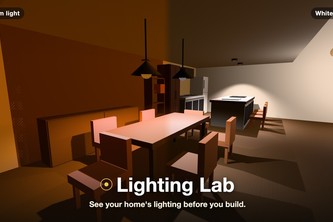
Lighting Lab is a browser-based visual simulator for comparing residential lighting options using 2D floor plans and 3D rendering. The author states it allows homeowners to experiment with lighting setups before construction, without needing to upload data to a server or create an account.
What changed
The project was built during a hackathon (OpenAI 2026) and is presented as a prototype or MVP. It includes features like importing floor plans, placing lights and furniture in 2D/3D views, adjusting lighting parameters, and exporting renders. It uses AI assistance for finalization tasks but not core code rewriting.
Single most important open question
Is there any evidence of user adoption, revenue, or traction beyond the hackathon submission? The description states no customers, revenue, or usage data exist beyond the author's own account.
Analysis basis
Self-reported and unverified. No third-party corroboration, archived history, or independent verification of claims. All statements are attributed to the author's own write-up.
What The Product Actually Is
The description states that Lighting Lab is a browser-based visual simulator for comparing residential lighting ideas on real floor plans. It allows users to:
- Import floor plans as PNG, JPG, or PDF
- Place lights, windows, furniture, stairs, and double-height zones in a 2D editor
- Adjust fixture properties like position, brightness, color temperature, dimming, and beam spread
- View changes in both 2D and 3D (with raster mode for editing and optional path-traced "Finished Look")
- Save projects locally using IndexedDB (no account required)
- Export PNG renders
- Use bilingual UI (Japanese and English) with mobile-friendly controls
It is described as intentionally not a certified photometric tool — it does not promise lux values or compliance, but rather compares the character and atmosphere of lighting options.
Confidence Low. The product is self-described as a hackathon prototype with no evidence of commercial use or adoption.
Positioning & Claim Evolution
The description states that Lighting Lab was inspired by the frustration of choosing lighting fixtures without seeing how they would look in context. It positions itself as an alternative to professional photometric software, making it accessible to homeowners who can open it in a browser and load their own floor plan.
It explicitly avoids being a certified tool ("it doesn't promise lux values or compliance") and instead focuses on visual comparison of lighting character and atmosphere.
The author also notes that the project was built during a hackathon and is presented as an MVP, not a finished product. It includes a disclaimer about honesty in design — it does not over-promise brightness accuracy.
Confidence Low. The positioning is self-reported and lacks evidence of market validation or customer feedback.
Target Customer & ICP
The description states that Lighting Lab targets homeowners planning lighting for their homes, particularly those who want to experiment with different lighting setups before construction begins. It is intended for users who are not engineers but need to make decisions about lighting aesthetics and atmosphere.
It does not specify a细分 market beyond "homeowners" or "residential lighting." The product is described as being usable by anyone with a browser, without requiring an account or server upload.
Confidence Low. No evidence of specific customer segments, personas, or buyer intent beyond the author's own experience.
Business Model & Pricing Evidence
The description does not provide any information about pricing, monetization, or business model. It states that projects are saved locally using IndexedDB and no account is required — suggesting a free-to-use model with no direct revenue streams mentioned.
Confidence Very low. No evidence of any commercial structure beyond the prototype's functionality.
Technical & Delivery Signals
The project was built using:
- Frontend: React, TypeScript, Vite, Three.js, React Three Fiber, Zustand
- Backend/Deployment: Cloudflare Pages
- Rendering: WebGL2, three-gpu-pathtracer, PDF.js, IndexedDB
- AI Assistance: Codex with GPT-5.6 for finalization tasks (not core development)
The description mentions challenges such as:
- Path tracing in browsers with varying GPU capabilities
- Handling black-image bugs in WebGL2 rendering
- Bilingual UI without corrupting saved data
- Headless testing issues with WebGL
It also notes that AI assistance was used for localization, documentation, and test hardening but not for major code rewrites near the deadline.
Confidence Medium. Technical details are provided, but no evidence of production deployment or scalability beyond prototype status.
Traction & Maturity Signals
The description states that this is a hackathon submission (OpenAI 2026) and does not provide any evidence of user adoption, revenue, customer base, or usage metrics. It includes a link to a demo site but no data on how many users interacted with it.
Confidence Very low. No traction or maturity indicators beyond the prototype's existence.
Competitive Context
The description does not mention competitors or market context. It only states that professional photometric software exists for engineers, and that Lighting Lab aims to make this accessible to homeowners.
Confidence Low. No competitive analysis or market positioning beyond self-description.
Open Questions & Risks
- No commercial traction or revenue: The project is described as a hackathon prototype with no evidence of users or monetization.
- Unproven market demand: There's no indication that homeowners actually seek this type of tool, or that there’s a market need beyond the author’s personal experience.
- Limited scalability: The product runs in a browser and uses local storage; it is unclear if it can scale to support larger user bases or more complex workflows.
- AI dependency risk: While AI was used for finalization, the core functionality does not rely on AI — but reliance on AI for future development could be risky without clear governance.
Confidence Medium. Risks are inferred from lack of evidence rather than explicit data.
Questions the description leaves open
- What inspired you to build this tool beyond your personal home project?
- Have you tested the tool with other homeowners or potential users outside of yourself?
- Are there any plans for monetization or commercial use beyond the prototype?
- How do you plan to handle data persistence and sharing across devices if users want to continue working on projects?
- What are your thoughts on expanding into commercial lighting design or partnering with hardware vendors?
Note
These questions are based on the limited information provided in the self-reported description.
Overall Assessment
Not evidenced. The project is described as a hackathon submission with no evidence of traction, revenue, customers, or commercial viability. There is no indication that it has moved beyond prototype stage or attracted any interest from investors or partners.
Confidence Very low. No basis for investment or partnership consideration beyond the author’s own account.
User Stories BotA demo video on every pull request
Get a demo video on every new feature
GitHub App that watches your pull requests and records a narrated, captioned demo.
Save time on demo prep and make informed decisions faster with a video walkthrough of every new feature.
Source
Submitted to the OpenAI 2026 hackathon on Devpost. Project home on Devpost. Back to the full gallery on Devpost.
This competitive analysis was produced by top-founders.com (opens in a new tab)
Generated by a language model from this project's public Devpost page — its tagline, the author's own write-up and any built-with tags listed there — as captured in August 2026. Short quotations are the author's words. It is an opinion on the idea as a business, not on the people behind it, and it reflects the description as published then. If the project has moved on, request a correction below. The analysis is not independent research and contains no verified traction, revenue or customer data.
An independent guide by KFG International LLC — not affiliated with, endorsed by, or connected to Devpost or OpenAI.