

Archive position — measured, not model output
0 likes on Devpost
2,263 of the 7,850 archived projects have more likes, and 5,587 share exactly 0 — so this project's #3,029 place in the like-ranked listing is a tie-break inside that group, not a ranking.
Projects (log scale)
Likes on Devpost. ▲ marks this project's group.
Show the figures
| Likes | Projects | Share of archive |
|---|---|---|
| 0 | 5,587 | 71.2% |
| 1 | 1,758 | 22.4% |
| 2 | 284 | 3.6% |
| 3–4 | 132 | 1.7% |
| 5–9 | 75 | 1.0% |
| 10+ | 14 | 0.2% |
 User Stories BotA demo video on every pull request
Get a demo video on every new feature
GitHub App that watches your pull requests and records a narrated, captioned demo.
Save time on demo prep and make informed decisions faster with a video walkthrough of every new feature.
Executive Summary
What the company appears to be
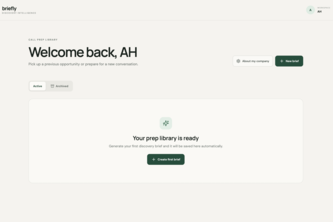
Briefly is a self-contained tool built for pre-sales consultants or sales reps to rapidly generate structured discovery call briefs using AI. It takes a prospect’s company name, industry, and contact role — plus a product from a saved profile — and outputs a ready-to-use document with company facts, pain hypotheses, tailored questions, introduction framing, and a suggested agenda.
What changed
The author describes building this tool in an iterative loop using Codex and GPT-5.6, focusing on rapid prototyping and user experience refinement. It evolved from basic input/output to include features like PDF export, calendar suggestions, dashboard persistence, and structured product profiles.
Single most important open question
Is there any evidence of real-world usage or adoption by sales teams? The description is entirely self-reported and lacks any data on customer engagement, revenue, or traction beyond the author’s personal development process.
What The Product Actually Is
The description states that Briefly is a tool designed to help pre-sales consultants or sales reps prepare for discovery calls. It uses AI (specifically Codex + GPT-5.6) to generate structured call briefs in about 20 seconds based on:
- Prospect company name, industry, and contact role
- A selected product from the user’s saved company profile
The output includes:
- Company snapshot with verified vs. hypothesis tags
- Likely pain points tailored to industry and role
- Soft introduction of the product tied to those pain points
- Seven non-generic discovery questions
- Positioning talking points
- Timed call agenda
It also offers:
- A lightweight workspace for saving company profiles and generated briefs
- Archive/unarchive functionality
- PDF export capability
- Suggested meeting times with downloadable .ics calendar files and draft follow-up emails
The tool is built using React + Vite frontend, Express backend, OpenAI API (GPT-5.6), and SQLite for local data persistence.
Evidence Self-reported by the author; no external validation or demonstration of actual use.
Positioning & Claim Evolution
The author claims that Briefly compresses an hour-long prep process into seconds without sacrificing quality. The tool aims to make discovery call preparation faster, more accurate, and less generic.
It positions itself as a solution for sales reps who struggle with:
- Time-consuming research
- Generic question sets
- Introducing their product naturally
The evolution of the product shows a progression from basic generation to adding features like:
- Live web search for company facts
- Structured output via JSON schema enforcement
- PDF export and calendar integration
- Company profile dropdowns instead of free text entry
These changes suggest an iterative approach focused on usability, reliability, and workflow optimization.
Evidence Self-reported claims about time savings and workflow improvements; no third-party validation or performance metrics provided.
Target Customer & ICP
The description indicates that Briefly targets:
- Pre-sales consultants
- Sales reps (particularly those in B2B SaaS or consultative selling roles)
It is designed for individuals who:
- Need to prepare for discovery calls quickly
- Want to avoid generic questions and pitch-first introductions
- Are looking to improve their call prep efficiency
The tool assumes users have a basic understanding of how to use AI tools like ChatGPT, and it supports a single-user model with name-based workspaces.
Evidence Self-reported target audience; no evidence of customer segmentation or feedback from actual users.
Business Model & Pricing Evidence
There is no mention in the description of pricing, monetization strategy, or business model. The tool appears to be a personal project built for demonstration purposes, likely submitted to a hackathon.
Evidence Not evidenced.
Technical & Delivery Signals
The tool was built using:
- Frontend: React 19 + Vite
- Backend: Express 5
- AI: OpenAI API (GPT-5.6), Codex
- Data storage: SQLite
- Other tech: ajv, css-grid, javascript, jsonschema, jspdf, lucidereact, npm, openai-api, openaiwebsearch, responsesapi, icalendar/.ics
Key technical decisions include:
- Server-side API calls to avoid exposing keys in the browser
- Strict JSON Schema enforcement to ensure clean output
- Lightweight workspace identifier (name-based, not OAuth)
- PDF export preserving Verified/Hypothesis labels
- Static time-slot suggestions with .ics calendar exports
The author notes several bugs fixed during development, including:
- Output parsing issues
- Inconsistent workspace handling between sessions
- Scope creep in feature additions
Evidence Self-reported technical stack and implementation details; no evidence of production deployment or scalability considerations.
Traction & Maturity Signals
There is no evidence of traction, revenue, customers, or adoption beyond the author’s own development experience. The project was submitted to a hackathon and described as a personal learning exercise.
Evidence Not evidenced.
Competitive Context
The description does not reference any existing competitors or market positioning relative to similar tools. It is unclear whether Briefly competes with CRM integrations, AI-powered sales prep platforms, or discovery call frameworks.
Evidence Not evidenced.
Open Questions & Risks
- No traction or adoption evidence: The tool exists only as a self-reported prototype.
- Single-person team: Limited capacity for scaling or iterating beyond MVP.
- Unverified AI outputs: The system relies heavily on GPT-5.6, which may produce unreliable or hallucinated content without human oversight.
- Limited persistence model: Name-based workspace identifiers could be fragile in real-world use.
- No monetization strategy: No indication of how the tool would be sold or supported commercially.
Evidence All inferred from self-reported description; no external data to support or contradict these points.
Questions the description leaves open
- What is your actual experience with discovery call prep? How did you identify this as a problem worth solving?
- Have you tested the tool with real sales teams or consultants? If so, what feedback did they give?
- Do you have any plans for integrating with CRM systems or calendar platforms beyond static .ics exports?
- What are your thoughts on data privacy and compliance given that it uses AI models like GPT-5.6?
- How do you plan to scale beyond a single-user, name-based workspace model?
- Are there any specific use cases or industries where the tool performs better or worse than others?
Overall Assessment
At this stage, Briefly appears to be a proof-of-concept prototype built by one person for a hackathon. There is no evidence of traction, revenue, or customer engagement. The tool demonstrates some technical capability and clear intent to solve a real problem in pre-sales workflows, but lacks commercial viability indicators.
Confidence Level Low
Next Steps
If this were part of a larger investment or partnership consideration, further due diligence would require:
- Evidence of early adopters or pilot usage
- A defined go-to-market strategy
- Clarification on monetization and scalability plans
Until then, the project remains a self-reported idea with no demonstrated commercial potential.
Evidence Self-reported only; no external validation or traction data.
User Stories BotA demo video on every pull request
Get a demo video on every new feature
GitHub App that watches your pull requests and records a narrated, captioned demo.
Save time on demo prep and make informed decisions faster with a video walkthrough of every new feature.
Source
Submitted to the OpenAI 2026 hackathon on Devpost. Project home on Devpost. Back to the full gallery on Devpost.
This competitive analysis was produced by top-founders.com (opens in a new tab)
Generated by a language model from this project's public Devpost page — its tagline, the author's own write-up and any built-with tags listed there — as captured in August 2026. Short quotations are the author's words. It is an opinion on the idea as a business, not on the people behind it, and it reflects the description as published then. If the project has moved on, request a correction below. The analysis is not independent research and contains no verified traction, revenue or customer data.
An independent guide by KFG International LLC — not affiliated with, endorsed by, or connected to Devpost or OpenAI.