

Archive position — measured, not model output
0 likes on Devpost
2,263 of the 7,850 archived projects have more likes, and 5,587 share exactly 0 — so this project's #4,992 place in the like-ranked listing is a tie-break inside that group, not a ranking.
Projects (log scale)
Likes on Devpost. ▲ marks this project's group.
Show the figures
| Likes | Projects | Share of archive |
|---|---|---|
| 0 | 5,587 | 71.2% |
| 1 | 1,758 | 22.4% |
| 2 | 284 | 3.6% |
| 3–4 | 132 | 1.7% |
| 5–9 | 75 | 1.0% |
| 10+ | 14 | 0.2% |
 User Stories BotA demo video on every pull request
Get a demo video on every new feature
GitHub App that watches your pull requests and records a narrated, captioned demo.
Save time on demo prep and make informed decisions faster with a video walkthrough of every new feature.
Executive Summary
What the company appears to be
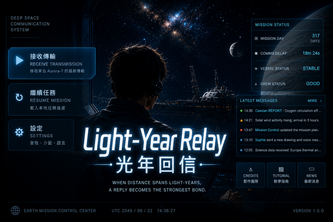
Light-Year Relay 光年回信 is a sci-fi narrative game built for the OpenAI 2026 hackathon. It is described as a decision-based game where players act as mission control in a deep-space scenario, with delayed transmissions forcing irreversible choices that affect both the mission and a family on Earth.
What changed
The project was submitted to a hackathon, indicating it is likely an early-stage prototype or proof-of-concept. No evidence of commercial traction, revenue, or customer adoption exists.
Single most important open question
Is this a playable prototype or a conceptual game with no functional implementation?
Analysis basis
Self-reported only. The description was provided by the author and has not been verified. All claims are based on the project's own words and tags. No evidence of revenue, customers, or operational history is present.
What The Product Actually Is
The description states that Light-Year Relay 光年回信 is a sci-fi decision game. It is built using technologies such as Node.js, TypeScript, OpenAI Codex, and Cloudflare, with support for web audio and narrative game design.
- The author describes it as a "decision game".
- It involves mission control in a deep-space exploration setting.
- It uses delayed transmissions to create irreversible choices.
- It is a web-based game, potentially using web audio and AI collaboration tools.
Evidence The author’s own description. No evidence of actual gameplay or functionality.
Positioning & Claim Evolution
The project is positioned as a narrative sci-fi game with a mission control theme and delayed communication mechanics. It appears to be a conceptual or hackathon submission, not a commercial product.
- The tagline: “Play as Mission Control in a sci-fi decision game where delayed transmissions force irreversible choices that shape both a deep-space mission and the family waiting on Earth.” is the only positioning statement.
- No evidence of prior versions, marketing, or evolution of claims is present.
Claim
The author positions this as a sci-fi narrative experience with strategic decision-making.
Evidence Self-reported only. No external validation or prior claims to compare against.
Target Customer & ICP
The description does not define a target customer or ideal customer profile (ICP).
- It is described as a decision game, but no indication of who plays it.
- The scenario involves mission control and family dynamics, but no user persona is defined.
- No evidence of market segmentation, audience targeting, or customer research.
Evidence Not evidenced. No mention of target users or personas.
Business Model & Pricing Evidence
There is no evidence of a business model or pricing strategy in the description.
- The project is described as a hackathon submission, not a commercial offering.
- No mention of monetization, licensing, or revenue streams.
- No pricing information or commercial intent is present.
Evidence Not evidenced. No indication of how this would be sold or funded.
Technical & Delivery Signals
The project is built with the following technologies:
- Node.js, TypeScript, OpenAI Codex, Cloudflare
- WebAudio API, webgame, indie game, sci-fi game, space exploration
- The author states it was built for a hackathon.
- It is described as a web-based game, suggesting no native app or platform dependency.
Evidence Author-declared tech stack. No evidence of delivery, scalability, or production readiness.
Traction & Maturity Signals
There is no evidence of traction or maturity.
- The project was submitted to a hackathon.
- It is described as a single-person effort (team size: 1).
- No mention of users, downloads, engagement, or adoption.
- No evidence of revenue, growth, or product-market fit.
Evidence Not evidenced. No signs of traction or commercial viability.
Competitive Context
No competitive analysis is possible from the description.
- The project is described as a hackathon submission.
- No mention of competitors or market positioning.
- No indication of how it compares to existing sci-fi or decision games.
Evidence Not evidenced. No competitive landscape or differentiation stated.
Open Questions & Risks
- Unproven concept: The project is described as a hackathon submission, not a tested product.
- No commercialization path: No evidence of monetization, users, or business model.
- Single-person team: Limited capacity for development and scaling.
- Unclear maturity: No evidence of gameplay, functionality, or delivery.
Inference The project may be conceptual or experimental, not a viable product.
Questions the description leaves open
- What is the current state of the game? Is it playable?
- How does the delayed transmission mechanic work in practice?
- Has this been tested with users or players?
- What is the intended business model or monetization strategy?
- Are there any plans to expand beyond the hackathon version?
Inference These questions are necessary due to lack of evidence on functionality and commercial intent.
Overall Assessment
There is no evidence to support a commercial investment or partnership opportunity.
- The project is described as a hackathon submission.
- No revenue, traction, or customer base is evident.
- No clear path to product-market fit or scalability.
- The team size is small (1 person), and the project lacks maturity.
Assessment Not evidenced. No basis for investment or partnership at this stage.
User Stories BotA demo video on every pull request
Get a demo video on every new feature
GitHub App that watches your pull requests and records a narrated, captioned demo.
Save time on demo prep and make informed decisions faster with a video walkthrough of every new feature.
Source
Submitted to the OpenAI 2026 hackathon on Devpost. Project home on Devpost. Back to the full gallery on Devpost.
This competitive analysis was produced by top-founders.com (opens in a new tab)
Generated by a language model from this project's public Devpost page — its tagline and any built-with tags listed there, since the author published no write-up — as captured in August 2026. Short quotations are the author's words. It is an opinion on the idea as a business, not on the people behind it, and it reflects the description as published then. If the project has moved on, request a correction below. The analysis is not independent research and contains no verified traction, revenue or customer data.
An independent guide by KFG International LLC — not affiliated with, endorsed by, or connected to Devpost or OpenAI.