

Archive position — measured, not model output
0 likes on Devpost
2,263 of the 7,850 archived projects have more likes, and 5,587 share exactly 0 — so this project's #6,944 place in the like-ranked listing is a tie-break inside that group, not a ranking.
Projects (log scale)
Likes on Devpost. ▲ marks this project's group.
Show the figures
| Likes | Projects | Share of archive |
|---|---|---|
| 0 | 5,587 | 71.2% |
| 1 | 1,758 | 22.4% |
| 2 | 284 | 3.6% |
| 3–4 | 132 | 1.7% |
| 5–9 | 75 | 1.0% |
| 10+ | 14 | 0.2% |
 User Stories BotA demo video on every pull request
Get a demo video on every new feature
GitHub App that watches your pull requests and records a narrated, captioned demo.
Save time on demo prep and make informed decisions faster with a video walkthrough of every new feature.
Executive Summary
What the company appears to be
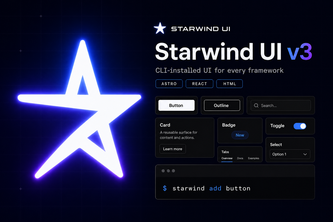
Starwind UI is a self-reported AI-native component system for developers and coding agents, built as an accessible, framework-agnostic UI library with support for Astro, React, and potentially Vue. It aims to provide polished, customizable components that live inside projects, backed by a shared behavior runtime.
What changed
The author reports using GPT-5.6 via Codex during OpenAI Build Week to turn an initial idea into a more complete product. Key developments include the creation of a framework-neutral DOM Runtime, implementation of primitive adapters for Astro and React, and a beta release process that includes CLI tooling, documentation, and performance validation.
Single most important open question
Is there evidence of real-world usage or adoption beyond the author's own development work?
This analysis is based entirely on the self-reported, unverified project description supplied by the caller. No third-party corroboration exists for any claims made in the description.
What The Product Actually Is
The description states that Starwind UI provides:
- Accessible Tailwind CSS components with familiar ergonomics
- Framework-neutral DOM Runtime owning behavior, state, focus, forms, overlays, and lifecycle
- Primitive adapters connecting frameworks to that Runtime
- Styled adapter contracts generating markup, variants, slots, icons, and Tailwind classes
- A CLI handling installation, updates, migrations, and dependencies
The product is described as a component system with three layers:
- Framework-neutral DOM Runtime
- Primitive adapters for frameworks
- Styled adapter contracts
It includes a DOM-first form system that preserves native forms while adding validation policies, accessible field composition, server errors, and participation from custom controls like Select, Combobox, and Color Picker.
Evidence The author's own write-up describes these features in detail.
Positioning & Claim Evolution
The description states:
- Starwind UI was initially inspired by shadcn/ui’s ownership model
- It evolved to address the problem of difficult-to-build accessible behaviors across frameworks
- The goal is to preserve Astro-first identity while creating one portable behavior foundation for multiple frameworks
- It positions itself as an AI-native component system for developers and coding agents
The author's own write-up indicates this was a deliberate architectural evolution from a simple Astro/Tailwind library to a more complex, framework-portable system with shared behavior runtime.
Evidence The author describes the progression of their thinking and product direction in the write-up.
Target Customer & ICP
The description states:
- Target customers are developers and coding agents
- It is positioned as a component system for developers who want accessible components they can own and customize
- The system supports Astro, React, and potentially Vue frameworks
Evidence The author's own write-up mentions these target groups and use cases.
Business Model & Pricing Evidence
Not evidenced.
The description does not contain any information about pricing models, monetization strategies, or business model details. No revenue streams, subscription tiers, or commercial arrangements are mentioned.
Technical & Delivery Signals
The description states:
- Built with Astro, React, Vue, JavaScript, TypeScript, Vite, pnpm, Vitest, Zod, Codex (GPT-5.6), commander, clack/prompts
- Uses a repository-native workflow around Codex for architecture, implementation, testing, debugging, documentation, performance analysis, and release engineering
- Implements Markdown specs for product and architecture decisions
- Divides approved specs into dependency-aware tickets
- Uses Codex to implement scoped changes in isolated Git worktrees
- Has separate Codex passes for review against spec and repository standards
- Includes tests, acceptance evidence, remaining concerns, and completion notes in the repository
- Maintains context maps, ADRs, project vocabulary, and custom Codex skills
- Built a private Vue 3.5 validation slice with generated components, SSR, hydration, browser tests, and demo
Evidence The author's own write-up details these technical approaches.
Traction & Maturity Signals
Not evidenced.
The description does not contain any information about customer adoption, usage metrics, revenue, or market traction beyond the author's own development work. No evidence of real-world usage is provided.
Competitive Context
Not evidenced.
The description does not mention competitors, market positioning relative to other UI libraries, or competitive landscape information.
Open Questions & Risks
Inferences based on the self-reported description:
- Single-person development: The team size is listed as 1, which raises concerns about scalability and long-term maintenance.
- Unverified claims: All claims are self-reported without external validation, including technical capabilities and product maturity.
- AI dependency: Heavy reliance on Codex (GPT-5.6) for development may create risks if that technology becomes unavailable or changes.
- Private Vue work: The fact that Vue adapter remains unpublished suggests incomplete development or potential quality issues.
- Beta status: Product is still in beta phase, indicating it may not be ready for production use.
Evidence These are inferences drawn from the self-reported description and general knowledge of software development practices.
Questions the description leaves open
- What specific performance metrics have been measured for package size and load times?
- How is the framework portability achieved technically, and what are the trade-offs?
- What is the actual usage or feedback from developers who have tried this system?
- How does the CLI tooling handle edge cases in real-world project setups?
- What are the concrete plans for expanding to other frameworks beyond Astro, React, and Vue?
- How is the Runtime's behavior consistency ensured across different framework implementations?
- What specific validation or testing processes exist for accessibility features?
- How does the system handle component customization and extension by users?
Overall Assessment
Not evidenced.
The description contains no information about funding rounds, valuations, investor interest, or partnership discussions. No commercial traction or financial data is provided beyond what the author states.
User Stories BotA demo video on every pull request
Get a demo video on every new feature
GitHub App that watches your pull requests and records a narrated, captioned demo.
Save time on demo prep and make informed decisions faster with a video walkthrough of every new feature.
Source
Submitted to the OpenAI 2026 hackathon on Devpost. Project home on Devpost. Back to the full gallery on Devpost.
This competitive analysis was produced by top-founders.com (opens in a new tab)
Generated by a language model from this project's public Devpost page — its tagline, the author's own write-up and any built-with tags listed there — as captured in August 2026. Short quotations are the author's words. It is an opinion on the idea as a business, not on the people behind it, and it reflects the description as published then. If the project has moved on, request a correction below. The analysis is not independent research and contains no verified traction, revenue or customer data.
An independent guide by KFG International LLC — not affiliated with, endorsed by, or connected to Devpost or OpenAI.