

Archive position — measured, not model output
0 likes on Devpost
2,263 of the 7,850 archived projects have more likes, and 5,587 share exactly 0 — so this project's #3,020 place in the like-ranked listing is a tie-break inside that group, not a ranking.
Projects (log scale)
Likes on Devpost. ▲ marks this project's group.
Show the figures
| Likes | Projects | Share of archive |
|---|---|---|
| 0 | 5,587 | 71.2% |
| 1 | 1,758 | 22.4% |
| 2 | 284 | 3.6% |
| 3–4 | 132 | 1.7% |
| 5–9 | 75 | 1.0% |
| 10+ | 14 | 0.2% |
 User Stories BotA demo video on every pull request
Get a demo video on every new feature
GitHub App that watches your pull requests and records a narrated, captioned demo.
Save time on demo prep and make informed decisions faster with a video walkthrough of every new feature.
Executive Summary
What the company appears to be
Breakpoint is a self-reported educational tool designed to diagnose student coding misconceptions, apply minimal repairs, and verify understanding before test completion. It is presented as a solution for improving student learning outcomes in programming education.
What changed
The project was submitted to the OpenAI 2026 hackathon on Devpost. No evidence of prior development or commercial activity exists beyond this submission.
Single most important open question
What is the actual mechanism by which Breakpoint diagnoses misconceptions and applies repairs, and how does it verify understanding?
Commercial due-diligence read
The description is extremely thin, self-reported, and unverified. There is no evidence of revenue, customers, traction, or even a working product. It appears to be an early-stage hackathon project with no demonstrated commercial viability or market validation.
What The Product Actually Is
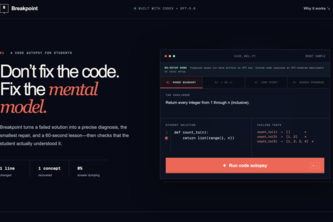
The description states that Breakpoint "diagnoses the misconception behind failed student code, applies the smallest repair, and verifies understanding before the tests turn green." This suggests a system that analyzes student code submissions, identifies conceptual errors, provides targeted feedback or fixes, and ensures comprehension before allowing progression.
However, there is no evidence of:
- A working prototype
- Technical implementation details
- Specific diagnostic algorithms
- Repair mechanisms
- Verification processes
The author declares the use of technologies including "api, chatgpt, codex, css, education, ffmpeg, gpt-5.6, next.js, node.js, openai, outputs, playwright, python, react, responses, sites, structured, tailwind, terra, typescript, web" — but no explanation of how these are integrated into the described functionality.
Positioning & Claim Evolution
The description states that Breakpoint is positioned to "diagnose the misconception behind failed student code, applies the smallest repair, and verifies understanding before the tests turn green."
This positioning implies:
- A focus on educational technology (edtech)
- An emphasis on conceptual learning over syntactic correctness
- A tool for automated assessment and feedback in programming education
The claim evolution appears to be minimal — there is no indication of prior versions or iterations. The self-description is a single sentence that defines the core functionality without elaboration.
Target Customer & ICP
The description states that Breakpoint is designed for "student code" and aims to "verify understanding before the tests turn green." This suggests an educational setting, likely in programming or computer science courses.
However, no specific customer segment is identified:
- No indication of grade level or academic context
- No mention of institutional vs. individual users
- No evidence of a defined ICP (Ideal Customer Profile)
The author identifies "education" as a technology tag, but this does not define the target market beyond the broad category.
Business Model & Pricing Evidence
There is no evidence of:
- Revenue model
- Pricing structure
- Monetization strategy
- Customer acquisition approach
- Sales process or channels
The description makes no claims about how Breakpoint would generate revenue or who would pay for it.
Technical & Delivery Signals
The author declares the following technologies were used in development:
api, chatgpt, codex, css, education, ffmpeg, gpt-5.6, next.js, node.js, openai, outputs, playwright, python, react, responses, sites, structured, tailwind, terra, typescript, web
This indicates a tech stack that includes:
- Frontend: React, Next.js, Tailwind
- Backend: Node.js, Python
- AI/ML: OpenAI APIs, GPT models (including gpt-5.6)
- Testing/automation: Playwright, FFMPEG
- Other: API integration, structured outputs
However, there is no evidence of:
- Technical architecture
- Scalability considerations
- Deployment strategy
- Performance metrics or benchmarks
Traction & Maturity Signals
The only signal of traction is that the project was submitted to the OpenAI 2026 hackathon on Devpost. No evidence exists of:
- User adoption
- Customer base
- Revenue generation
- Product development milestones
- Market validation
- Beta testing or user feedback
The team size is listed as one person (Satvik Patil), suggesting early-stage development with limited resources.
Competitive Context
There is no evidence provided about:
- Direct competitors
- Indirect substitutes
- Market size or growth trends
- Competitive advantages
- Differentiation from existing tools
The description does not mention any competitive landscape or positioning relative to other educational technology solutions.
Open Questions & Risks
- Unproven concept: The described functionality has no demonstrated implementation or results.
- Single-person team: Limited development capacity and expertise.
- Hackathon project: No evidence of sustained development beyond a competition submission.
- Unclear technical approach: No explanation of how diagnostic, repair, and verification mechanisms work.
- No commercial viability: No evidence of revenue model, customers, or market traction.
- Overreliance on AI: Heavy dependence on OpenAI APIs without indication of cost management or alternative approaches.
Questions the description leaves open
- What specific programming languages or frameworks does Breakpoint support?
- How does Breakpoint identify misconceptions in student code? What is the diagnostic process?
- What constitutes "the smallest repair" — how is this determined algorithmically?
- How does Breakpoint verify understanding — what methods are used for assessment?
- What is the expected user journey from code submission to verification?
- How does Breakpoint handle edge cases or complex programming concepts?
- What data privacy and security measures are in place for student information?
- Are there any existing partnerships with educational institutions or platforms?
- What are the technical limitations of current implementation?
- How would Breakpoint scale to support multiple users simultaneously?
Overall Assessment
Not evidenced
The description provides no evidence of:
- Revenue or profitability
- Customer traction or adoption
- Product-market fit
- Team experience or track record
- Financial viability
- Market opportunity
- Competitive positioning
This appears to be an early-stage hackathon project with no demonstrated commercial potential. The lack of any working prototype, user feedback, or business model makes it impossible to assess investment merit or partnership value at this stage.
The author states that Breakpoint is designed for educational use and aims to improve student learning outcomes in programming education, but there is no evidence of actual implementation, testing, or market validation. Any potential value would require significant development and validation before any meaningful due diligence could be performed.
User Stories BotA demo video on every pull request
Get a demo video on every new feature
GitHub App that watches your pull requests and records a narrated, captioned demo.
Save time on demo prep and make informed decisions faster with a video walkthrough of every new feature.
Source
Submitted to the OpenAI 2026 hackathon on Devpost. Project home on Devpost. Back to the full gallery on Devpost.
This competitive analysis was produced by top-founders.com (opens in a new tab)
Generated by a language model from this project's public Devpost page — its tagline and any built-with tags listed there, since the author published no write-up — as captured in August 2026. Short quotations are the author's words. It is an opinion on the idea as a business, not on the people behind it, and it reflects the description as published then. If the project has moved on, request a correction below. The analysis is not independent research and contains no verified traction, revenue or customer data.
An independent guide by KFG International LLC — not affiliated with, endorsed by, or connected to Devpost or OpenAI.