

Archive position — measured, not model output
1 like on Devpost
505 of the 7,850 archived projects have more likes, and 1,758 share exactly 1 — so this project's #1,057 place in the like-ranked listing is a tie-break inside that group, not a ranking.
Projects (log scale)
Likes on Devpost. ▲ marks this project's group.
Show the figures
| Likes | Projects | Share of archive |
|---|---|---|
| 0 | 5,587 | 71.2% |
| 1 | 1,758 | 22.4% |
| 2 | 284 | 3.6% |
| 3–4 | 132 | 1.7% |
| 5–9 | 75 | 1.0% |
| 10+ | 14 | 0.2% |
 User Stories BotA demo video on every pull request
Get a demo video on every new feature
GitHub App that watches your pull requests and records a narrated, captioned demo.
Save time on demo prep and make informed decisions faster with a video walkthrough of every new feature.
Executive Summary
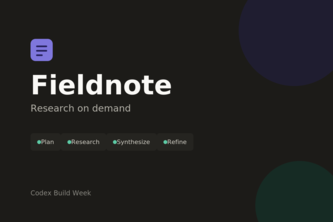
The company appears to be a single-person project named FieldNote-Research-Agent, built as part of an OpenAI 2026 hackathon submission. The author describes it as a tool that turns questions into structured, cited Markdown digests through four stages: planning, research, synthesis, and refinement. It uses GPT-5.6, DuckDuckGo, Cheerio, and Next.js/React stack.
What changed: This is a self-reported prototype or proof-of-concept submitted for a hackathon. There is no evidence of prior development, funding, customers, or commercial traction.
Single most important open question: Is there any indication that this project will evolve into a product with real market demand or commercial viability beyond its hackathon origin?
What The Product Actually Is
The description states that FieldNote-Research-Agent is a single-page application built with Next.js, React, and TypeScript, using the OpenAI API (GPT-5.6) for research planning, synthesis, and refinement. It retrieves web results from DuckDuckGo, parses them with Cheerio, and validates outputs using Zod.
It operates in four stages:
- Plan: Breaks a topic into 3–5 focused queries.
- Research: Searches the live web and collects distinct sources.
- Synthesize: Compares evidence and creates a cited draft.
- Refine: Critiques weak claims, improves balance, and calculates an evidence-confidence score.
Users can inspect each stage in real time, read the final digest, and download it as Markdown. The app requires no database or authentication system.
Inference: It is a research assistant tool that emphasizes transparency in how answers are derived, rather than delivering a single instant answer.
Positioning & Claim Evolution
The author states that Fieldnote was built to address the problem of "online research often beginning with a simple question but quickly becoming a maze of tabs, repeated information, and unclear sources."
It positions itself as a tool that makes research more structured, transparent, and useful, by showing how the process unfolds—from planning inquiries to gathering evidence and refining the final report.
The author claims it is not just about giving an answer but about making the research process visible, so users understand where conclusions come from and where uncertainty remains.
Inference: The positioning implies a shift away from black-box AI tools toward more explainable, traceable research workflows—though this is a claim, not a fact of adoption or traction.
Target Customer & ICP
The description does not name specific customer segments or personas. However, the author’s stated goal suggests it targets individuals who conduct research and value transparency in sourcing, such as:
- Researchers
- Students
- Journalists
- Knowledge workers
It is implied that users want to understand how a conclusion was reached, not just receive it.
Inference: The ICP likely includes people who are uncomfortable with opaque AI outputs and seek structured, cited research workflows. But no evidence of actual user targeting or segmentation exists.
Business Model & Pricing Evidence
There is no evidence in the description of any business model or pricing strategy. The project is described as a hackathon submission, not a commercial product.
The author notes that the app requires no database, authentication system, or paid search API, suggesting low infrastructure costs, but this does not imply a monetization path.
Inference: No business model or pricing structure is evident beyond the fact that it’s a prototype. The tool may eventually be offered as freemium, SaaS, or integrated into other platforms—but nothing is stated.
Technical & Delivery Signals
The app is built with:
- Next.js, React, TypeScript
- Uses OpenAI API (GPT-5.6) for core functionality
- Retrieves web results via DuckDuckGo HTML interface, parsed with Cheerio
- Outputs validated with Zod to ensure structured responses
- Streams results using newline-delimited JSON events
- No database or authentication required
It handles:
- Duplicate pages and redirects
- Citation validation
- Partial results and errors during multi-stage workflows
Inference: The technical stack is lightweight and self-contained, which suggests ease of deployment but also limits scalability or enterprise integration. It’s a prototype with strong engineering discipline for handling edge cases.
Traction & Maturity Signals
The project is described as a single-person hackathon submission, built in a short timeframe (likely under 24–48 hours). There is no evidence of:
- Revenue
- Customers
- User adoption
- Product-market fit
- Iteration history or prior versions
- Any form of monetization or growth
Inference: The project has zero traction and is at a very early stage—likely a prototype or MVP. It lacks any signs of commercial maturity.
Competitive Context
The description does not mention competitors, nor does it provide context about the broader market for AI-powered research tools. However, it implies that there’s a gap in the market for tools that:
- Show their reasoning process
- Provide cited outputs
- Are transparent about source diversity and confidence
It is positioned as an alternative to generic chatbots or search engines that deliver answers without showing how they were derived.
Inference: The competitive landscape is unclear, but it likely overlaps with AI research assistants like Perplexity, Notion AI, or ChatGPT plugins, though Fieldnote's emphasis on process transparency sets it apart.
Open Questions & Risks
- No commercial traction or revenue: The tool is a hackathon submission with no evidence of adoption.
- Single-person development: Limited capacity for scaling or iteration.
- Dependency on third-party APIs (DuckDuckGo, OpenAI): Risk of rate limits, cost increases, or API changes.
- Unproven market demand: No evidence that users actually want this product or are willing to pay for it.
- Limited scope: The tool is focused on basic research and lacks features like content extraction, academic integrations, or export formats beyond Markdown.
Inference: The project is a prototype with no commercial viability or risk mitigation in place. It may be a useful idea, but there’s no evidence of execution, traction, or product-market fit.
Questions the description leaves open
- What problem are you solving that existing tools don’t?
- Have you tested this with real users? If so, what feedback did you get?
- Are you planning to monetize this tool? How?
- How do you plan to scale beyond the current prototype?
- Do you have any plans for integrating with academic or enterprise sources?
- What are your long-term goals for FieldNote beyond the hackathon?
- Have you considered how to handle bias, misinformation, or low-quality sources in research workflows?
Overall Assessment
Not evidenced.
There is no evidence of:
- Revenue
- Customers
- Traction
- Product-market fit
- Commercial strategy
- Team expansion
- Funding rounds
This project is described as a single-person hackathon submission, and the author does not state any intention to pursue commercialization or partnership opportunities. It is a prototype with strong engineering execution but no signs of viability or market readiness.
Inference: At this stage, it is not suitable for investment or partnership consideration unless there are plans to evolve it into a product with clear user demand and monetization strategy.
User Stories BotA demo video on every pull request
Get a demo video on every new feature
GitHub App that watches your pull requests and records a narrated, captioned demo.
Save time on demo prep and make informed decisions faster with a video walkthrough of every new feature.
Source
Submitted to the OpenAI 2026 hackathon on Devpost. Project home on Devpost. Back to the full gallery on Devpost.
This competitive analysis was produced by top-founders.com (opens in a new tab)
Generated by a language model from this project's public Devpost page — its tagline, the author's own write-up and any built-with tags listed there — as captured in August 2026. Short quotations are the author's words. It is an opinion on the idea as a business, not on the people behind it, and it reflects the description as published then. If the project has moved on, request a correction below. The analysis is not independent research and contains no verified traction, revenue or customer data.
An independent guide by KFG International LLC — not affiliated with, endorsed by, or connected to Devpost or OpenAI.