

Archive position — measured, not model output
0 likes on Devpost
2,263 of the 7,850 archived projects have more likes, and 5,587 share exactly 0 — so this project's #6,886 place in the like-ranked listing is a tie-break inside that group, not a ranking.
Projects (log scale)
Likes on Devpost. ▲ marks this project's group.
Show the figures
| Likes | Projects | Share of archive |
|---|---|---|
| 0 | 5,587 | 71.2% |
| 1 | 1,758 | 22.4% |
| 2 | 284 | 3.6% |
| 3–4 | 132 | 1.7% |
| 5–9 | 75 | 1.0% |
| 10+ | 14 | 0.2% |
 User Stories BotA demo video on every pull request
Get a demo video on every new feature
GitHub App that watches your pull requests and records a narrated, captioned demo.
Save time on demo prep and make informed decisions faster with a video walkthrough of every new feature.
Executive Summary
What the company appears to be
Speakwise is a self-reported tool that claims to offer communication coaching for conversations, based on recorded audio. The author states it uses AI to transcribe conversations, identify communication patterns, and provide evidence-based feedback with rephrased suggestions.
What changed
The project was submitted as part of the OpenAI 2026 hackathon. It is described as a prototype built in a short timeframe using GPT-5.6, AssemblyAI, and Express.js.
The single most important open question
Is there any evidence of real-world usage or customer feedback beyond the author's personal experience?
What The Product Actually Is
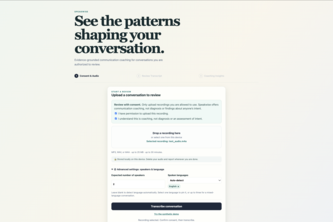
The description states that Speakwise is a TypeScript and Express web app built with Codex using GPT-5.6 Terra. It uses AssemblyAI for diarized transcription and GPT-5.6 through the OpenAI Responses API to generate schema-constrained coaching reports.
It turns authorized conversation recordings into speaker-labelled, timestamped transcripts and provides concise coaching reviews that identify evidence-supported communication patterns. Each observation is linked to an exact quote and time, with one strained moment highlighted by a respectful, goal-preserving rephrase.
The app includes an authorization gate, a synthetic demo for testing, deletion controls, sanitization, and a local daily cap for live provider runs.
Evidence The author's own write-up.
Confidence Low — this is self-reported functionality without independent verification or demonstration of actual use.
Positioning & Claim Evolution
The author states that the inspiration came from personal family arguments where it was hard to review constructively. The product aims to offer a private, practical way to revisit actual words said without turning it into a diagnosis or guess about intent.
It positions itself as an evidence-grounded communication coaching tool for conversations.
Evidence The author's own write-up.
Confidence Low — this is a personal claim and not validated by any external data or customer feedback.
Target Customer & ICP
The description does not explicitly state who the target customers are. However, it implies that the product is aimed at individuals who have tense conversations and want to reflect on them constructively, particularly in family settings.
Evidence The author's own write-up.
Confidence Low — no explicit customer segmentation or ICP defined beyond personal use case.
Business Model & Pricing Evidence
There is no evidence of a business model or pricing structure in the description. The project appears to be a prototype submitted for a hackathon, with no indication of monetization plans or pricing tiers.
Evidence Not evidenced.
Confidence Very low — no mention of revenue, pricing, or monetization strategy.
Technical & Delivery Signals
The product is built using:
- TypeScript
- Express.js
- Node.js
- AssemblyAI (for diarized transcription)
- OpenAI GPT-5.6 via the OpenAI Responses API
- Codex for code generation
It includes features such as:
- Authorization gate
- Synthetic demo
- Deletion controls
- Sanitization
- Local daily cap for live provider runs
Evidence The author's own write-up.
Confidence Low — this is a prototype built in a short timeframe, not a production-ready product.
Traction & Maturity Signals
There is no evidence of traction or maturity beyond the project being submitted to a hackathon. No customer data, usage metrics, or adoption indicators are provided.
Evidence Not evidenced.
Confidence Very low — no signs of real-world usage or user engagement.
Competitive Context
The description does not provide any information about competitors or market positioning. It is unclear whether there are existing tools in the communication coaching space that this product might compete with.
Evidence Not evidenced.
Confidence Very low — no competitive analysis or market context provided.
Open Questions & Risks
- Unverified claims: All features and functionality are self-reported without independent validation.
- No traction or customers: No evidence of real-world usage or adoption.
- Prototype nature: Built for a hackathon, not intended for production use.
- Privacy concerns: Involves recording and analyzing personal conversations — potential legal and ethical issues.
- Limited scope: Only described for family arguments; unclear if it scales to other domains.
Evidence Not evidenced.
Confidence Moderate — based on the lack of evidence and the prototype nature of the project.
Questions the description leaves open
- What is the actual user base or feedback you've received beyond personal use?
- How do you plan to scale this beyond a hackathon prototype?
- Have you considered privacy, consent, and legal implications of analyzing personal conversations?
- Is there any intention to monetize this product, and if so, how?
- What are the technical limitations or edge cases in processing real-world conversation recordings?
Evidence Not evidenced.
Confidence Low — these questions are based on the lack of information provided.
Overall Assessment
There is no evidence to support any commercial viability, traction, or scalability of Speakwise. The project appears to be a hackathon prototype with no demonstrated market need, revenue model, or customer feedback.
Evidence Not evidenced.
Confidence Very low — the description provides no basis for investment or partnership consideration.
User Stories BotA demo video on every pull request
Get a demo video on every new feature
GitHub App that watches your pull requests and records a narrated, captioned demo.
Save time on demo prep and make informed decisions faster with a video walkthrough of every new feature.
Source
Submitted to the OpenAI 2026 hackathon on Devpost. Project home on Devpost. Back to the full gallery on Devpost.
This competitive analysis was produced by top-founders.com (opens in a new tab)
Generated by a language model from this project's public Devpost page — its tagline, the author's own write-up and any built-with tags listed there — as captured in August 2026. Short quotations are the author's words. It is an opinion on the idea as a business, not on the people behind it, and it reflects the description as published then. If the project has moved on, request a correction below. The analysis is not independent research and contains no verified traction, revenue or customer data.
An independent guide by KFG International LLC — not affiliated with, endorsed by, or connected to Devpost or OpenAI.