

Archive position — measured, not model output
0 likes on Devpost
2,263 of the 7,850 archived projects have more likes, and 5,587 share exactly 0 — so this project's #6,887 place in the like-ranked listing is a tie-break inside that group, not a ranking.
Projects (log scale)
Likes on Devpost. ▲ marks this project's group.
Show the figures
| Likes | Projects | Share of archive |
|---|---|---|
| 0 | 5,587 | 71.2% |
| 1 | 1,758 | 22.4% |
| 2 | 284 | 3.6% |
| 3–4 | 132 | 1.7% |
| 5–9 | 75 | 1.0% |
| 10+ | 14 | 0.2% |
 User Stories BotA demo video on every pull request
Get a demo video on every new feature
GitHub App that watches your pull requests and records a narrated, captioned demo.
Save time on demo prep and make informed decisions faster with a video walkthrough of every new feature.
Executive Summary
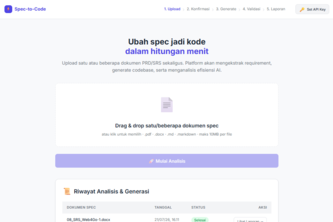
The description states that Spec-to-Code Intelligence Platform is an AI-powered tool designed to convert PRD/SRS files into modular code using Codex, with auto-validation of requirement coverage and a visual heatmap for performance tracking. The author describes building a monorepo application with React frontend, Node.js backend, and OpenAI integrations including GPT-4 and Codex. It is presented as a hackathon submission with no evidence of revenue, customers or traction beyond the self-reported project description.
The single most important open question is whether this tool can reliably generate production-ready code from complex specifications at scale — an assertion not evidenced in the description.
What The Product Actually Is
- The description states that it is an AI tool converting PRD/SRS files into modular code via Codex.
- It features spec ingestion from multiple file types (PDF/DOCX/MD) using GPT to extract structured JSON requirements.
- Dependency-based code generation uses OpenAI Codex with a strict order: data_entity ➔ constraint ➔ feature ➔ flow.
- Auto-validation semantically cross-references generated code with original requirements, highlighting gaps.
- It generates an acceleration report visualized as a color-coded heatmap showing performance telemetry (Green = Clean/Fast, Yellow = Retried, Red = High Gaps/Failed).
- The platform is built as a monorepo using React 18, Vite, TypeScript, Node.js, Express, better-sqlite3 database, and OpenAI APIs including GPT-4 and Codex-mini-latest.
Positioning & Claim Evolution
- The description states the tool aims to solve two major pain points: dependency ordering in multi-page PRD translation and lack of empirical data on AI time savings.
- It positions itself as an end-to-end spec-to-code pipeline that also measures velocity and acceleration of the AI generation process.
- The author claims it not only generates full modules from natural specs but also measures exact velocity and acceleration of the AI generation process.
- The tool is described as measuring where AI saved time versus where it got stuck in retry/refactoring loops.
Target Customer & ICP
- Not evidenced. The description does not specify target customer segments or ideal customer profiles beyond general developer use cases.
Business Model & Pricing Evidence
- Not evidenced. There is no mention of pricing, monetization strategy, or business model in the self-reported description.
Technical & Delivery Signals
- Built as a monorepo with React 18, Vite, TypeScript frontend; Node.js, Express, TypeScript backend.
- Uses better-sqlite3 database for data persistence.
- Integrates OpenAI APIs including GPT-4 and Codex-mini-latest.
- Implements background queues with live status polling to ensure UI responsiveness.
- Addresses context length constraints by developing a code-summarizer that extracts core structural definitions.
- Solves API latency issues through asynchronous generation tasks and caching report narratives.
- Includes fallback mechanisms using keyword-based syntax matching if OpenAI keys are absent.
Traction & Maturity Signals
- Not evidenced. The description does not contain any data on users, revenue, adoption, or product maturity beyond the hackathon submission context.
Competitive Context
- Not evidenced. No mention of competitors or competitive positioning in the self-reported description.
Open Questions & Risks
- The tool is described as a hackathon submission with no evidence of commercial traction.
- Reliance on OpenAI APIs may create dependency risks and cost concerns at scale.
- The author notes challenges such as context length constraints, API latency, and fallback mechanisms — suggesting technical complexity or limitations.
- No evidence of production-ready code generation capabilities or scalability beyond prototype level.
Questions the description leaves open
- What specific PRD/SRS formats does the platform support?
- How does it handle ambiguity or incomplete requirements in specifications?
- Has the tool been tested on real-world projects with complex dependencies?
- What is the expected accuracy rate of requirement coverage validation?
- Are there plans to integrate with existing development workflows (e.g., CI/CD, Git)?
- How does the platform address potential legal or intellectual property issues related to AI-generated code?
Overall Assessment
- Not evidenced. No information provided about funding rounds, valuation, or partnership opportunities beyond the hackathon submission context.
Note: This analysis is based solely on the self-reported project description provided by the caller. All claims are unverified and should be treated as such.
User Stories BotA demo video on every pull request
Get a demo video on every new feature
GitHub App that watches your pull requests and records a narrated, captioned demo.
Save time on demo prep and make informed decisions faster with a video walkthrough of every new feature.
Source
Submitted to the OpenAI 2026 hackathon on Devpost. Project home on Devpost. Back to the full gallery on Devpost.
This competitive analysis was produced by top-founders.com (opens in a new tab)
Generated by a language model from this project's public Devpost page — its tagline, the author's own write-up and any built-with tags listed there — as captured in August 2026. Short quotations are the author's words. It is an opinion on the idea as a business, not on the people behind it, and it reflects the description as published then. If the project has moved on, request a correction below. The analysis is not independent research and contains no verified traction, revenue or customer data.
An independent guide by KFG International LLC — not affiliated with, endorsed by, or connected to Devpost or OpenAI.