

Archive position — measured, not model output
0 likes on Devpost
2,263 of the 7,850 archived projects have more likes, and 5,587 share exactly 0 — so this project's #6,889 place in the like-ranked listing is a tie-break inside that group, not a ranking.
Projects (log scale)
Likes on Devpost. ▲ marks this project's group.
Show the figures
| Likes | Projects | Share of archive |
|---|---|---|
| 0 | 5,587 | 71.2% |
| 1 | 1,758 | 22.4% |
| 2 | 284 | 3.6% |
| 3–4 | 132 | 1.7% |
| 5–9 | 75 | 1.0% |
| 10+ | 14 | 0.2% |
 User Stories BotA demo video on every pull request
Get a demo video on every new feature
GitHub App that watches your pull requests and records a narrated, captioned demo.
Save time on demo prep and make informed decisions faster with a video walkthrough of every new feature.
Executive Summary
SpecGhost is a self-reported AI-powered API release intelligence tool designed to identify behavioral regressions in APIs, trace them back to code changes, and block risky merges via CI/CD integration. The author states it operates as a zero-dependency Node.js application with CLI and GitHub Actions capabilities, using GPT-5.6 for optional live analysis. It claims to analyze API contracts, generate contract tests, replay user journeys, and provide remediation guidance.
The project is presented as a hackathon submission with no evidence of revenue, customers, or traction beyond the author’s own description. The tool appears to be built around developer workflows and API contract testing, but lacks any verified commercial activity or market validation.
Single most important open question
Is there any evidence that SpecGhost has been used in production environments or integrated into real development pipelines outside of a demo context?
What The Product Actually Is
The description states that SpecGhost is an API Release Intelligence platform. It analyzes API contracts, identifies behavioral promises, generates contract tests, compares baseline and proposed contracts, flags release risk, reviews Git diffs, connects code changes to broken promises, replays affected user journeys, and provides remediation guidance.
It includes:
- A CLI
- GitHub Actions merge gate
- Browser-based workspace
- Optional GPT-5.6-powered live analysis
The product is described as a zero-dependency Node.js web application with a responsive interface.
Inference The tool appears to be built for developers working in CI/CD environments, with an emphasis on preventing breaking API changes before they reach production.
Positioning & Claim Evolution
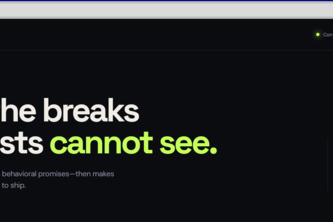
The author states that APIs often “work” while quietly breaking users — a 200 OK response does not guarantee functionality. SpecGhost aims to understand behavioral promises made by APIs, not just endpoint shape or status codes.
It positions itself as:
- A tool for behavioral API contract analysis
- A platform that connects code changes to broken user journeys
- A release gate that can block breaking changes in CI
The project is described as a zero-dependency Node.js web application, with a CLI and GitHub Actions integration, suggesting it targets developers who want lightweight, integrated solutions.
Inference The positioning reflects an attempt to solve a gap in API reliability — specifically, the disconnect between schema correctness and real-world user impact.
Target Customer & ICP
The description states that SpecGhost is built for developers working in CI/CD environments, particularly those concerned with API contract testing and preventing breaking changes. It includes a CLI and GitHub Actions integration, suggesting it targets teams using Git-based workflows.
It also mentions:
- A browser-based workspace
- Playwright contract tests
- Pull-request diff review with source evidence
Inference The ICP likely includes software engineers or DevOps teams responsible for API development and release management in environments that use CI/CD pipelines, GitHub Actions, and developer tooling.
Business Model & Pricing Evidence
Not evidenced. The description does not mention any pricing model, monetization strategy, or business model.
Inference There is no indication of how the product would be sold or whether it has a commercial plan beyond its hackathon demo.
Technical & Delivery Signals
The project is described as:
- A zero-dependency Node.js web application
- Built with Codex and GPT-5.6 for scope shaping, implementation, UI design, and workflows
- Includes a CLI and GitHub Actions merge gate
- Has a deterministic demo mode to avoid requiring API credentials or complex setup
It also includes:
- Semantic contract diffs
- Generated Playwright tests
- User-journey impact replay
- Downloadable remediation reports
Inference The tool is built with developer-centric technologies and integrates into existing workflows, but lacks evidence of production deployment or scalability beyond a demo.
Traction & Maturity Signals
Not evidenced. There is no mention of:
- Customers
- Revenue
- Usage metrics
- Product adoption
- Market traction
The project is described as a hackathon submission, and the author notes that it was designed to be reliable for judges, not for production use.
Inference The tool has no verified traction or maturity beyond its demo context.
Competitive Context
Not evidenced. No mention of competitors, market positioning, or competitive landscape.
Inference The author does not reference existing tools in the API contract testing or CI/CD release gate space.
Open Questions & Risks
- No commercial traction: The tool is presented as a hackathon demo with no evidence of real-world usage.
- Unverified claims: All features and functionality are self-reported without independent validation.
- Limited scope: The product appears to be built for a narrow use case (API contract testing in CI/CD) and lacks broader market or integration support.
- AI dependency: Reliance on GPT-5.6 for optional live analysis raises questions about scalability, cost, and consistency outside of demo mode.
Questions the description leaves open
- Has SpecGhost been used in any real development environments beyond the demo?
- What is the current plan for monetization or commercial viability?
- Are there any existing users or pilot programs?
- How does SpecGhost handle large-scale API contracts or complex workflows?
- What are the limitations of its GPT-5.6 integration, and how is it managed in production?
- Is there a roadmap for integrating with major CI/CD platforms beyond GitHub Actions?
Overall Assessment
Not evidenced. No information is provided about:
- Valuation
- Funding status
- Strategic partnerships
- Commercial readiness
Inference The project is in an early stage, likely pre-product-market fit, and lacks any evidence of commercial viability or investor interest.
User Stories BotA demo video on every pull request
Get a demo video on every new feature
GitHub App that watches your pull requests and records a narrated, captioned demo.
Save time on demo prep and make informed decisions faster with a video walkthrough of every new feature.
Source
Submitted to the OpenAI 2026 hackathon on Devpost. Project home on Devpost. Back to the full gallery on Devpost.
This competitive analysis was produced by top-founders.com (opens in a new tab)
Generated by a language model from this project's public Devpost page — its tagline, the author's own write-up and any built-with tags listed there — as captured in August 2026. Short quotations are the author's words. It is an opinion on the idea as a business, not on the people behind it, and it reflects the description as published then. If the project has moved on, request a correction below. The analysis is not independent research and contains no verified traction, revenue or customer data.
An independent guide by KFG International LLC — not affiliated with, endorsed by, or connected to Devpost or OpenAI.