

Archive position — measured, not model output
1 like on Devpost
505 of the 7,850 archived projects have more likes, and 1,758 share exactly 1 — so this project's #1,002 place in the like-ranked listing is a tie-break inside that group, not a ranking.
Projects (log scale)
Likes on Devpost. ▲ marks this project's group.
Show the figures
| Likes | Projects | Share of archive |
|---|---|---|
| 0 | 5,587 | 71.2% |
| 1 | 1,758 | 22.4% |
| 2 | 284 | 3.6% |
| 3–4 | 132 | 1.7% |
| 5–9 | 75 | 1.0% |
| 10+ | 14 | 0.2% |
 User Stories BotA demo video on every pull request
Get a demo video on every new feature
GitHub App that watches your pull requests and records a narrated, captioned demo.
Save time on demo prep and make informed decisions faster with a video walkthrough of every new feature.
Executive Summary
What the company appears to be
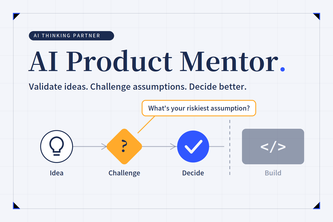
Elly is an AI-powered product mentor designed to assist Product Managers (PMs) in making better decisions about whether, when, and how to build with AI. It offers three core workflows: Challenge Idea, Product Decision, and AI Planning.
What changed
The author describes building a prototype for a hackathon that includes a FastAPI backend, frontend UI, and specialized prompts for different PM decision-making contexts. The system uses GPT-5.6 via Codex during development and OpenAI’s API in production.
Single most important open question
Is there any evidence of real-world usage or feedback from PMs beyond the author's own experience?
Note: This analysis is based entirely on the self-reported, unverified description provided by the project author. No external data, revenue figures, customer names, or traction metrics are available.
What The Product Actually Is
The description states that Elly is an AI product mentor helping PMs think through product ideas before committing engineering resources. It provides three workflows:
- Challenge Idea: Asks questions to challenge the underlying problem, user, assumptions, risks, and MVP scope.
- Product Decision: Evaluates trade-offs between options and suggests validation steps before larger investments.
- AI Planning: Collects requirements and goals to assess AI readiness, possible use cases (Workflow, RAG, Agent), risks, and next questions.
Elly uses a FastAPI backend with a frontend built using HTML, CSS, JavaScript. It routes conversations into specialized modes—Challenge, Decision, or General Mentoring—using prompts tailored for each mode. Conversation memory is implemented via SQLite to retain context without overwhelming the model.
Claim: Elly helps PMs improve judgment rather than just generate documents faster.
Evidence: The author explicitly states this principle in both "Accomplishments I’m proud of" and "What I learned".
Positioning & Claim Evolution
The author positions Elly as a tool for PMs to validate ideas early, especially in AI product development where communication with developers and QA is critical.
Initial claim: “I originally wanted to create something that could help PMs examine everyday product decisions before development begins.”
Evolution of the claim:
- Started with idea validation.
- Expanded into decision-making support.
- Added AI planning workflow as a prototype.
- Future plans include full AI product journey support from idea to evaluation.
Claim: Elly supports the complete AI product journey.
Evidence: Stated in “What’s next for Elly” section; however, no implementation details beyond prototypes are given.
Target Customer & ICP
The target customer is clearly identified as Product Managers (PMs), particularly those working on AI products.
The author notes that planning AI products introduces new questions around:
- When to use AI
- Acceptable error risk
- How AI output should be evaluated
- When a human should step in
Claim: PM involvement becomes more important—not less—as teams build more AI products.
Evidence: The author states this directly in the “Inspiration” section.
No specific segmentation or persona details are provided beyond the role of PM.
Business Model & Pricing Evidence
Not evidenced. The description does not mention any pricing strategy, monetization approach, or business model.
Finding: No evidence of commercial structure or revenue model.
Technical & Delivery Signals
The system is built with:
- Backend: FastAPI
- Frontend: HTML, CSS, JavaScript (dependency-free)
- AI models: GPT-5.6 for development; gpt-5 in production
- Memory system: SQLite-based conversation memory
- Tools used: Codex, OpenAI Responses API
The author describes:
- Transparent routing rules between mentor modes
- Specialized prompts per mode
- Structured response format to avoid long reports
- Context retrieval using keyword relevance and recent messages
Claim: Elly uses a structured prompt behavior for product thinking.
Evidence: Explicitly stated in “What I learned” section.
Traction & Maturity Signals
Not evidenced. There is no mention of:
- Customers or users
- Revenue or monetization
- Product adoption or usage statistics
- Any form of traction beyond the hackathon submission
Finding: No evidence of real-world traction or user engagement.
Competitive Context
Not evidenced. The description does not reference competitors, market positioning, or competitive landscape.
Finding: No evidence of competitive analysis or differentiation strategy.
Open Questions & Risks
- Lack of Traction: No evidence of actual users or feedback from PMs.
- Prototype-Only Status: Most features are described as prototypes or future plans.
- Single Developer: Team size is listed as 1, raising concerns about scalability and long-term maintenance.
- Unverified Claims: All claims are self-reported without independent verification.
- No Commercial Model: No indication of how the product will be monetized.
Inference: Without traction or commercial viability, the project may not yet be ready for investment or partnership.
Questions the description leaves open
- Have you tested Elly with actual PMs? What feedback did they give?
- How do you plan to scale beyond a single developer?
- What is your path to monetization?
- Are there any early adopters or pilot customers?
- What are the key assumptions in your AI planning workflow that need validation?
Overall Assessment
Not evidenced.
Finding: There is insufficient evidence to assess whether this project is ready for investment or partnership. The description indicates a prototype built during a hackathon with no known traction, revenue, or commercial model. The single-founder structure and lack of external validation raise significant concerns about viability at scale.
User Stories BotA demo video on every pull request
Get a demo video on every new feature
GitHub App that watches your pull requests and records a narrated, captioned demo.
Save time on demo prep and make informed decisions faster with a video walkthrough of every new feature.
Source
Submitted to the OpenAI 2026 hackathon on Devpost. Project home on Devpost. Back to the full gallery on Devpost.
This competitive analysis was produced by top-founders.com (opens in a new tab)
Generated by a language model from this project's public Devpost page — its tagline, the author's own write-up and any built-with tags listed there — as captured in August 2026. Short quotations are the author's words. It is an opinion on the idea as a business, not on the people behind it, and it reflects the description as published then. If the project has moved on, request a correction below. The analysis is not independent research and contains no verified traction, revenue or customer data.
An independent guide by KFG International LLC — not affiliated with, endorsed by, or connected to Devpost or OpenAI.