

Archive position — measured, not model output
1 like on Devpost
505 of the 7,850 archived projects have more likes, and 1,758 share exactly 1 — so this project's #1,004 place in the like-ranked listing is a tie-break inside that group, not a ranking.
Projects (log scale)
Likes on Devpost. ▲ marks this project's group.
Show the figures
| Likes | Projects | Share of archive |
|---|---|---|
| 0 | 5,587 | 71.2% |
| 1 | 1,758 | 22.4% |
| 2 | 284 | 3.6% |
| 3–4 | 132 | 1.7% |
| 5–9 | 75 | 1.0% |
| 10+ | 14 | 0.2% |
 User Stories BotA demo video on every pull request
Get a demo video on every new feature
GitHub App that watches your pull requests and records a narrated, captioned demo.
Save time on demo prep and make informed decisions faster with a video walkthrough of every new feature.
Executive Summary
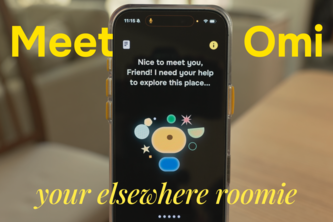
Elsewhere Roomie is a self-reported voice-first mobile web experience powered by GPT Realtime 2.1, designed to invite users to explore their familiar surroundings through an AI character named Omi — a traveler from Elsewhere who finds everything unfamiliar and guides the user in rediscovering their home. The project was built over one weekend by two team members with no traditional engineering background, using tools including React, Node.js, Express.js, TypeScript, OpenAI Realtime API, WebRTC, and Codex. It is described as an experimental prototype submitted to the OpenAI 2026 hackathon.
The description states that Elsewhere Roomie aims to help users slow down, notice overlooked details, and bring imagination into everyday spaces by encouraging curiosity through a novel interaction model where AI does not provide answers but instead invites reflection and reframe. The experience is structured around five steps: Observe → Imagine → Ask → Reframe → Remember.
Key commercial due-diligence read: There is no evidence of revenue, customers, or product-market fit beyond the self-reported prototype. The project lacks any traction signals, pricing information, or business model details. The single most important open question is whether this concept has potential for broader adoption or if it remains a one-off creative experiment.
What The Product Actually Is
The description states that Elsewhere Roomie is a voice-first exploration experience powered by GPT Realtime 2.1, designed to be used on mobile web. Users hold their phone flat like a compass and follow directions chosen by Omi, the AI character who acts as a roomie from Elsewhere.
It combines:
- Live voice interaction
- Device orientation and compass data
- User descriptions of objects in the environment
The system uses a structured conversation flow with five steps:
- Observe
- Imagine
- Ask
- Reframe
- Remember
Omi does not function as an object identifier or productivity tool; instead, it encourages imaginative interpretation and reflection.
Inference: The product appears to be an experimental AI-driven narrative experience rather than a commercial SaaS offering.
Positioning & Claim Evolution
The description states that Elsewhere Roomie was inspired by the idea of "the traveler's mind" — when traveling, people stay curious about unfamiliar things, but at home they often stop noticing their surroundings. The project seeks to rekindle this curiosity through an AI character named Omi who is unfamiliar with Earth and must learn from the user.
The positioning claim is:
“AI does not tell us what we don’t already know; it helps us see our surroundings as if it's for the first time.”
This positions the product not as a utility or productivity tool, but as an experience that fosters awareness and wonder. It frames AI not for recognition or task completion, but for curiosity-driven discovery.
Inference: The positioning reflects a niche creative or emotional use case rather than a mainstream commercial application.
Target Customer & ICP
The description does not explicitly define target customers or personas. However, it implies that the intended audience includes:
- People who spend significant time at home
- Individuals seeking mindfulness or reflection
- Users interested in novel AI interactions or creative experiences
It also suggests a demographic that values curiosity, imagination, and reconnecting with familiar spaces.
There is no evidence of segmentation, buyer personas, or specific user groups identified beyond the general idea of "home users".
Inference: The ICP is likely broad and emotionally driven, possibly targeting early adopters of experimental AI experiences or those interested in personal development tools.
Business Model & Pricing Evidence
The description contains no evidence of a business model, pricing strategy, monetization approach, or revenue streams. It does not mention any paid features, subscriptions, licensing, or commercial partnerships.
Inference: No commercial viability or monetization plan is evident from the self-reported materials.
Technical & Delivery Signals
The project was built using:
- Frontend: React, TypeScript, Vite
- Backend: Node.js, Express.js
- AI Engine: GPT Realtime 2.1
- Other Tools: WebRTC, Codex, OpenAI Realtime API
Key technical elements include:
- Live voice interaction with low-latency audio handling
- Integration of device orientation and compass data
- Multi-layered orchestration including conversation context, animation states, memory, and sub-agent coordination
- Use of Codex for prompt engineering, architecture planning, and frontend development
The team reports having overcome challenges related to:
- Making Omi feel naturally curious
- Synchronizing multiple system layers in real-time voice interactions
- Managing agent behavior consistency across components
Inference: The technical stack is functional for a prototype but lacks scalability or production-grade infrastructure. The delivery approach shows rapid iteration and collaboration between human and AI agents.
Traction & Maturity Signals
The description states that Elsewhere Roomie was built in one weekend by two individuals with no traditional engineering background. It was submitted as a hackathon entry to the OpenAI 2026 hackathon on Devpost.
There is no evidence of traction, including:
- No customers
- No revenue
- No user base
- No product adoption metrics
- No post-submission usage data
The project is described as an early demonstration and prototype, not a finished product or commercial offering.
Inference: The maturity level is that of a proof-of-concept, with no indication of ongoing development or market validation.
Competitive Context
The description does not provide any information about competitors or similar products. It does not reference existing AI-driven exploration tools, mindfulness apps, or voice-based experiences in the market.
Inference: No competitive landscape is evident from the self-reported materials.
Open Questions & Risks
- No commercial viability: The project lacks any indication of a monetization strategy or business model.
- Prototype-only status: Built as a hackathon submission with no evidence of further development or product-market fit.
- Unproven user demand: No data on user interest, engagement, or adoption beyond the authors' own claims.
- Technical complexity without scale: The system handles real-time voice and multi-layered interaction, but there is no evidence of production readiness or performance metrics.
- Limited team depth: Two founders with no traditional engineering background may struggle to scale or iterate effectively.
Inference: The project is at a very early stage and carries high risk due to lack of traction, commercialization plans, and technical scalability.
Questions the description leaves open
- What are your plans for transitioning from prototype to product?
- Have you tested the experience with real users beyond the hackathon setting?
- Are there any existing or planned partnerships or integrations that could support growth?
- How do you intend to monetize this experience, if at all?
- What would constitute success for this project beyond the initial demo?
- Do you have a roadmap for improving voice pipeline latency and agent consistency?
- Have you considered how to make this experience accessible or appealing to a broader audience?
Overall Assessment
The description states that Elsewhere Roomie is an experimental prototype built in one weekend as part of a hackathon submission. There is no evidence of revenue, customers, traction, or commercial viability.
It is described as a creative exploration of AI’s role in fostering curiosity and mindfulness rather than a product with clear market demand or monetization potential.
Assessment: Not suitable for investment or partnership at this time. The project shows promise as an idea but lacks the foundational signals required to assess its commercial potential. Further development, user testing, and evidence of traction would be necessary before considering any strategic move.
User Stories BotA demo video on every pull request
Get a demo video on every new feature
GitHub App that watches your pull requests and records a narrated, captioned demo.
Save time on demo prep and make informed decisions faster with a video walkthrough of every new feature.
Source
Submitted to the OpenAI 2026 hackathon on Devpost. Project home on Devpost. Back to the full gallery on Devpost.
This competitive analysis was produced by top-founders.com (opens in a new tab)
Generated by a language model from this project's public Devpost page — its tagline, the author's own write-up and any built-with tags listed there — as captured in August 2026. Short quotations are the author's words. It is an opinion on the idea as a business, not on the people behind it, and it reflects the description as published then. If the project has moved on, request a correction below. The analysis is not independent research and contains no verified traction, revenue or customer data.
An independent guide by KFG International LLC — not affiliated with, endorsed by, or connected to Devpost or OpenAI.