

Archive position — measured, not model output
1 like on Devpost
505 of the 7,850 archived projects have more likes, and 1,758 share exactly 1 — so this project's #1,006 place in the like-ranked listing is a tie-break inside that group, not a ranking.
Projects (log scale)
Likes on Devpost. ▲ marks this project's group.
Show the figures
| Likes | Projects | Share of archive |
|---|---|---|
| 0 | 5,587 | 71.2% |
| 1 | 1,758 | 22.4% |
| 2 | 284 | 3.6% |
| 3–4 | 132 | 1.7% |
| 5–9 | 75 | 1.0% |
| 10+ | 14 | 0.2% |
 User Stories BotA demo video on every pull request
Get a demo video on every new feature
GitHub App that watches your pull requests and records a narrated, captioned demo.
Save time on demo prep and make informed decisions faster with a video walkthrough of every new feature.
Executive Summary
What the company appears to be
Emberframe Studio (formerly Emberframe Workshop) is a self-reported Windows desktop application that allows developers to organize AI coding agents on a visual canvas. The app enables workflows with parallel agents, Git isolation, and live previews, built using Electron, React, and TypeScript.
What changed
The project evolved from an idea to a functional prototype that supports real agent interactions, Git worktrees, and interactive terminals. It was submitted as part of the OpenAI 2026 hackathon.
Single most important open question
Is there evidence of any real-world usage or developer adoption beyond the author's own development efforts?
What The Product Actually Is
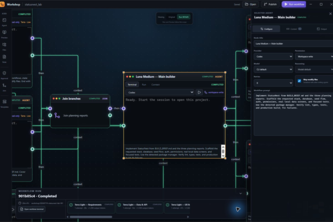
The description states that Emberframe Studio is a Windows desktop app for organizing AI coding agents on a visual canvas. It allows users to add:
- Coding agents
- Project files
- Markdown build briefs
- Live app previews
- Approval steps
- Parallel branches
- Join nodes
The purple connections define the workflow execution, while green connections pass information between agents.
Each workflow runs inside its own Git branch and worktree, isolating changes from the main project until reviewed by the developer.
It uses technologies such as:
- Electron
- React
- TypeScript
- Vite
- React Flow
- SQLite
- xterm.js
- Windows ConPTY
- Git worktrees
The app connects to locally installed tools like Codex, Claude Code, Gemini, Git, and GitHub CLI, using the developer’s existing logins instead of storing credentials.
Inference The product is a developer tool for orchestrating AI agents, not a general-purpose AI assistant or platform. It is built as a desktop application with visual workflow capabilities.
Positioning & Claim Evolution
The author claims that Emberframe Studio addresses a problem they personally encountered: “everything lived in separate chats and terminal windows” when using coding agents, leading to manual coordination.
They describe the evolution from an idea into a working prototype that supports:
- Real interactive agent terminals
- Parallel workflows
- Readable output instead of raw JSON
- Git isolation
- Approval gates
This suggests a shift from conceptualization to a functional tool for managing AI-assisted development tasks.
Inference The positioning has evolved from a hackathon idea into a developer-centric workflow tool, not a general-purpose AI platform or marketplace.
Target Customer & ICP
The description states that Emberframe Studio is intended for developers who use AI coding agents and want to manage them visually. It supports workflows involving:
- Multiple agents working in parallel
- Isolated Git branches
- Approval steps before changes are applied
It targets users who already work with tools like Codex, Claude Code, or Gemini, integrating into their existing environments.
Inference The ICP is likely technical developers or engineering teams using AI agents for code generation, particularly those working in local-first development environments and seeking better coordination and visibility of agent workflows.
Business Model & Pricing Evidence
There is no evidence provided about pricing, monetization, or business model. The project description does not mention any commercial aspects such as subscriptions, licensing, or paid features.
Not evidenced
Technical & Delivery Signals
The app is built using:
- Electron
- React
- TypeScript
- Vite
- React Flow
- SQLite
- xterm.js
- Windows ConPTY
- Git worktrees
It integrates with local tools like Codex, Claude Code, Gemini, Git, and GitHub CLI.
Key technical features include:
- Interactive agent terminals
- Parallel workflow execution
- Readable output (not raw JSON)
- Isolated Git branches and worktrees
- Approval gates before actions
- Failed-step recovery and resume
- Live local web previews
- Reusable workflow templates
- Model and permission settings for individual agents
Inference The product shows strong technical maturity, especially in handling complex workflows, terminal interaction, and Git integration. However, it is currently limited to Windows.
Traction & Maturity Signals
The project was submitted to the OpenAI 2026 hackathon, indicating early-stage development and validation through a competitive environment.
It includes:
- A functional desktop app
- Real agent workflows
- Git isolation
- Live previews
- Reusable templates
However, there is no evidence of revenue, customers, or user adoption beyond the author’s own use.
Not evidenced
Competitive Context
The description does not provide information on competitors. It does not mention similar tools in the market for managing AI agents or visual workflow systems.
Not evidenced
Open Questions & Risks
- Single-person team: The project is built by one person (Noel Bobby), which raises concerns about scalability and long-term maintenance.
- Limited platform support: Currently only supports Windows, limiting its reach.
- Unproven adoption: No evidence of real-world usage or developer traction beyond the author’s own development.
- Unclear commercial viability: No pricing, monetization, or business model described.
- Dependency on external tools: Relies heavily on local installations of AI tools and Git, which may limit ease-of-use or portability.
Questions the description leaves open
- What is the current level of user feedback or testing beyond your own use?
- Are there any plans to support macOS or cross-platform deployment?
- How do you plan to monetize this tool, if at all?
- Have you considered how to scale beyond a single developer workflow?
- What are the main technical challenges that remain unresolved in the current version?
- Do you have any early adopters or pilot users who could validate the utility of the product?
Overall Assessment
The project is early-stage, self-reported, and lacks any evidence of traction, revenue, or customer base. It demonstrates strong technical capability but remains unproven in real-world use.
Confidence: Low
This is a developer tool for AI-assisted workflows, built by one person, with no commercial data or user feedback available. The author states that the project was submitted to a hackathon and has not yet been validated outside of their own development cycle.
Inference While technically impressive, there is insufficient evidence to support a conclusion on whether this represents a viable product or business opportunity at this stage.
User Stories BotA demo video on every pull request
Get a demo video on every new feature
GitHub App that watches your pull requests and records a narrated, captioned demo.
Save time on demo prep and make informed decisions faster with a video walkthrough of every new feature.
Source
Submitted to the OpenAI 2026 hackathon on Devpost. Project home on Devpost. Back to the full gallery on Devpost.
This competitive analysis was produced by top-founders.com (opens in a new tab)
Generated by a language model from this project's public Devpost page — its tagline, the author's own write-up and any built-with tags listed there — as captured in August 2026. Short quotations are the author's words. It is an opinion on the idea as a business, not on the people behind it, and it reflects the description as published then. If the project has moved on, request a correction below. The analysis is not independent research and contains no verified traction, revenue or customer data.
An independent guide by KFG International LLC — not affiliated with, endorsed by, or connected to Devpost or OpenAI.