

Archive position — measured, not model output
0 likes on Devpost
2,263 of the 7,850 archived projects have more likes, and 5,587 share exactly 0 — so this project's #4,932 place in the like-ranked listing is a tie-break inside that group, not a ranking.
Projects (log scale)
Likes on Devpost. ▲ marks this project's group.
Show the figures
| Likes | Projects | Share of archive |
|---|---|---|
| 0 | 5,587 | 71.2% |
| 1 | 1,758 | 22.4% |
| 2 | 284 | 3.6% |
| 3–4 | 132 | 1.7% |
| 5–9 | 75 | 1.0% |
| 10+ | 14 | 0.2% |
 User Stories BotA demo video on every pull request
Get a demo video on every new feature
GitHub App that watches your pull requests and records a narrated, captioned demo.
Save time on demo prep and make informed decisions faster with a video walkthrough of every new feature.
Executive Summary
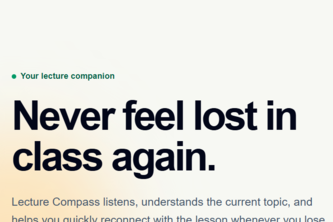
Lecture Compass is an AI-powered lecture companion designed to help students regain context during lectures by analyzing live audio transcripts and identifying current topics. The project was built as a solo hackathon submission using OpenAI APIs, Next.js, and Supabase. It is described as a tool that supports student learning without replacing it, focusing on quick recovery from brief attention loss.
The author states this is their first individual hackathon project, developed with AI tools like Codex and GPT-5.6. The system processes lecture transcripts to extract key concepts and present them in an easy-to-understand format. It includes a feature called "I'm Lost" that helps students catch up quickly.
Key commercial due-diligence questions include: Is there evidence of actual student usage or feedback? What is the technical feasibility of real-time audio processing at scale? How does this differ from existing tools like lecture recording or note-taking apps?
Most Important Open Question
Does the described solution address a genuine and scalable problem, or is it a personal prototype with limited commercial potential?
What The Product Actually Is
The description states that Lecture Compass is an AI-powered lecture companion. It analyzes live lecture transcripts to identify the current topic being discussed and displays key information in a simple format.
It includes a feature called "I'm Lost" which helps students quickly understand the current lecture context when they lose focus.
The system integrates with audio input (via live transcript processing) and course materials (via uploaded documents). It uses AI to extract meaningful content from these inputs and presents it through a focused interface designed for students.
The product is described as being built using:
- Frontend: Next.js, Tailwind.css
- Backend: Supabase
- AI tools: Codex, OpenAI APIs (specifically GPT-5.6)
- Document processing: pdf.js
It was developed as a solo hackathon project with no evidence of external funding or team support.
Positioning & Claim Evolution
The author claims that Lecture Compass helps students "quickly get back on track" during lectures by combining live audio with uploaded course materials to identify the current topic and key concepts.
The positioning is described as:
- A support tool, not a replacement for learning
- Designed to help students regain direction when they lose focus
- Focused on minimal mental effort and quick guidance
- Built specifically for student needs during fast-paced lectures
The claim evolution shows a progression from personal frustration (missing two minutes of lecture) to a solution that addresses a broader problem (students losing context during lectures). The author emphasizes that the tool is meant to "help students stay oriented" rather than disrupt their learning flow.
Target Customer & ICP
The description states that Lecture Compass is designed for students who experience difficulty regaining focus during lectures. It targets users who:
- Attend fast-paced lectures
- Occasionally lose track of what's being discussed
- Need quick context recovery without interrupting their learning flow
- Want minimal mental effort to catch up
The target customer profile appears to be:
- Individual students (not institutional buyers)
- Likely college or university-level learners
- Users who already have access to lecture recordings and course materials
- People who value tools that reduce cognitive load during study sessions
No evidence of specific demographic data, usage patterns, or institutional adoption is provided.
Business Model & Pricing Evidence
Not evidenced. The description does not contain any information about pricing models, revenue streams, monetization strategies, or business model assumptions beyond the fact that it's a student-developed prototype.
Technical & Delivery Signals
The project was built as a solo hackathon submission using:
- Frontend: Next.js, Tailwind.css
- Backend: Supabase
- AI tools: Codex, OpenAI APIs (specifically GPT-5.6)
- Document processing: pdf.js
It processes lecture transcripts and extracts meaningful information to present through a focused interface.
The author notes that the biggest technical challenge was integrating AI-powered transcript analysis, particularly managing API costs while achieving quality performance.
There is no evidence of scalability considerations, production deployment details, or infrastructure architecture beyond the development stack mentioned.
Traction & Maturity Signals
Not evidenced. The description contains no information about:
- Actual user adoption or usage metrics
- Customer feedback or testimonials
- Revenue generation or monetization attempts
- Product iteration history or roadmap
- Market validation or pilot programs
- Any form of traction beyond the single-person development and hackathon submission
Competitive Context
Not evidenced. The description does not mention any existing competitors, market positioning relative to other tools, or competitive advantages claimed by the author.
Open Questions & Risks
Several key risks and open questions are evident from the self-reported description:
- Single-person development: The project was built by one person (min xuan kam) as a solo hackathon submission with no evidence of team structure or external support.
- Unproven market demand: There is no evidence of actual student usage, feedback, or market validation beyond the author's personal experience.
- Technical feasibility concerns: The description mentions challenges with AI transcript analysis and API cost management, suggesting technical limitations that may not scale.
- Limited scope: The solution appears to be a prototype addressing a narrow use case (recovering from brief attention loss) without evidence of broader functionality or integration capabilities.
- No business model clarity: No information about how the product would generate revenue or sustain itself beyond personal development.
- Hackathon origin: The project was submitted to a hackathon, indicating it's likely an experimental prototype rather than a mature commercial offering.
Questions the description leaves open
- What specific user feedback have you received from students who actually used this tool?
- How do you plan to address the technical challenges of real-time audio processing and accuracy at scale?
- Have you validated that students are willing to pay for this type of solution, or is it primarily a personal project?
- What are your plans for expanding beyond the current scope (e.g., supporting different types of educational content)?
- How do you intend to manage API costs as usage scales?
- What is your timeline for moving from prototype to a production-ready product?
- Have you considered how this tool would integrate with existing learning management systems or platforms?
Overall Assessment
Not evidenced. The description provides no information about:
- Financial performance or projections
- Market opportunity size
- Team experience or track record
- Strategic fit for potential investors or partners
- Any form of commercial viability beyond the author's personal development experience
The project is described as a solo hackathon submission with no evidence of traction, revenue, or institutional support. It appears to be an experimental prototype addressing a personal problem rather than a scalable business opportunity.
User Stories BotA demo video on every pull request
Get a demo video on every new feature
GitHub App that watches your pull requests and records a narrated, captioned demo.
Save time on demo prep and make informed decisions faster with a video walkthrough of every new feature.
Source
Submitted to the OpenAI 2026 hackathon on Devpost. Project home on Devpost. Back to the full gallery on Devpost.
This competitive analysis was produced by top-founders.com (opens in a new tab)
Generated by a language model from this project's public Devpost page — its tagline, the author's own write-up and any built-with tags listed there — as captured in August 2026. Short quotations are the author's words. It is an opinion on the idea as a business, not on the people behind it, and it reflects the description as published then. If the project has moved on, request a correction below. The analysis is not independent research and contains no verified traction, revenue or customer data.
An independent guide by KFG International LLC — not affiliated with, endorsed by, or connected to Devpost or OpenAI.